
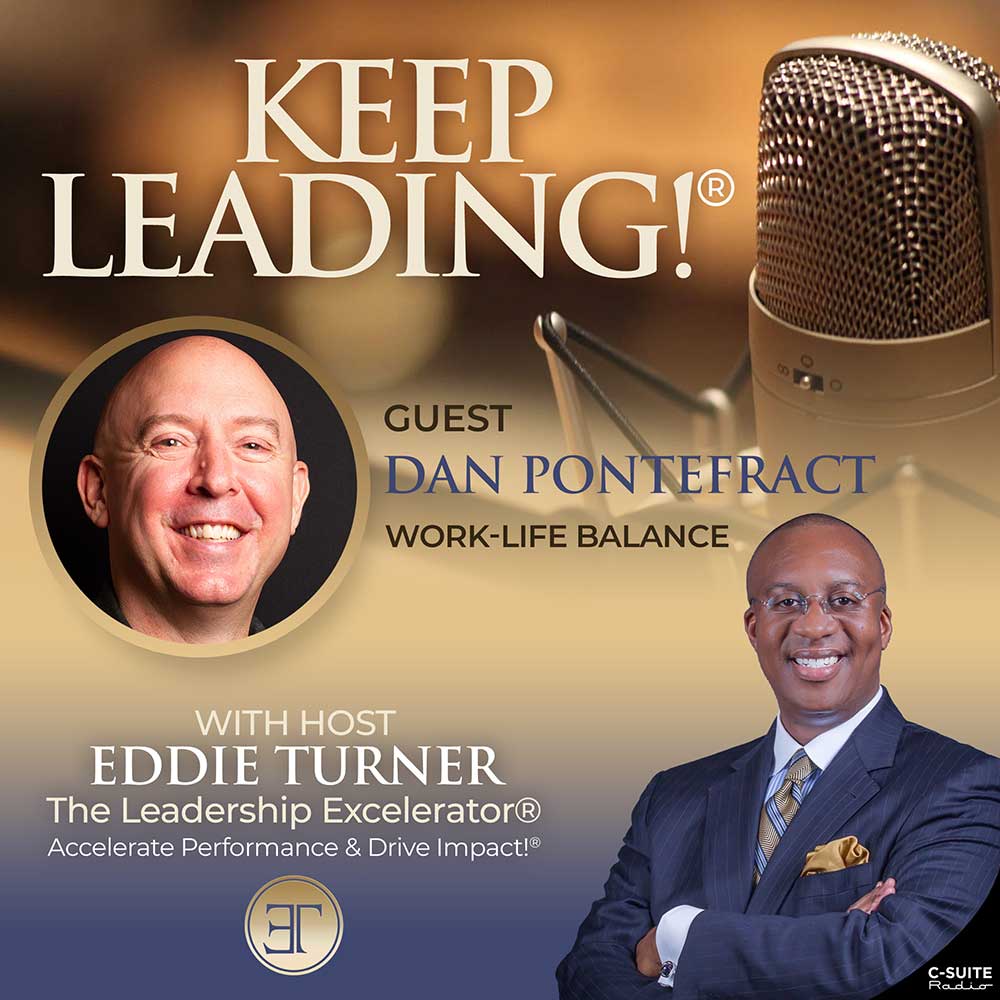
Dan Pontefract
Award-winning 5-time author | leadership & culture strategist | keynote speaker | 4-time TEDx speaker | Thinkers50 Radar
Work-Life Balance
Episode Summary
In this episode of the Keep Leading!® Podcast, host Eddie Turner welcomes Dan Pontefract, leadership strategist, author, and expert on workplace culture, to explore one of today’s most pressing leadership topics—work-life balance.
Dan shares practical strategies for achieving harmony between professional success and personal fulfillment, offering insights drawn from his extensive experience advising global organizations. Together, Eddie and Dan discuss how leaders can create healthier, more sustainable work environments that support productivity, purpose, and employee well-being.
Tune in to learn how to lead with balance, build trust, and redefine what success looks like in the modern workplace. Whether you’re an executive, entrepreneur, or emerging leader, this episode will inspire you to keep leading with intention—and live better while you do it.
Keep Leading!® Live
Bio
Dan Pontefract is a renowned leadership strategist, award-winning author, and keynote speaker with over two decades of experience helping organizations and leaders improve overall performance.
He has presented at four TED events and earned multiple industry awards, including Thinkers50 Radar, HR Weekly’s 100 Most Influential People in HR, PeopleHum’s Top 200 Thought Leaders to Follow, and Inc. Magazine’s Top 100 Leadership Speakers.
Dan has written five best-selling books including his most recent—the Gold Medal Winner of the Axiom Business Book Awards, “Work-Life Bloom”—and he also writes for Forbes and Harvard Business Review.
Website
https://www.danpontefract.com
LinkedIn
https://www.linkedin.com/in/danpontefract/
Subscribe, share, and review on Apple Podcasts!
https://podcasts.apple.com/us/podcast/keep-leading/id1461490512
Subscribe, share, and review on Spotify
https://open.spotify.com/show/0I7uAW3x4AWsLe6cnAzHp7?si=14549a44dec3495f
Full Episode Transcripts and Detailed Guest Information
www.KeepLeadingPodcast.com
Keep Leading LIVE (Live Recordings of the Keep Leading!® Podcast)
www.KeepLeadingLive.com
Connect with Eddie Turner
Website: https://www.eddieturnerllc.com
LinkedIn: https://www.linkedin.com/in/eddieturner
About the Keep Leading!® Podcast
The Keep Leading!® podcast is for people passionate about leadership. It is dedicated to leadership development and insights. Join your host, Eddie Turner, The Leadership Excelerator®, as he speaks with accomplished leaders and people of influence across the globe about their journeys to leadership excellence. Listen as they share leadership strategies, techniques, and insights.
Share the Inspiration
Inspired by what you hear? Share the episode with your network and help spread the message of empowerment and leadership. Use the hashtag #KeepLeadingPodcast and join the community of listeners who are dedicated to continuous growth and leadership excellence.
Join us on this journey to empower women leaders and create a future where everyone can thrive. Keep Leading!®
Transcript
EDDIE: Hello, everyone. Welcome to another edition of Keep Leading Live. Keep Leading Live is dedicated to leadership development and insights. I’m your host, Eddie Turner, the leadership accelerator. I work with leaders to accelerate performance and drive impact through the power of executive coaching, masterful facilitation, and professional keynote speeches.
Wherever you’re joining us from today, please let us know you are here by dropping a comment in the chat box. And if you hear something that is of interest to you, that resonates with you, let us know. If you have a question, ask your question. We want you to be a part of the conversation. The platforms don’t always pass everything through, but if I see it, I will acknowledge it. We’re streaming on YouTube, LinkedIn, and Facebook.
If you’re not following my guest today, I strongly encourage you to do so. You’ll see why as we enter our conversation. And also, you’re going to want to grab a copy of any of his five books—especially this latest book that we’re going to talk about today.
There is no shortage of opinions and ideas about work, life, and this word called “balance” between the two—how you do that, how you achieve it. It’s a never-ending quest we’re all on and that many talk about. How can we achieve it? In his book Work-Life Bloom: How to Nurture a Team That Flourishes, Dan Pontefract gives his unique perspective on how to build strong workplaces with great teams for great people where everyone blooms.
Dan Pontefract is a renowned leadership strategist, award-winning author, and keynote speaker with over two decades of experience helping organizations and leaders improve their overall performance. He’s presented four TED Talks. He’s earned multiple industry awards including the Thinkers50 Radar, HR Weekly’s 100 Most Influential People in HR, PeopleHum’s Top 200 Thought Leaders to Follow, and Inc. Magazine’s Top 100 Leadership Speakers. Dan has written five best-selling books, including the gold medal winner at the Axiom Business Book Awards, Work-Life Bloom, and that’s the book we’re going to talk about today. He’s also a Forbes writer and writes for the Harvard Business Review.
Join me in welcoming to Keep Leading Live to discuss work-life balance, Dan Pontefract. Dan, welcome to the show.
DAN: Mr. Turner, it’s a privilege, it’s an honor—that’s honor with both H-O-N-O-R and H-O-N-O-U-R, Canadian to an American. Hope you’re doing well. Thanks for the time today, Mr. Turner.
EDDIE: I love the Canadian translation of that. Thank you, that’s fantastic. And this is part of why I just couldn’t wait to interview you. I love your personality, I love your spirit.
For those who don’t know, I met you at the prestigious Thinkers50 event, where you were one of the honorees on the Radar list there. Do you remember this?
DAN: Do I remember this? You’re the most affable, lovable, strategic leadership coach that I think I know. We had some good times both in our private function and in some of the larger sessions there—with Dorie, with Marshall, and then the bigger audience. So, Eddie, that was my first time giving you a big bear hug. It was amazing. Thank you.
EDDIE: It was, and I appreciate that. So, meeting you last November in London at the Thinkers50 event and at the pre-party we had with the Rexers—the Dorie Clark group of Recognized Experts—you, and our friend Michael Bungay Stanier. Just a special night and then we were all together the next couple of days.
DAN: Well, I mean, the photo is a little bit ruined with Michael in it, but despite that, I’m happy with that shot. Yeah, well done, Eddie.
EDDIE: For those who don’t know, your fellow Canadian and great friend.
DAN: Yes. I mean, if no one’s getting my self‑deprecating Canadian humor yet, then you might as well pop off. But yeah, MBS—good friend to both of us and ridiculously handsome, obviously.
EDDIE: Indeed, indeed. Now, I also did not tell people that you are host of one of the best podcasts around. So if they haven’t tuned in, they definitely want to do that. And I had the great honor of being featured on your podcast. They should listen despite the fact you had me on.
DAN: Come on.
EDDIE: It was such a treat to be on your show. I really enjoyed it. And then you did something that I just thought was first class. You then wrote about the content of the interview in a Forbes piece. Really phenomenal work that you’re doing, and I couldn’t wait to have you because I wanted more people to know about you and your great work.
So, please tell us anything I may have missed that people who are hearing from you and learning about you for the first time should know.
DAN: Well, I suppose first and foremost, Eddie, I’m dad to three lovely younglings. They are 21, 19, and 17, so being a dad is really important. Perhaps equally so is being a hubby to Denise Lamashe—married a great French babe.
Mostly I’d say I’m trying to be the antithesis—which is a fancy word for the opposite—of my last name. My last name is Pontefract. The “Ponti” part means bridge in Latin—le pont in French—and “fract” means to break. So I’m trying to build bridges, Eddie. I’m trying to be the opposite of my last name.
Those bridges are often between concepts like employees and senior leaders, or between organizational culture and the wretched ways in which organizational culture plays out. I live in this world where I hope that 1 + 1 = 3, and I’m trying to determine for people how you get that math equation right.
EDDIE: That is wonderful. Great content, great background—love hearing that.
Dan, I wanted to tell people about your great book here. So tell us about Work-Life Bloom: How to Nurture a Team That Flourishes. This doesn’t just blossom overnight. Tell us the genesis of it.
DAN: Yeah. So, Eddie, a couple of titles we didn’t use at the beginning: one was Work-Life Doom—too negative. Another was Work-Life Gloom—that one didn’t really jump off the page either.
What I set out to do was refute a couple of HR and senior‑leader concepts that seem to be painted into the values on the walls of organizations, yet they’re not really lived—or they’re impossible. Clearly, with what we’re going to chat a bit about today, one of those is work-life balance.
From what I’ve learned in the research—and I’ve been around the sun 53 times, watching this happen over three decades—it actually starts with work-life imbalance. What we try to do as leaders and in organizational culture is posit something like work-life balance as if that’s attainable or the goal. What I’ve discovered is that we need to start with the fact there is an imbalance, and there will always be an imbalance between life and work.
It’s our duty—both as humans and, arguably, a leader’s fiduciary responsibility if they want performance, productivity, and revenue—to start there, so we can develop and inculcate the right levers to help people bloom. But we’re not going to be able to balance all the time and, in fact, we’re not going to be able to bloom all the time. We have to be more real about what’s happening out there and stop serving up a bit of this HR culture garbage like “work-life balance.”
EDDIE: Indeed. Well said. This imbalance we’re trying to get around—let’s get real. You’ve gotten so real in this book. It’s not just me, as a podcast host, saying this is a good book. This book ended up on the prestigious list of Thinkers50’s 10 Best New Management Books for 2024. For those who don’t know, Thinkers50 is the Oscars for leadership and management. When they say your book is good, your book is good.
DAN: It’s amazing where twenty dollars will take you, Eddie. I’ll be honest.
No, I’m thrilled. The unique part about the Thinkers50 nod is that it’s user‑nominated and then somehow voted on, which is kind of nice. That means enough people had read enough to put it forward as a possibility for the 2024 list.
To sit there beside Zeynep, Adam, Amy, amongst others, is pretty humbling. But it’s not about me. I do this work because I’m curious and also thwarted by my work in the organizations I’m privileged to work with. When I say thwarted, I mean thwarted by some of those inanities that keep popping up.
I’m not going to stop writing or speaking or consulting until I’m gone, because I think there’s lots of work still to do for people like you and me.
EDDIE: Indeed, indeed. And yes, you don’t end up on this list by accident. This is, as you said, a vetted list—people like Adam Grant, Amy Edmondson. This isn’t a popularity contest. Your book was submitted, people suggested it, and then top thinkers looked at them and voted.
That’s why I want folks to know that we’re interviewing you because you’re definitely someone to know, read, and follow. Wonderful.
You gave us your point of view. It seems like an oxymoron—the idea that work-life balance is something we can really have. It’s become kind of a laughing joke, but when we look at the impact it has on people’s lives, it’s not a joke. You use a lot of real‑life stories in your book. Can you give us one example of how the principles you put forth really work?
DAN: I did get to meet several people through the interviews and research. One that sticks out is Angie Kim. Angie is an immigrant to Toronto, Ontario, Canada, having spent her youth with a military dad from South Korea. They moved around a bit and eventually ended up in Toronto. She did her undergrad there, got a couple of jobs, and then landed in a very large chain that has drug stores, pharmacies, grocery stores, financing, etc.
Angie eventually became the VP of Buying—a big job. She had a huge team of thousands, and her job was to buy products: for grocery stores, pharmacies, etc. Her team worked with every possible CPG vendor you can think of.
What she discovered over the evolution from director to VP, when she was promoted into those roles, was that more and more was being placed on her. She was feeling that soul‑sucking sound of imbalance. After an 11‑year career at the company, she recognized she was burnt out. She couldn’t do it anymore.
Without anywhere to go, and with her husband’s blessing, she quit and had to figure out what really made sense for her—from this work‑life imbalance piece and what really drove her in terms of meaning, purpose, strategy, and all these work and life factors I associate in the book.
Angie’s a really good example. She wanted something, thought she had it, and then stepped back and said, “Actually, this is too much, and it’s also not enough”—not enough on the balance side, not enough from a purpose, meaning, and norms perspective, and too much of what the organization was asking her to do.
Through self‑recognized and therapy‑recognized burnout, she took almost a year just trying to piece together some serenity, some calmness, some “Who am I?”—a redefinition of her identity. From outside Toronto, where she’d been working at headquarters, she moved about 300 kilometers—about 200 miles—down the road to a very small town.
The town had fewer people than were on her former team. She’s now managing what we call Canadian Tire—it’s a bit like a Home Depot—in a community of about 4,000 people. She’s loving it. Her husband Matt moved with her, and she’s now feeling that she’s blooming and flourishing again, because she’s not feeling all of the extraneous pressures. She’s able to define her balance between work and life, the store, her husband, and her community.
She’s a good example of moving up, crashing down, and moving back up. One of the things I’ve discovered through the research is that why work-life balance is sort of meaningless is that all of us, like Angie, will have times when we’re up or down or somewhere in between.
You can’t be fully balanced or engaged or flourishing all the time. We need to be honest with ourselves, and leaders need to be honest with their teams, that you can’t have this 100% quest for work-life balance or employee engagement or whatever you pick, because we’re humans. We have ups and downs. So let’s get over that.
EDDIE: Yes, and thank you for sharing that story about Angie. I remember reading about her in your book. One of the things that stood out to me was that she was not only emotionally intelligent as a leader, but she had a lot of self‑awareness that led her to the steps you’re describing.
She was protective of her people and felt like she couldn’t give them what they needed, so she made that change. She’s a remarkable example. Thank you for sharing that.
You used that word again—blooming. It takes me back to what you said when you were coming up with the title. Talk a little more about why you used that specific word as your antidote to what needs to happen.
DAN: I’m a cyclist. I usually cycle about 275–300 kilometers a week—about 200 miles. Got to stay fit, Eddie!
On one of those rides in February—I live in the northwest of Canada. We don’t really get snow; it’s more like a Seattle or England climate. It’s drizzle in February, not snow. So I’m out on a bike ride right after Valentine’s Day and I notice the daffodils. We always get daffodils in February here in Victoria, because it’s a lovely place to live.
Then it hit me: the daffodils are gone in May, but then there are daffodils blooming later in places like the eastern seaboard—Maine, New York, outside Toronto where I used to live. So daffodils bloom, then they’re gone, then they come back the next year and bloom again.
I thought, “Maybe we’re a lot like plants.” Maybe we have opportunities to bloom, but we also need nurturing. Through weather patterns—fire and heat, sunlight, good water or too much water, a hurricane that might wilt or break a stem—there are extraneous factors that hit us.
We’re kind of like the cycles of a plant. We plant ourselves; we might be in renewal, we might be a seed. Then we might be budding. We might be stunted by something going on, or we might be blooming. I hope we all bloom for as long as we can. But when I turned the greenhouse light on myself, I realized I haven’t bloomed in every career move or every work‑life scenario. I realized I’m just like everybody else. I’m like Angie, I’m like you. There are times when we bloom and times when we don’t.
So can we stop with the nonsense and recognize that sometimes we’re budding, sometimes we’re stunted, sometimes we’re in renewal—little seed‑planting—and sometimes we’re blooming. And that’s okay.
If we can start there, then all of us will have a better sense of self. To your point about Angie, the self‑recognition that it’s okay to be in renewal as long as you’re taking steps to fuel the redevelopment—getting the right water, the right soil, the right nutrients—so that you can bloom again, like she did at Canadian Tire.
EDDIE: So true. In fact, to bloom, we do have to go through that renewal process and that re‑cultivating at times. Another reason your book and your work stood out to me is because, when I saw that title and you explained it to me when we met, I may have shared this with you: when I was growing up, one of the senior leader’s wives used to remind us, “Sometimes you have to learn to bloom where you’ve been planted.”
I’d be thinking I needed to move to “better soil,” but she’d say, “Sometimes learn to bloom where you’ve been planted,” and that always stuck with me. Very good usage of the word and what it means for our careers in the workplace. Thank you, Dan.
What I want to do now is pause for just a moment and highlight the sponsor of the Keep Leading podcast.
If a single employee’s indecision can cost an organization $10,000 to a million dollars, imagine the potential financial impact when more individuals are added to this indecision equation. It can spiral out of control quickly. The solution is Decision X. It is a bespoke on‑demand service designed to help your leaders overcome indecision and move forward with their work. Visit PapillonMDC and discover how you can help your team get unstuck, shift perspective, and advance today. That’s PapillonMDC.ca.
All right. Dan, before I jump back into our conversation, I want to share that we have someone tuned in from LinkedIn and a couple of folks from Facebook giving reactions. Thank you to Tasha Warren Walls for showing us a little love on the Facebook side. On the LinkedIn side, Sharon Summerfield has weighed in on our conversation. Thank you, Sharon, for not only viewing our discussion but weighing in live.
She says, “Yes, sometimes we need to learn to bloom where we have been planted.” So she’s weighing in on that conversation. Thank you, Sharon. Any further acknowledgement on that?
DAN: First of all, Sharon’s an amazing, supportive individual of my work, so I want to shout out Sharon—another great Canadian up here in the Great White North. Thank you, Sharon, for tuning in.
Yes, I end the book actually somewhere in there, Eddie, with a Canadian poet named Brittni Oakman. She writes, “Every season is one of becoming, but not always one of blooming. Be gracious with your ever-evolving self.”
That notion is that we’re in this stage of becoming, and it may not be in the becoming that you bloom—and that’s okay. You have to respect the becoming phases that might only be budding. Or, to your point, bloom where you’re planted—sometimes it takes a while to bloom because of the conditions of the planting: the soil, nutrients, pH balance, etc.
In the real world, that might mean your company was acquired and you get a new boss. Or you’re privileged to have a new child in your home. Or your parents—one of them—is suffering from dementia. Or you’re pre‑menopausal or menopausal and suffering from some sort of wellness factor. All of these things can impact whether you’re blooming or not, and we need to be, as Oakman says, gracious with your ever‑evolving self.
EDDIE: Well said. Thank you for that, and thank you, Sharon, again for tuning in and being a part of our conversation. We appreciate you.
As we move into the final stages of the conversation, if you’re watching and listening, we invite you to do a share, let us know your reactions to what’s being said, and if you have a question for Dan, please feel free to post your question so he can answer it for you.
Dan, you make a point in your book—and I think we’ve probably covered this, but I want to highlight it. You said that work and life are complementary and contradictory forces. I really like the way you said that. Can you talk about that a little more?
DAN: Very happy to, Eddie. Complementary means that sometimes life can tuck nicely into work or vice versa, and suddenly you feel like you’re the cat’s meow. You might be able to do a little “bleisure” trip: you’re off to a meeting or a conference and you decide, “You know what? I’ll stay a couple more days and invite my partner or a friend to hang out with me.” That’s work tucked into life and life tucked into work—that’s complementary.
But there are times when it’s contradictory because you’re unable to disassociate something going on in life that you have to bring to work, and that affects your work. Let’s say you’re renegotiating your mortgage rate these days. That’s weighing heavily on you because your mortgage might go up three, four, five, six, seven hundred dollars a month. “Where am I going to come up with that money?”
That’s going to weigh on you at work, and it’s contradictory because your work might suffer. It’s “supposed” not to, but it will—because of that contradictory effort happening with your real life.
We have to be rational and real that sometimes they’re copasetic and in unison, and sometimes they’re diametrically opposed. It’s okay in either situation so long as we’re conscious and cognizant of what to do about those scenarios.
EDDIE: Indeed. And not only we as individuals, but also leaders leading others. When we have people in a role—or in a period of their role—where it’s complementary, and then the contradictory phase kicks in and performance goes down, do we understand that perhaps this is a period where the employee is going through stress at home they may not be able to talk about yet, but it’s impacting how they show up at work?
Do we just write them off, or do we give them the assistance they need to get through and weather that storm so they can get back to the complementary side of work? I really liked how you highlighted that as part of it, and again, allowing us to then be rejuvenated and bloom so we can have that work‑life balance. I love it.
DAN: Amen, my friend. Amen.
EDDIE: Tell us, if you would, Dan: What’s the most important content you want people to take away from the conversation we’ve had today?
DAN: Be gracious with your ever-evolving self. Whether you’re 18 or 98, we are, as the First Nations and Indigenous teach us, on a journey to the waterfall. That’s a metaphor for life. It meanders; sometimes it’s dry, sometimes it’s overflowing, and sometimes it’s just right.
We need to be gracious in the sense that we are all becoming, and blooming is awesome. I hope you spend as much time as possible in that quadrant. But to be budding or stunted and in renewal is equally okay, as long as you’re gracious with your ever-evolving self and you continue on the development path to the waterfall.
EDDIE: “Be gracious with your ever‑evolving self.” I love that as our final thought. But I was also going to ask you what leadership quote you use to keep leading. I like that one, but do you have another one you’d like to share?
DAN: I think I’ll end with this, Eddie. I’ve lived my work and my life with a declaration of purpose. I actually encourage people in many of my workshops and talks to do the work and find the words that matter to them to declare their purpose.
I’m not a big fan of “Start with Why,” I’ll be honest. I have a better sense of, “Declare who you are so that people know who you are and what you stand for.” It’s not necessarily a why; it’s more of a declaration.
So, if it’s one line, two lines, whatever the case may be, mine is as follows:
“We’re not here to see through each other; we’re here to see each other through.”
EDDIE: I love that. That is powerful. Thank you, Dan.
I’m going to insert something you said to me before that I want to share, because I think it fits with our Canadian theme—all the Canadians we talked about, and my sponsor is in Canada. You shared this with me: “To improve is to change; to be perfect is to change often.” Sir Winston Churchill.
So I wanted to throw that in because you’ve given me so many good nuggets. Dan, I could talk to you for hours. Thank you so much. I’m excited that I finally got a chance to interview you. Thank you so much for being a guest on the Keep Leading podcast.
DAN: It was honestly a great honor of mine. “E.T. phone Dan” anytime—not just home.
EDDIE: Will do. And I want folks to pick up a copy of your book Work-Life Bloom. You’ve written five books—pick up a copy of any of your books. Check out your TEDx talks. Visit your website, DanPontefract.com. We’re running that at the bottom of the screen for those who can see how to get to your website, follow you on social media, and read your work wherever they find it.
Thank you again for being a guest.
DAN: You’re an awesome dude, Mr. Turner. Thank you again.
EDDIE: Thank you, Dan. And thank you for listening. That concludes this episode of the Keep Leading podcast—the live version, everyone. I’m Eddie Turner, reminding you that leadership is not about our position or our title. Leadership is action. Leadership is activity. It’s not a garment that we put on and take off. We must be a leader at our core and allow it to emanate in all we do.