
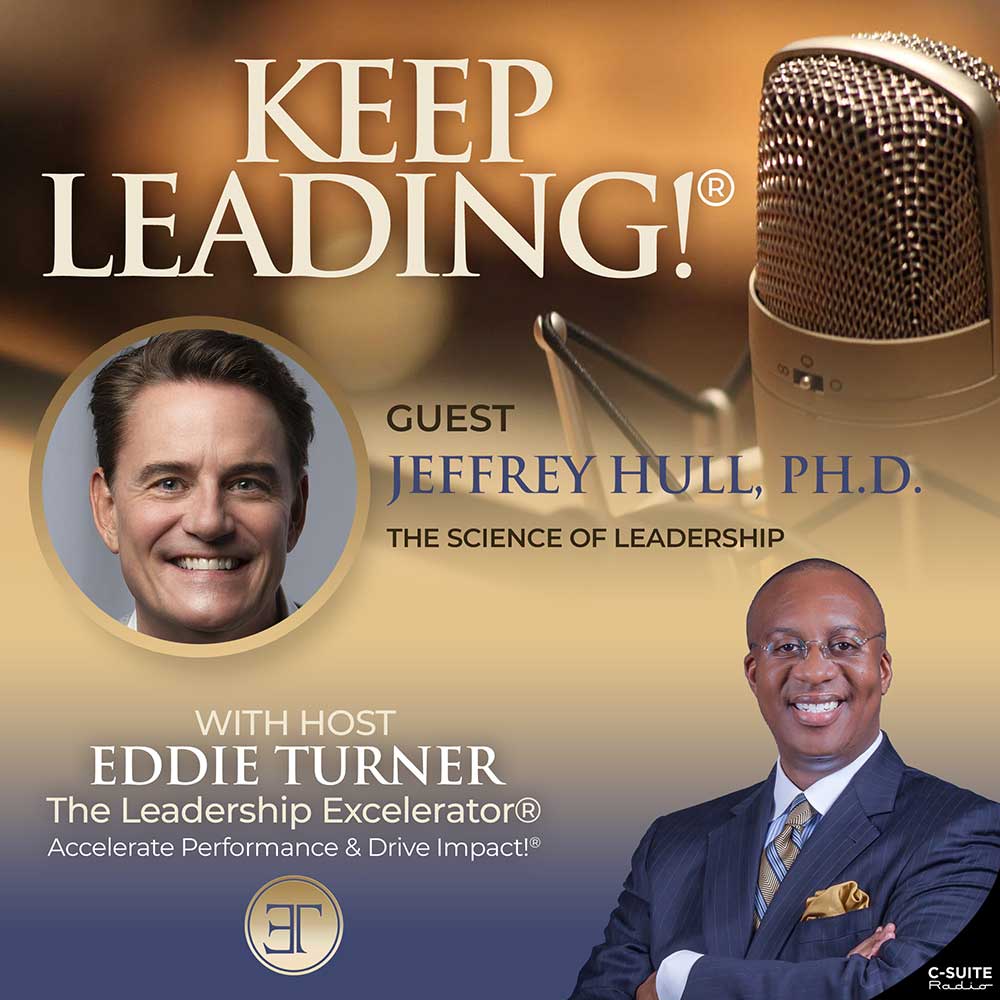
Jeffrey Hull, Ph.D.
Best-Selling Author, Harvard Faculty, Thinkers 50 Top Global Coach 2025, member 100 Coaches, Executive Director, Institute of Coaching, CEO at Leadershift, Inc.
The Science of Leadership
Episode Summary
What does science teach us about becoming a more effective leader? In this episode of the Keep Leading!® Podcast, host Eddie Turner sits down with Dr. Jeffrey Hull, executive coach, psychologist, and author of Flex: The Art and Science of Leadership in a Changing World.
Together, they explore how cutting-edge research in neuroscience, emotional intelligence, and adaptive leadership is transforming how we think about success in organizations today. Dr. Hull shares actionable insights on:
- Applying the science behind leadership agility and psychological safety.
- Leading teams through rapid change and innovation.
- Balancing data-driven decision-makingwith empathy and authenticity.
- Developing emotional intelligence to improve team engagement and performance.
Whether you’re an executive, team leader, or aspiring coach, this conversation offers science-backed strategies to help you lead with clarity, curiosity, and confidence.
Listen now to discover why leadership is both an art and a science—and how you can use proven research to Keep Leading!®
Keep Leading!® Live
Bio
Jeffrey Hull is a leadership consultant, executive coach, and Executive Director of the Institute of Coaching at Harvard Medical School, where he also serves as a clinical instructor in psychology. Named one of the top fifty coaches in the world by Thinkers50 in 2024, Hull has conducted over 20,000 coaching sessions with senior leaders globally through his consultancy, Leadershift Inc. He is the author of the bestselling book “FLEX: The Art and Science of Leadership in a Changing World” and co-author of the upcoming “The Science of Leadership: Nine Ways to Expand Your Impact” (July 2025), which combines coaching practices with actionable science for everyday leaders. An adjunct professor at New York University and sought-after keynote speaker, Hull has worked with major organizations including Goldman Sachs, Yale New Haven Medical Institute, and the International Coach Federation, focusing on evidence-based leadership development and transformational coaching techniques.
Website
https://www.jeffreyhull.com
Dr. Jeff Hull’s Book
https://www.scienceofleadership.com
LinkedIn
https://www.linkedin.com/in/jeffreywhull/
Subscribe, share, and review on Apple Podcasts!
https://bit.ly/4kPBcZo
Subscribe, share, and review on Spotify
https://spoti.fi/4iOFzlB
Full Episode Transcripts and Detailed Guest Information
www.KeepLeadingPodcast.com
Keep Leading LIVE (Live Recordings of the Keep Leading!® Podcast)
www.KeepLeadingLive.com
Connect with Eddie Turner
Website: https://www.eddieturnerllc.com
LinkedIn: https://www.linkedin.com/in/eddieturner
About the Keep Leading!® Podcast
The Keep Leading!® podcast is designed for individuals passionate about leadership. It focuses on leadership development and insights. Join your host, Eddie Turner, as he engages with accomplished leaders and influential figures from around the world about their journeys to leadership excellence. Listen as they share their leadership strategies, techniques, and insights.
Share the Inspiration
Are you inspired by what you hear? Share the episode with your network to help spread the message of empowerment and leadership. Use the hashtags #KeepLeading and #KeepLeadingPodcast to join the community of listeners dedicated to continuous growth and excellence in leadership.
Transcript
Eddie Turner:
Hello, welcome to Keep Leading Live. This is the live edition of the Keep Leading podcast where we look at leadership subjects and the idea is about leadership development and insights for my listeners. I’m Eddie Turner, the Leadership Accelerator. I work with leaders to accelerate performance and drive impact through the power of executive coaching, masterful facilitation,
and keynote speeches. I’m broadcasting today on usually LinkedIn, don’t think that was gonna work, but Facebook and YouTube. This is a part of the C-suite network. So on C-suite radio, you can access this or wherever you download podcasts within a week or so we’ll have that live there. And this is available on Spotify as a video.
as well as the audio for you to be able to replay later. So we’ll encourage you to access the show later on in that respect. And if you’re not following my guests today, I’m going to encourage you to do that. This is someone who you definitely want to know. Now, here’s the reason why. This is a Keep Leading Podcast. It’s all about leadership. And I’ve examined many aspects of leadership.
And everyone has definitions. And I even took one of my most fulfilling programs I ever took in my life was about the art of leadership. Well, today I have a gentleman who has done research on the science of leadership. What does that mean? Why does it matter? Why should you want to read this new book that he’s released with that precise title?
Jeffrey Hull:
My guest today is Dr. Jeffrey Hull. Dr. Jeffrey Hull at Department of War.
Eddie Turner:
My guest today is Dr. Jeffrey Hull. Dr. Jeffrey Hull and Margaret Moore have written the book, The Science of Leadership. And we’re going to look at the systematic elements that they have compiled that allow you to process what effective leadership looks like. And Dr. Jeff Hull is no stranger here on the Keep Leading Podcast. He is one of my few repeat guests.
Jeffrey Hull:
the science of leadership. And we’re going to look at the systematic elements of the EF compile that allow you to process what effective leadership looks like. And Dr. Jeff Ho is no stranger to that.
Eddie Turner:
So when I saw that he had this new book coming out, it’s right in harmony with everything that I’m passionate about. had to interview him. So I’m grateful that he accepted my interview. Jeff, welcome back to the Keith Levy Podcast.
Jeffrey Hull:
Thank you, Eddie. It’s a pleasure to be back with you again.
Eddie Turner:
Thank you for agreeing to come back and be with me. Tell our listeners who don’t know who you are, just a little bit about yourself.
Jeffrey Hull:
Well, like everyone else, I have a long convoluted resume, but the simple version is I am currently the executive director of the Institute of Coaching, which is a global association of coaches affiliated with Harvard Medical School. And I am also a leadership coach like you. So a good portion of my time is spent coaching leaders all over the world.
And then finally I do some writing, as you mentioned, a new book just came out, my third book. And I also teach Harvard Medical School part-time at NYU. And I recently started teaching part-time in Berlin at ESMT, doing some programs there. So a little combination, I guess they call it the portfolio career, writing, teaching, coaching, all the great stuff.
Eddie Turner:
Yeah, but what’s beautiful is you’re writing, teaching, coaching, they go hand in hand. And so when you’re teaching, you’re bringing real world evidence to the classroom that is practical. Not just we need that hardcore academic component, but you’re able to blend the two and you’re a true citizen of the world, truly traveled across the globe. And all of that shows through not only your examples that you share,
Jeffrey Hull:
Right.
Eddie Turner:
but also in your writing and the depth of your research that isn’t just focused on one hemisphere, as sometimes we might fall into the trap of doing. And therefore, this book is truly something that everyone can benefit from because it has global application. To that end, tell us, you and Margaret Moore, who I’m also a tremendous fan of, decided to combine your years of experience to write this book. How did that happen?
Jeffrey Hull:
Well, it’s obviously these things, it’s a long convoluted story as to how it all fell in place, but Margaret Moore is one of the co-founders of the Institute of Coaching. She has a very long celebrated career in research and science. She was actually a biotech executive before she went into the coaching space. And then I have a psychology background and
was a executive coach and psychologist for a number of years before I joined the Institute of Coaching. So together we have been working, bringing the science of coaching to coaches for over a decade. And we started having a conversation with a publisher a couple of years ago around the lack of access that leaders have, not just coaches, but leaders.
to the latest and greatest research on what makes leadership effective. And we all discussed with the publisher the fact that there are so many academic publications over the last 20, 30 years of research that look at different components of leadership. And they are then written up in academic journals.
And they’re really interesting if you like reading academic journals. But the reality is that the vast majority of day-to-day leaders, and you know this as well as I do, the people we coach, they don’t have time to read academic research. They know that it’s there. They get a little summary here and there from Harvard Business Review or from Forbes. But in general, the academic research that has been building strongly over the last decades
Eddie Turner:
Yes.
Jeffrey Hull:
is really not accessible or not day-to-day usable for most leaders. And so Margaret and I decided with the support of our publisher to basically go through a summary of all the research in the last 20 or 25 years around leadership effectiveness, all the studies. And we did not read 15,000 studies, but what we did do is we went through them.
Eddie Turner:
So
Jeffrey Hull:
bulk of the majority of studies in the last five years on all the different topics related to leadership. And you can imagine it’s servant leadership, transformational leadership, authentic leadership, agile, there’s so many different versions, right? And what we tried to do was then putting on our coach hats, we took that research summary
Eddie Turner:
Yes, absolutely.
Jeffrey Hull:
and tried to frame it in such a way that this great academic work, by the way, that includes 22 countries around the world. So it’s global research, academics from universities all over the world. We look for a way to frame it so that it would be accessible and practical. We created a framework with what we considered to be the nine most studied
Eddie Turner:
you
Jeffrey Hull:
competencies or modalities of leadership. And then we incorporated the two things that I think are really crucial to any leader, which is coaching stories, like real life stories of how these apply, and then finally some practices. So each chapter has real practices that leaders can put into action, or they could work with a coach and use them. The book could be…
Eddie Turner:
Mm-hmm.
Jeffrey Hull:
used by the leader by him or herself, or it could be used with a coach. But each chapter, each of the nine areas that we focused on has specific practices. So the idea fundamentally was to take really rich research and translate it into something accessible.
Eddie Turner:
Excellent.
Eddie Turner:
And that you’ve done. So, and thank you for giving me an early copy. I have a digital copy. Normally I’d have it on my shelf here. Excuse me, sharing that. Now I’m getting all choked up talking to you. Normally I’d have that on display. So I have had a chance to read it and it’s precisely everything you described. So the idea that you have taken 15,000 specific scientific studies across 22 different countries.
Jeffrey Hull:
That’s okay.
Eddie Turner:
applied your 20,000 hours of coaching to distill it in a way that would be meaningful to not just those in the executive suite who want to understand leadership, no matter what level they’re at, but also to those who will coach them. That’s quite powerful. And as evidence of the quality of the research you put into this book, you have some very impressive endorsements.
Jeffrey Hull:
Right.
Eddie Turner:
When you open it up and you see that none other than noted Harvard Business School professor, Amy Edmondson has endorsed this book. Global executive coaching leader and thinker, Marshall Goldsmith has endorsed this book. And the CEO of the International Coaching Federation, Magda Mook has endorsed it. Just to say a couple of people, that tells you the quality of the book and what people think about, who’s the target audience?
These people have said this is the book you want to read if you’re in these lanes.
Jeffrey Hull:
Yeah, I think what’s unique is this approach that we took to leadership is that the vast majority, there’s hundreds and hundreds of leadership books, and some really good ones. And I think, in fact, you’ve written a couple of good ones yourself. So there’s some really good leadership stuff out there. But what we tried to do was to look at the
Eddie Turner:
Yes.
Jeffrey Hull:
studies that academic researchers have been doing on the different domains of leadership over the last decade, couple of decades. And recognizing that the science, I mean, I think most people think of leadership as an art and the science. It’s a little bit of both. And a lot of the art of leadership is written about by coaches like yourself or me, and also by famous
Eddie Turner:
Yes.
Jeffrey Hull:
famous CEOs, know, Jeff Bezos or CEO Elon Musk or the CEO of Starbucks. What was his name? I’m forgetting, but you know who I’m talking about.
Eddie Turner:
Yes, I can’t believe I forget Howard Schultz.
Jeffrey Hull:
Howard Schultz, yeah. So they write these wonderful stories and they’re very inspiring. And I think they can be really helpful to leaders, but every leadership dynamic is unique. So you can’t just read Jeff Bezos’ story and try to replicate that. That’s a unique situation. It’s inspiring, but it’s a particular moment in time with a particular idea. It’s like an entrepreneur’s leadership. What we tried to do
is look at the research that is more across the board, across the landscape of leadership, summarize the findings that these professors of 22 different universities across the globe have discovered, and then make that information, which is available in the public domain, but it’s not easy to read. It takes a lot of extra time and energy. We tried to summarize it in a way
Eddie Turner:
Yes.
Jeffrey Hull:
that is really simple, very accessible, and also creates a roadmap for leaders. Whether a senior leader or a starting out leader, you can’t really be good at everything right from the beginning, right? You have to grow, you have to learn.
Eddie Turner:
Are you sure? Because there are some folks that would argue with you on that one now.
Jeffrey Hull:
They wake up one day and they’re just an expert at every domain of leadership, right? I wish that were the case.
Eddie Turner:
Yes, yes. Well, you brought it down to nine specific areas. I won’t ask you to give us all nine, but can you tell us, is there one that’s more important than all of the nine?
Jeffrey Hull:
That’s a very difficult question because I think it would depend on the situation that the leader is facing. But I will, to simplify the framing, one way we did try to think about it was three levels of complexity. And you think about leadership these days in today’s disrupted world, it’s a very complex environment that every leader faces. Lots of change.
Eddie Turner:
Okay.
Jeffrey Hull:
artificial intelligence and all the globalization and the political spheres, very complex. But there are definitely three levels at which every leader needs to operate. The first is within themselves. You have to start with yourself, right? You have to know yourself. You have to look at your strengths. You have to look at what your development opportunities are as an individual. Secondly, you have to look around at the people you interact with.
your team, your subordinates, your board of directors, whoever is above, below, and around you. So the second level is your facing your others, the teams. And then finally, when you get to be a sophisticated leader at any level, you wanna start to think about the system. You wanna think about the organization and the broader impact. So we did frame the book into three levels, self, other, and system.
and then interspersed the nine domains. So there’s three in each of them.
Eddie Turner:
So is it meant to be an SOS on purpose, Jeff?
Jeffrey Hull:
Actually, now that you say that, that’s true.
Eddie Turner:
Hey, because I know for some leaders, where we are today with all of, as you mentioned, the complexity that we’re facing, it is truly an SOS. And I love, as you mentioned several times, the idea that you’ve taken all this research that exists in the public domain and it’s available, right? Knowledge is exponential these days, but how can we get the specific component that we need in the moment in time that we need it? And so you’ve
Jeffrey Hull:
Right?
Jeffrey Hull:
Right.
Eddie Turner:
You’ve brought it down to these three specific areas that leaders can challenge themselves and do it, or as you mentioned, be able to work with their coach and do this to be able to have a focused approach to their leadership development.
Jeffrey Hull:
That’s right.
Jeffrey Hull:
Yes, absolutely. And the idea is to start where you are as a leader. And you asked me, you know, what is the most important of the nine? And if I was forced to answer the question, because I think they’re all important, but the very first step into this roadmap, we call conscious leadership. And consciousness is about awareness.
So starting point for all of us as leaders, whether it’s you or me or anyone else that aspires or works in a leadership domain, is to know ourselves. And so seeing yourself clearly is always the place to start. And that means your willingness to receive some feedback, whether it’s through an assessment or through colleagues or through a coach.
but getting some feedback so that you can understand your strengths and maybe your, what we call shadows or your triggers or some of the things that are not quite so friendly about all of us. We all have them. We all have to become aware of them. We all have to look at ways we can be more present and more mindful. So conscious leadership is really the starting point. And then you’re.
You leap forward from there into authentic leadership and relational leadership and positive leadership and servant leadership and ultimately transformational leadership. And I’ll let you, we can decide what we key in on in this conversation.
Eddie Turner:
You know, this is my, this is why I invited you all, right? This is the area I’m so passionate about because there are so many aspects of leadership and to your point, it depends on who the leader is, where they’re leading, in terms of the organization that they’re leading, which country are they leading in? What is the demographics? So it’s so.
Jeffrey Hull:
Hahaha
Jeffrey Hull:
Right.
Eddie Turner:
dependent and it’s the idea that there’s only one way to do it, one way to be successful is wrong to make that conclusion. So it’s good to have this exposure to a full breadth of leadership principles, leadership concepts, leadership theory, and then see how they should be applied. And you expose the reader to that and then you show them what that looks like in practical application.
through the stories that you introduce the leaders to. Now, you also talk about the cost of not taking action. What does the, or how much does it cost organizations when they tolerate poor leadership?
Jeffrey Hull:
Right.
Jeffrey Hull:
Well, I think the statistics of engagement and burnout, lack of engagement and burnout. I’m not quite up on the latest McKinsey studies, but they haven’t gotten much better over the last couple of years. And burnout is at an all time high, engagement is at an all time low. And a lot of that, I mean, I hate to say it, but it really does trace back to the leaders effectiveness.
Eddie Turner:
Yes, sir.
Jeffrey Hull:
I mean, people look to their leaders to create the space, to create the tone, to create the culture that inspires, motivates, and has people have a desire to be engaged with them towards a goal. And there are, as you said, there is a lot of different ways to approach that. And what we do in our book is ask a leader
who’s starting to read the book to do a quick assessment of these nine capacities, these nine capabilities, and think about what their strengths are, because some leaders have a natural strength in some domains. But then to realize that there’s a lot more that they can grow, they can learn, and then maybe go through the entire book step by step, or just choose, you know, there have been clients of mine
Eddie Turner:
Thank you.
Jeffrey Hull:
who have looked at the nine domains and said to me, you know, Jeff, there’s a couple of things that jump out at me. Number one, I don’t really understand what you mean by positive leadership. And number two, I’m not sure I’m very good at shared leadership. So let’s talk about those two. And those are two of the chapters in the book. So we’ll focus in on positive leadership. What does that really mean?
and then we’ll focus in on shared leadership. What does that really mean and how can you apply that? So, you you don’t have to do all nine, but recognizing that in order to really increase the level of commitment, engagement, minimize the burnout of your team, it helps to really have an awareness of these different domains and how they could be put to use with your real life situation.
Eddie Turner:
Thank you. And in addition to what you talked about in the book and also in our conversation about engagement, you shared a staggering number with me that I want to highlight. Everything that you said, then you put a price tag on it. You said it’s costing $360 billion. And when we just think about how organizations are doing layoffs or taking other maneuvers to shore up the bottom line, if we did something about leadership, that
Jeffrey Hull:
you
Eddie Turner:
in and of itself would go a long way to showing off the bottom line because it would solve all the things that you just mentioned.
Jeffrey Hull:
Yeah, and I think it’s also safe to say that the emergence of artificial intelligence is going to create additional complexity for leaders to make decisions about how to elevate the human element that is really crucial for their success and to think about what could be replaced with artificial intelligence tools and
You know, those human beings that are still working in the real world, even with AI, they need to be led in a way that they are inspired, they’re connected, they’re engaged. And so even as we become more technological in our organizations, we are still going to have to create environments where human beings are creative and innovative. you know, your leaders are the ones that create that atmosphere.
If you want to get innovation, you’re going to need to be a good leader. If you want to have creativity, if you want to have transformation, if you want to be on the leading edge, your people are going to look to you as a leader to create that environment. So knowing these themes is going to be really important.
Eddie Turner:
Indeed.
Eddie Turner:
Indeed. Now, you, as I mentioned earlier, aren’t just an academic. You are that person who is a professor at the prestigious Harvard University. And I forgot when you mentioned in Berlin and other places, New York University. But you also came out of the business world. So you saw what this looked like. You worked at places like Goldman Sachs and other prestigious firms. Can you tell us how
Jeffrey Hull:
Right.
Eddie Turner:
your unique lens of actually been in top corporations and now in top academia, how that really comes through to help leaders to understand the steps they need to take.
Jeffrey Hull:
Well, for me, my early corporate career was with Booz Allen & Hamilton, one of the big consulting firms. And when I was with them as a director of HR, I was very aware in early days of coaching these executives, whether it was the partners at Booz Allen or some of the senior executives at our clients, we worked at Citibank, we worked at Goldman, that, you know, they…
were brilliant. In many cases, they’re really, really smart, really, really successful, highly educated, but they struggled too with how to motivate people. They struggled with feedback because it’s sometimes painful to take feedback. you think of yourself as being a straight A student or going to Harvard Business School. And then all of a sudden you get a coach one day like Dr. Jeffrey Hull who says, well, maybe you’re not as good at this.
as you thought. It’s like humbling, right? And ironically, humility in our book is a part a big part of the chapter on servant leadership. And things like humility are actually really key to success. So, you know, what I learned early on in my corporate career was to be humble myself to not get too full of myself as a leader or as a coach.
Eddie Turner:
And then we’re crushed.
Jeffrey Hull:
but also to help my clients recognize that when they had some humility, they had some willingness to be transparent about their strengths and their opportunities, their growth opportunities. People are drawn to that, it’s magnetic. And all of a sudden, instead of being cocky or having all the answers, the people they’re leading are like, wow, I love you, you’re so human.
Eddie Turner:
Yeah, yes.
Jeffrey Hull:
You’re so real. And that is a stepping stone into one of the chapters in the book, which is on servant leadership, being a servant of your people, stepping from behind, leading, as they say, from behind. It’s actually one of the most sophisticated of all the leadership capacity.
Eddie Turner:
So Jeff, that’s a far cry from what we learned in the 60s and 70s where you were told you had to be hard, tough, you know, completely different breed. They would call that something very different today. So, yes. Yes.
Jeffrey Hull:
Hahaha!
Jeffrey Hull:
But there’s a place for that too. So that’s the interesting thing. I don’t believe in throwing baby out with the bathwater. So if you have an emergency or you have an urgent situation or you have a pandemic, for example, you do need to be a strong, authoritative leader and there is a role for that. But that is, you’re making the point, Eddie, which is really crucial, which is if you…
If you are just one type, you will not be successful in today’s world. You need a variety, you need agility, you need to be able to choose based on the context.
Eddie Turner:
Absolutely.
Eddie Turner:
Yeah, one of my favorite analogies comes from Daniel Goldman’s work, landmark article in Harvard Business Review, where he likened leadership to a club, set of golf clubs that depending on where you are, you’re going to pull up the right club for that part of the course. You’re just swinging the driver everywhere, being authoritative. That’s not going to work so well.
But to your point, little humility, a little putter, a little gentle. That’s what we need most of the time, right? When you get stuck in the sand trap, you got to block that sand wedge, right? So it’s having the appropriate range as a leader to know which one you should use when.
Jeffrey Hull:
I love that.
Jeffrey Hull:
Right, right, yeah.
Jeffrey Hull:
Right, absolutely.
Eddie Turner:
Fascinating. Well, I can’t let you get out of here. You are the executive director of the Institute of Coaching, a prestigious organization that many coaches look to for the latest and greatest insights to guide us in the work that we’re doing. Please just give us one morsel that you can share with us that we need to know about as we’re facing the end of the year.
Jeffrey Hull:
I mean, my favorite theme coming out of the book, the latest book with Margaret, is to think about sharing your leadership. So this is a sophisticated concept, but I like to lead this with people, which is transfer the I to we when you’re leading. Elevate everyone around you to be a leader with you.
We need to have more leaders in the organizations we work with. So rather than just the pinnacle leader at the top, think about if you’re a boss, ask yourself, am I leading alone or am I leading with others? And if I need to lead with others, how do I do that? How do I shift from?
I to we, elevating, empowering, growing. At the end of the day, we want to create as many leaders as possible because we need those talent. We need that talent in today’s world.
Eddie Turner:
Absolutely beautiful. We appreciate that. Well, I’ve been talking to Dr. Jeffrey Hull, bestselling author of Flex and his new book, The Science of Leadership. He’s a part of the Harvard faculty that Stakers 50 named him one of the top 50 coaches in the world. And he is a member of Marshall Goldsmith’s esteemed 100 coaches. I neglected to mention that.
Jeffrey Hull:
I think that’s how I met you. we did that’s right.
Eddie Turner:
Yes, yes. Well, I think you and I knew each other before that. I met you at the Institute of Coaching’s conference in 2015 or 2016. We became Marshall Goldstein colleagues five years later. Yes. And then of course, we mentioned that you are the executive director of the prestigious Institute of Coaching and the CEO of Leadership. What’s the most important concept you want to
Jeffrey Hull:
Right?
Jeffrey Hull:
That’s right, that’s right.
Eddie Turner:
keeping a walk away from our conversation with today.
Jeffrey Hull:
Leadership is a journey of learning and growth like everything else in life. And there’s a lot of good science. It’s an art to be a good leader, but there is science, there is research, there is demonstrated evidence. And Margaret and I are trying to make that available.
Eddie Turner:
Fantastic. Is there a quote that you use or a short story that you use that helps you keep leading?
Jeffrey Hull:
My favorite mantra is the time to be present is when there’s no time to be present.
Eddie Turner:
I like that. I like that.
Jeffrey Hull:
I use that with my clients every day. The time to be focused is when there’s no time to be focused. Variations. But basically, if you feel rushed, that’s the time to take a deep breath, calm down, and refocus. Get present.
Eddie Turner:
That’s so true.
Eddie Turner:
Well, thank you for sharing that. And where could people learn more about you?
Jeffrey Hull:
Easily on LinkedIn, just put my name, Jeffrey Hull, or institutivecoaching.org, or thescienceofleadership.com, or jeffreyhull.com. So, a bunch of places.
Eddie Turner:
Fantastic. We’ll be sure to put that in the show notes. Thank you again for your time, for your wisdom and knowledge that you’re sharing into the world. I appreciate you. And I know that the millions of cultures around the world and leaders appreciate all the great work that you’re doing.
Jeffrey Hull:
Okay.
Jeffrey Hull:
Thank you, Eddie. It’s great to think back and realize that we’ve been friends for many years. I wish you all the best with your podcast, with your writing, with your coaching, and it’s been great fun.
Eddie Turner:
Thank you. And thank you for listening. That concludes this episode, ladies and gentlemen. I’m Eddie Turner reminding you that leadership is not about our position or our title. Leadership is an activity. Leadership is action. It’s not the case of once a leader, always a leader. It’s not a garment that we put on or take off. We must be a leader at our core and allow it to emanate in all we do. So whatever you’re doing, always keep leading.