
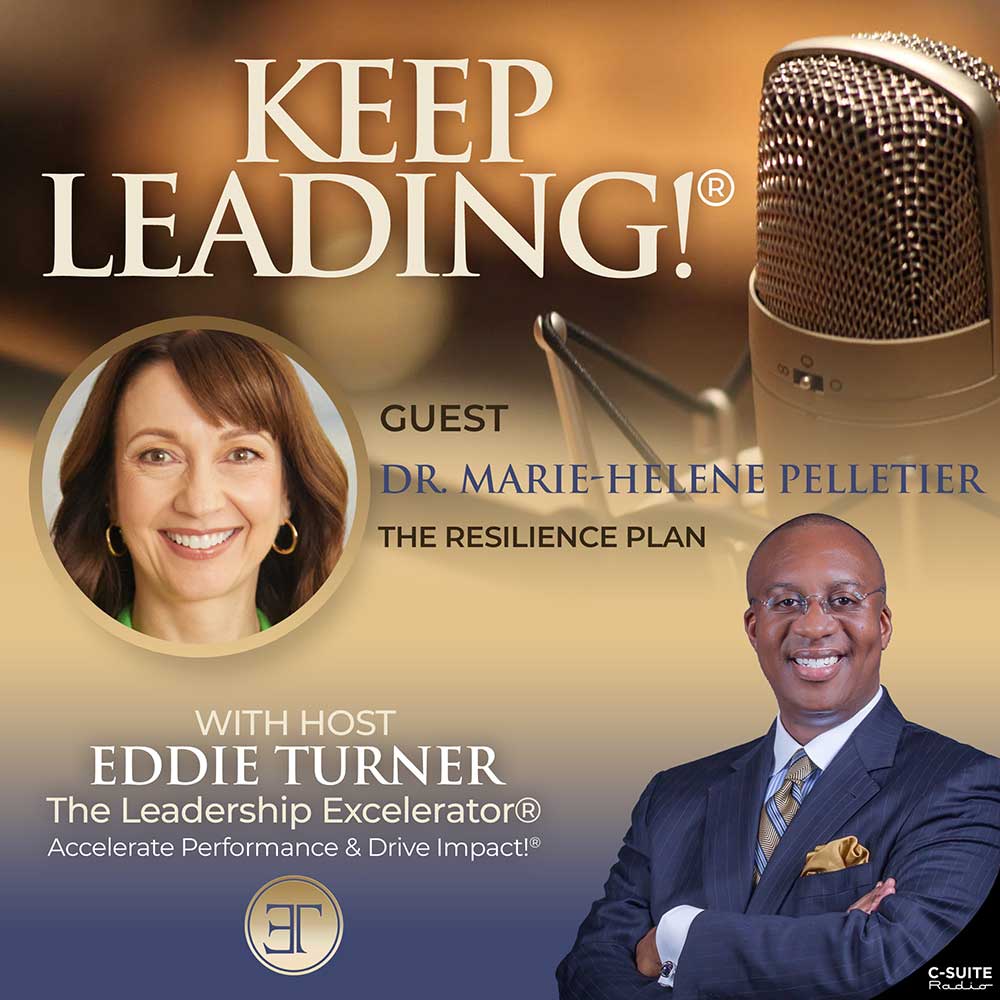
Dr. Marie-Helene Pelletier
Keynote Speaker on Strategic Resilience & Leadership in the Age of AI | Leadership Psychologist & Executive Coach | Award-Winning Author of The Resilience Plan | TEDx Speaker
The Resilience Plan
Episode Summary
In this episode of Keep Leading!® Live, host Eddie Turner engages with Dr. Marie-Ellen Peltier, a mental health expert, to discuss the critical importance of resilience in leadership. They explore the concept of resilience, its strategic implications, and how mental health exists on a continuum. Dr. Peltier shares insights from her book, ‘The Resilience Plan,’ emphasizing the need for leaders to recognize signs of mental health decline and to adopt practical strategies for building resilience. The conversation also highlights the role of organizational culture in supporting mental health and the importance of open communication within teams.
Takeaways
- Resilience is about strategic performance without burnout.
- Mental health exists on a continuum, not a dichotomy.
- Leaders must recognize signs of mental health decline.
- Understanding supply and demand in personal energy is vital.
- Anything is better than nothing when it comes to self-care.
Keep Leading!® Live
Bio
Throughout her career in management and psychology, Dr. Pelletier has spearheaded the dialogue on the crucial issues of leadership resilience and work performance. Drawing on her extensive background in corporate, insurance, and governance, she brings an international perspective and unique expertise on leadership. She has over 20 years of experience as a leadership psychologist, executive coach, and senior leader. Marie-Helene is a Member of the Global Clinical Practice Network of the World Health Organization, and past Director on the boards of the Canadian Psychological Association and the International Association of Applied Psychology. She has presented and authored and co-authored a number of industry and academic publications and has won numerous academic and industry awards. Dr. Pelletier is a highly rated instructor at the University of British Columbia, Sauder School of Business, Executive Education and a member of the Harvard Business Review Advisory Council, an opt-in research community of business professionals. Her award-winning book, The Resilience Plan: A Strategic Approach to Optimizing Your Work Performance and Mental Health, was named a “Top 5 Book to Read” by Inc. Magazine and Forbes.
Website
https://www.drmarie-helene.com
LinkedIn
https://www.linkedin.com/in/drmhpelletier/
Instagram
https://www.instagram.com/drmhpelletier/
Dr. Marie’s Book
Subscribe, share, and review on Apple Podcasts!
https://podcasts.apple.com/us/podcast/keep-leading/id1461490512
Subscribe, share, and review on Spotify
https://open.spotify.com/show/0I7uAW3x4AWsLe6cnAzHp7?si=14549a44dec3495f
Full Episode Transcripts and Detailed Guest Information
www.KeepLeadingPodcast.com
Keep Leading LIVE (Live Recordings of the Keep Leading!® Podcast)
www.KeepLeadingLive.com
Connect with Eddie Turner
Website: https://www.eddieturnerllc.com
LinkedIn: https://www.linkedin.com/in/eddieturner
About the Keep Leading!® Podcast
The Keep Leading!® podcast is designed for individuals passionate about leadership. It focuses on leadership development and insights. Join your host, Eddie Turner, as he engages with accomplished leaders and influential figures from around the world about their journeys to leadership excellence. Listen as they share their leadership strategies, techniques, and insights.
Share the Inspiration
Are you inspired by what you hear? Share the episode with your network to help spread the message of empowerment and leadership. Use the hashtags #KeepLeading and #KeepLeadingPodcast to join the community of listeners dedicated to continuous growth and excellence in leadership.
Transcript
Eddie Turner:
Hello everyone, welcome to Keep Leading Live. Keep Leading Live and the Keep Leading Podcast are dedicated to leadership development and insights. I’m your host, Eddie Turner, the leadership accelerator. I work with leaders to accelerate performance and drive impact through the power of executive coaching, masterful facilitation,
and professional speaking. My goal is to help you stay inspired, stay motivated, so you can keep leading. Today I’m streaming live on YouTube, Facebook, and LinkedIn.
Eddie Turner:
How many times this week have you pushed through exhaustion? Have you skipped lunch to power through meetings? Or told yourself, I’ll rest when this project is done?
If you’re not in your head right now, you’re not alone. Here’s the truth. With so much being demanded of leaders at all levels today, we must be more resilient than ever. But what does that really mean? What is resilience? Resilience isn’t about how much you can endure. It’s about how you can strategically perform at your best without burning out.
So to talk about this in greater detail, I’ve invited an authority on the show today. I’ve invited Dr. Marie-Ellen Peltier, and she goes by Dr. M.H. She’s joining us, and she’s an award-winning mental health expert who draws on her extensive knowledge in psychology and business to show how resilience is a key defense against burnout and how everyone
can build it in themselves. She’s the author of The Resilience Plan, a strategic approach to optimizing your work, performance, and mental health. And she’s worked with top leaders in organizations around the world. And I’m looking forward to her showing us some of the techniques that she has used in our conversation today. So if you’ve ever felt like you’re running on empty or you’re leading a team,
that’s showing signs of strain, this conversation is for you. So let’s get to talking about how we can not just survive, but thrive. Dr. Peltier, welcome to the Keep Leading Podcast.
Dr. MH Pelletier:
thank you. What a pleasure to be here.
Eddie Turner:
Dr. Tapaltier, tell my audience just a little bit about you.
Dr. MH Pelletier:
Yes, yes. So my background is a combination of psychology and business. And I worked in as a work psychologist in private public sectors, and then moved into leadership roles from very junior managing call centers and middle management and then the C-suite. And now I’m a public speaker, doing keynotes, executive coach, and still working as a small practice psychologist.
Eddie Turner:
phenomenal and your book the resilience plan has really Caught fire and is resonated with readers around the world and in fact I didn’t say the I did say the full title the resilience plan a strategic approach to optimizing your work performance and mental health It’s pictured right there behind you. Tell us the reason you wrote this book
Dr. MH Pelletier:
I wrote this book because the model, the framework that I’m using in the book, I use in my work with professionals and leaders. And a number of times, and it just repeated itself over time, where people would tell me, MH, I am so glad I know this now and I wish I knew this sooner. And so I’ve heard this a few times and at some point I was like…
Okay, maybe if I write it down, someone’s going to learn this sooner and benefit from it. And so that was the incentive for it.
Eddie Turner:
Wonderful. And the fact that it is able to be shared with people and people are able to read it is essential. In my work as an executive coach, there is not a week that goes by that I do not hear from a client how burnt out they are, how exhausted they are. And these are top performers. These are people who have succeeded beyond imagination.
And when you hear people at this level with all the stress that are on individuals and on corporations these days, it just it seems like it’s no longer just an anomaly. This seems like it’s more of a daily occurrence with everyday people. What’s been your experience with this? Obviously, you the book on it. What’s been your experience with this in your clientele?
Dr. MH Pelletier:
Yes, very, very similar to what you’re describing. We’re hearing a lot about it. And I think it is a combination. Like, why are we hearing more about it now? Right. It is more something we talk about. That’s one part of it. We’ve got efforts from the world health organizations, from various countries, getting more involved in the overall conversation about mental health in general, and the state of burnout in professionals and leaders and other groups as well.
But there’s also the fact that we’re dealing with even more demands, both acute and chronic ones. One of which, for example, is just having AI more present in our personal and professional lives. So it’s not, sometimes it’s acute in part, but it’s also always there. And so that combination of all of these demands at some point puts us at risk unless we deliberately invest in our resilience.
Eddie Turner:
Interesting. Now, Dr. M.H., I covered this topic before and I did it with an expert psychologist who I absolutely love. But what attracted me to you and your work was, I love the book, love the title, but the idea that you’re not just a psychologist, you’re a mental health expert. So you’re combining two different worlds. Is there a reason that
We need to consider both.
Dr. MH Pelletier:
We do, yes. This and the other part that I combine also in this conversation is the whole business angle, the importance of being strategic with our resilience. And that’s an important additional angle. But to this first part you’re mentioning, yes.
The reality is we all have a physical, a financial and a mental health. Okay. And they all impact each other, of course. And one of the things that will have an impact on maintaining good mental health is investing proactively in our resilience, our ability to navigate all these demands and grow even stronger from them, to learn from them. The challenge, part of the challenge is that
If we reviewed all the things that we can do, should do to increase our resilience, you, me, everyone listening to us, we could make that list. We know the information and we trust the research and then we should, it is true. However, the challenge often comes in the implementation. And that’s where the business side, the strategic side is so important in, in changing how we think about our resilience, changing that conversation.
and most importantly, what we do.
Eddie Turner:
Excellent. Yes, and the idea that, yes, many people are comfortable talking about psychology and human makeup, but when you talk about the mental health component, a subject that was kind of taboo in some senses for many years, right? But now people are understanding that mental health is not taboo. It’s something we need to talk about more. And in fact, some of us may deal with mental health issues that we didn’t even realize it. And so you cover something in your book that I thought was pretty interesting. You said,
Our mental health is on a continuum. And I just stopped when I read that sentence. I thought, wow, I never considered it like that. Tell us a little bit more about what you mean when you say.
Dr. MH Pelletier:
Yes, yes. This one came up as, so I’ve been teaching at the University of British Columbia executive education for years, speaking with leaders of all levels. And, and I was mentioning mental health, which when we’re in the field, we think of it this way, but as leaders and having been a leader, we don’t. As a leader, we tend to think of mental health as a dichotomy. You’re either mentally healthy.
which most of us are, we assume, and or were not, which unfortunately a few of us are not, and that’s just the way it is. The problem with this is that number one, it’s not the reality of it, but one of the, also one of the problems means that we’re going to be, say, on the healthy side and gradually slide, but because we’re thinking of it as a dichotomy, we’re not going to even pay attention to that slide until we’re on the other side, fully burnt out over here.
And so when I talk about the continuum is to help us make sure we see that line that yes, there is a dotted line. At some point we move on having say a mental health disease or challenge or disorder, but it is a continuum. And the beauty with this other than that’s the reality of it is that it means we want to pay attention while we’re on the healthy side, when our mental health is moving here.
so that we can proactively take actions to bring it back to as healthy as possible. Much the same way we think of our physical and we should think about our financial health as well.
Eddie Turner:
Yes. And so when we think about our physical health and our financial health, we often need someone else to show us the way. And sometimes we may not even realize we have a physical malady until we show up for a doctor’s annual visit or something. And he says, hey, listen, this is wrong. need to check on this. We need to some work. Or with our financial advisor says, hey, listen, these are not quite the way they should be. What resources are there? How can we know as leaders when our mental health needs
to be regulated because we’re now sliding, as you say, into this area that we don’t realize.
Dr. MH Pelletier:
Yes, yes. Well, certainly if we know anyone listening, we’re here today and we’re thinking, yeah, feels like it’s not right kind of thing. would say a good recommendation is to go check in with a professional to your point. So that way an external person who has the expertise, like a psychologist, for example, will help you figure this out and see exactly where you’re at. But for most of us, one of the things we can think about today is to
Think about when we were feeling our ideal self on a zero to 10 scale, solid 10 or nine and a half, know, pretty good. Whenever that was a few years ago and you compare it to where you’re at now, you’ll be able to see how that compares. And sometimes you’ll say, yeah. And you’ll look at things like I’m really my same usual self in terms of making decisions, in terms of my concentration, in my energy levels, in…
my ability to interact with others versus finding yourself having a hard time making decisions, needing to reread the same document a few times, or being impatient in your interactions with others. And these are just some of the signs, but you’ll see it. And often the shortest way to summarize this is are you your usual leader self, if you’re in a leadership role, for example. And people will know, your clients, my clients,
They know, if you ask that question, if we ask it to ourselves, we’ll know. And it’s important to be realistic about it as much as we really don’t like to acknowledge if we’re not where we used to be. Because certainly from a pure health perspective, the psychologist side of me is saying just for your health, it’s so important. But then sometimes I’ll get my clients who are hesitant to do it for their health, I’ll say, it for your brand.
You’ve spent decades building this brand as a professional, as a leader. And because of these hits on your health, you’re not your usual self. You’re not that guy. You’re not that woman. You’re not that person. And that’s impacting. And frankly, Eddie, they more often listen to this. I’ll get them on that argument more than on the health one, even though, yes, health would be something that is very important.
Eddie Turner:
That is so true. I love the way you said that because that will resonate deeper. And I think with a wider spectrum of people, you put it in those words that you want to do it for your brand, you’ve built a reputation and it took years. And if you’re no longer able to show up that way or things are happening to you and you’re trying to mask it, it’s not working.
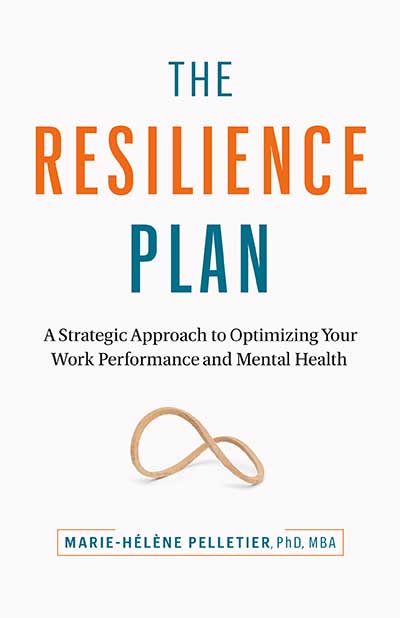
So wow, I really appreciate you sharing that. And to that end, it leads to one of the other reasons I was attracted to your work is when I saw your book in the cover, you have something there that I’ve always used as the illustration for resilience. Tell us about the rubber band.
Dr. MH Pelletier:
Well, the rubber band and the shape of that rubber band, it ties into a few things from my book. I mean, number one, it’s not rubber band can be broken, right? And so, no, it’s not something that, I just am resilient as a personality trait. It’s in me and cannot move, will not change over time. And it’s wonderful always. No, it has a fragility to it.
that can be nourished in the right conditions, but can suffer also in more challenging conditions. And so you want to think about it also as something that you’re stretching as opposed to breaking, for example, but also the shape of it that we very intentionally had on the cover is similar to that twisted DNA symbol. And in my book, my framework about being strategic about your resilience very much involves
Just like what we think of as the DNA, this visual that we see often, the two sides, like the sides of a ladder are both the professional and the personal side, because that’s another thing. Often leaders will come to you and to me thinking more about their work, the work side of things, which is of course where we’ll put most of the focus. And we need to also weave in the personal.
It’s not like emotions have lanes. You are still the same person. So these two are connected and need to be thought of in that sense that they’re both part of our full context. And then the rungs of the ladder I described in the book, but that was part of having that shape that also connects with the framework.
Eddie Turner:
Beautiful. That’s something essential for people to remember when it comes to resilience, what it looks like, how we define it, and how we actually execute on that. So to that point, you offer several solutions, pardon me, in your book about how we build this resilience. So for my listeners who are burnt out, who are exhausted, how can they benefit from what you’ve documented in your book?
Dr. MH Pelletier:
Yes, how? And that’s very much what I’m all about. Very applied always using the research, but then let’s apply it to something that’s useful for you, me and everybody else. So, and I’ll tell you the way this emerged even, because again, I was speaking with professionals and leaders and they were saying, yeah, I made, know, how complicated can that be? This resilience thing, really. And…
And, but yet, yes, they were having trouble implementing these actions in their lives. And so I said, okay, if we were in a business and we have a new idea for a new offering, would we just, new product, new service, whatever, would we just say, we have this great idea, let’s implement it. Or would we say, we have this great idea, let’s look at who else is offering this? How much are they charging for it?
Who else might, what else might impact the demand for it in the short, moderate and long term? We would do all this. We would be strategic. So let’s do the same thing in our personal lives. We want more resilience. We can’t just say, okay, yeah, yeah, I’ll do it. We need to look at a few things and we’ll have, if you want, I can send you for the show notes, the worksheets that are associated with the book and they can be used independently or with the book. So they’re very…
self-explanatory, but that’s a way to guide anyone who wants to try this in a very easy, doable way. But basically what I do is guide people through reviewing their values, starting with this. Just like in a business, we would start with what’s most important, what are our values as a business. So let’s do the same here, because it’s going to need to be customized. Your plan will be different from mine because we have different values.
Suspecting we share some, but we also have some different ones. Then we want to look at our sources of what I call supply and demand. And there’s a very simple worksheet for that one too, but that is the one worksheet I’ve received the most comments about people saying I did all of them. And that one spreadsheet is what shifted my thinking entirely. Because what I’m
Eddie Turner:
What is it about that one that shifted them entirely?
Dr. MH Pelletier:
I know, I know, it’s, I think all of them are great myself, but this one I’ll tell you. It’s, so it’s a table, two columns, demands and supply. And I’m guiding people. I’m just saying, okay, list all the demands you have at work. They usually put two or three that are very stressful. They don’t like. Then I say list two or three at home. And so they list two or three, they’re like, yeah, it’s a bit heavy or whatever. Then I say, go back to the work list and add as many as you.
can, including positive ones. so I had this new big clients I’ve been wanting, but now it’s adding like a lot of load. Same thing at home. I have this person in my life that I enjoy helping or spending time with, and it represents a demand. We tend to underestimate the demands. That’s part of the optimistic bias of a good leader, but it also at times becomes
detrimental, it becomes a liability, the degree to which we underestimate the demands. And then on the supply side, same thing, what gives you energy at work, at home and all this. And then we realize we overestimate. Cause if I just say, how much supply do you think you have? you’re yes, that’s great. I have all this energy. I go to the gym so many times a week and all this. And then I’ll say, yeah, okay. So past two weeks, how many times?
well, the past two months I’ve been really busy, so no, but in general, I’m like, well, then it doesn’t go on the list, does it? And so that’s that realization that we’re really underestimating the demands, overestimating the supply and having it written down shifts that perspective to the reality of it.
Eddie Turner:
I love that concept, Dr. MH, of supply and demand and allocating that out just like you do a product or something in your business.
Dr. MH Pelletier:
It is. And the other piece too is that, you know, sometimes I’ll give that other analogy where I’ll say, you if we were in a business, would you just say, you know, I don’t need to see the financials, just let me know if we’re close to bankruptcy. We would never do this, but it’s almost like we do this for our resilience. yeah, I’m good, you know, that’s fine. Until I’m not. So no, let’s proactively look at the reality and the details of it. Actually doesn’t take that long.
Eddie Turner:
Hahaha!
Right.
Dr. MH Pelletier:
but it does shift the visibility you have and therefore puts you in such a much stronger position.
Eddie Turner:
Now, are you saying that those are in the back of the book? Thank you for sending me a copy of the PDF of the book. But in the physical book, those are in the back of the physical book?
Dr. MH Pelletier:
Yes, and I’ll send you a link. They’re also online. I have a link for you and your audience if they want to connect them. Yes.
Eddie Turner:
That’ll be phenomenal because I know that will benefit a lot of people. I I listen to people talk about the fact, mean, obviously it’s not a day that goes by that we don’t pick up the paper and see how many demands are put on people as companies are doing massive layoffs, as AI is creating this tremendous disruption in industry. And there’s one quote that I quote, I repeat a lot that came out of the Wall Street Journal that said, when companies are keeping people,
If you weren’t one of the people who were laid off, you’re happy, but it said, we still think you’re not working enough. Which means we’re not giving you additional resources just because we can’t be you. We expect you to do more, but in the way that you say it in my GE life, do more, but do it faster. Right, do more with less, but do it faster. So.
Dr. MH Pelletier:
Yeah.
Eddie Turner:
What is someone supposed to do? How can they build? You gave us some tips here and we got the spreadsheet links you’re going to share with us. But is there any other practical steps that someone can take as a leader when their plate is already full to, as you said, hey, don’t wait till I’m actually bankrupt on my energy, but how can I be monitoring this and now take active steps to bounce back as your rebel band illustration says?
Dr. MH Pelletier:
That’s right. And that brings us to a critical central aspect when we think of resilience, particularly in a work context, is that resilience, we need to think of it in a systems type of way. So we’ve got us, the individuals, we’ve got the team we’re in, we’ve got the organization we’re in. We even have the country we’re in, the moment in time we’re in. So many things impact our individual resilience here and our individual resilience.
Eddie Turner:
Yes.
Dr. MH Pelletier:
influences these other parts as well. So it is a reciprocal relationship. Now, this, so far we’ve talked a bit more about us as individuals here, because my point is, even if all this is a system, we don’t want to just say, well, this is my team’s fault, this is my organization’s fault, this is the world we live in, and I’ve got no impact or control or power over this. Not true. There are things we can do. That being said,
It would also be a mistake to think that it is entirely in our hands. Right. So we also want to be looking at, what can we have a conversation as a team on where do we have opportunities to decrease stress points or moments where everyone gets more anxious or nervous because it is a procedure we don’t do often or we’re not as optimized on whatever. We can talk about things as a team. We want to learn about.
What as an organization, what is the organization’s mental health strategy? If they have one, if they don’t, what do we know from the HR partners, from the HR teams, what are the resources we have? What are the themes, the plans perhaps that we have to support all of us as humans in the age of AI in this organization? So that, especially if we’re in a leadership role, but even if we’re an individual contributor,
If we know this from the organization, we can maybe optimize, amplify that voice, use these resources, share with others that we do, and possibly even make suggestions or recommendations about additional things that may help. And so, and that’s important to think of it this way, because when we’re looking at say workload, for example, culture.
opportunities for growth and development and so many other factors that we know influence the resilience of everyone, psychological safety as well. There are things we can do and often actions, people will shy away from say conversations on workload because they think leaders will say, well, if I open that, conversation, it’s yeah, I won’t be able to do anything. It will be terrible. It’s better to not even talk about it. And.
Dr. MH Pelletier:
You see where this is going. I’m going to say, no, we do want to open up that conversation. We can do it in a realistic way. We can say, probably cannot change.
Eddie Turner:
That is one of number one corporate fears, I will tell you. Absolutely.
Dr. MH Pelletier:
That’s right. Yes, I know. And yet that’s probably the number one corporate opportunity to change how resilient people are, how we feel about the psychological safety in this organization and in the team we’re in. So yeah, no, we can open the conversation. We can open it realistically and look for the nuggets. And we’ve all been there.
You find something that looks like 5 % of the overall situation, you change it, and it feels like a 20 % change, which starts feeling material. So we want to open that.
Eddie Turner:
So this is a very salient point that you’re making. I really appreciate how you said that people should not consider this as an undertaking that they have to do all by themselves, that to consider this as a systemic cultural shift that might need to be made inside the organization. And the organization is where many people might say, hey, that’s where all my pressure’s coming from. So to have that courage to be able to have that conversation with their manager, try to start the conversation with the team.
try to make that something that maybe we can promulgate throughout the organization to help build resilience as a community in the organization is really something to consider. I really like that. So thank you for sharing that.
Dr. MH Pelletier:
Absolutely. Yes. And there are, so go ahead. I was going to add an example of this just to get very practical quickly here, but an example, because people may say, okay, I like the idea. sounds very, whatever, inspiring perhaps, but concretely, what can I do next week without additional budget or additional anything? Well, in your next team meeting, you can ask the team.
Eddie Turner:
What’s the mo- go ahead. Go right ahead.
Dr. MH Pelletier:
When is, and you may know, but you can still as a team, when’s the moment in the next 12 months that we know is the highest demand point? Okay. We often know it is in three months from now, it is always March or whatever it is. Okay. Let’s find one thing we can do now to shift how we’re going to arrive in this most demanding time. See, not a big thing. Small changes. It gives people influence, some control.
We’re being proactive. You’re sharing the value of resilience in the team. Didn’t take budget or a lot of time. That’s an example.
Eddie Turner:
Thank you for sharing that practical suggestion. That’s gonna help a lot of the listeners. Dr. M.H., you’ve shared a lot of morsels of wisdom with us in this conversation. What’s the most important concept or lesson you want listeners to take away from our time together?
Dr. MH Pelletier:
I would love everyone to, and I, when I say this, it literally includes me at times. I have to remind myself to do this, to be strategic about our resilience, to be constantly curious, to look for the ways in which we can, just like in business, step back for a moment and realistically look at what’s in front of us today and in the near future. And what can I do today to shift this?
What for each person that will vary again, always love the practicals. I’m going to give a small example. A lot of leaders will tend to recover in a very active way. They do cardio, they do strength training, and these are wonderful things we want to keep. For many leaders, meditation is not on their list. They sort of know the research and that, but they’ve tried it. Maybe they think it’s not for them. Consider this. If you’re wondering concretely, MH, what can I try now that I…
I have unlikely tried, start the meditation, find an app that’s easy for you, start with two minutes, five minutes, and start implementing. Cause that is one of the things we know from research makes a difference.
Eddie Turner:
That’s a phenomenal suggestion. And as you said, there are many apps that help people to do this. Many people wear smartwatches. And I know that the Apple Watch has that feature built in. It will remind you, hey, it’s been a long day. Take a minute to do some mindful breathing or what have you. So that’s a really great suggestion. Thank you for that. What’s one quote that you use that helps you to keep leading or the best leadership advice you’ve ever received?
Dr. MH Pelletier:
Yes.
Dr. MH Pelletier:
that is a good question. So many. I’ll say. Well, related to today’s conversation, one that, and I don’t know if it’s a famous quote from, it’s not necessarily from someone, but a sentence I tend to use, especially with busy leaders. And again, applying it to myself is anything is better than nothing.
And that’s a bit important because often part of what got us to good leadership is doing things fully, a hundred percent. I need to have my half hour of this. I cannot do half hour. I will do it tomorrow instead. You cannot do half an hour. Can you do 15 minutes? Can you do five? Can you do one? Just anything better than nothing, because then you’re maintaining the habit. You’re maintaining the message you tend to yourself. You’re maintaining your…
your curiosity to look for ways to make it work. And so, yeah, I’m going to go with that. Anything better than nothing.
Eddie Turner:
Anything is better than nothing. Those are indeed words to help us all keep leading. It’s been a pleasure to have you, Dr. Image. Where can listeners learn more about you and your work?
Dr. MH Pelletier:
hehe
Dr. MH Pelletier:
They can go to thereziliensplan.com and we’ll have perhaps this information in the show notes. Always love connecting on LinkedIn. Send me an invitation and we’ll connect. But that link will get you to my website, to the book, and we can go from there.
Eddie Turner:
Wonderful. Well, I’m going to encourage all my listeners to follow Dr. M.H Peltier. She is a phenomenal leader who’s doing tremendous work. Get a copy of her book and use those tips to help you in your journey of leadership so that you can keep leading. Thank you again for being a guest on the Keep Leading podcast.
Dr. MH Pelletier:
Thank you. was a pleasure.
Eddie Turner:
And thank you for listening. That concludes this episode, everyone. I’m Eddie Turner, reminding you that leadership is not about our title or our position. Leadership is an activity. Leadership is action. Leadership is not a role that we play. It’s who we are. It’s not a garment that we take off and put on. We must be a leader at our core.
and allow it to emanate in all we do. So whatever you’re doing, always keep leading.