
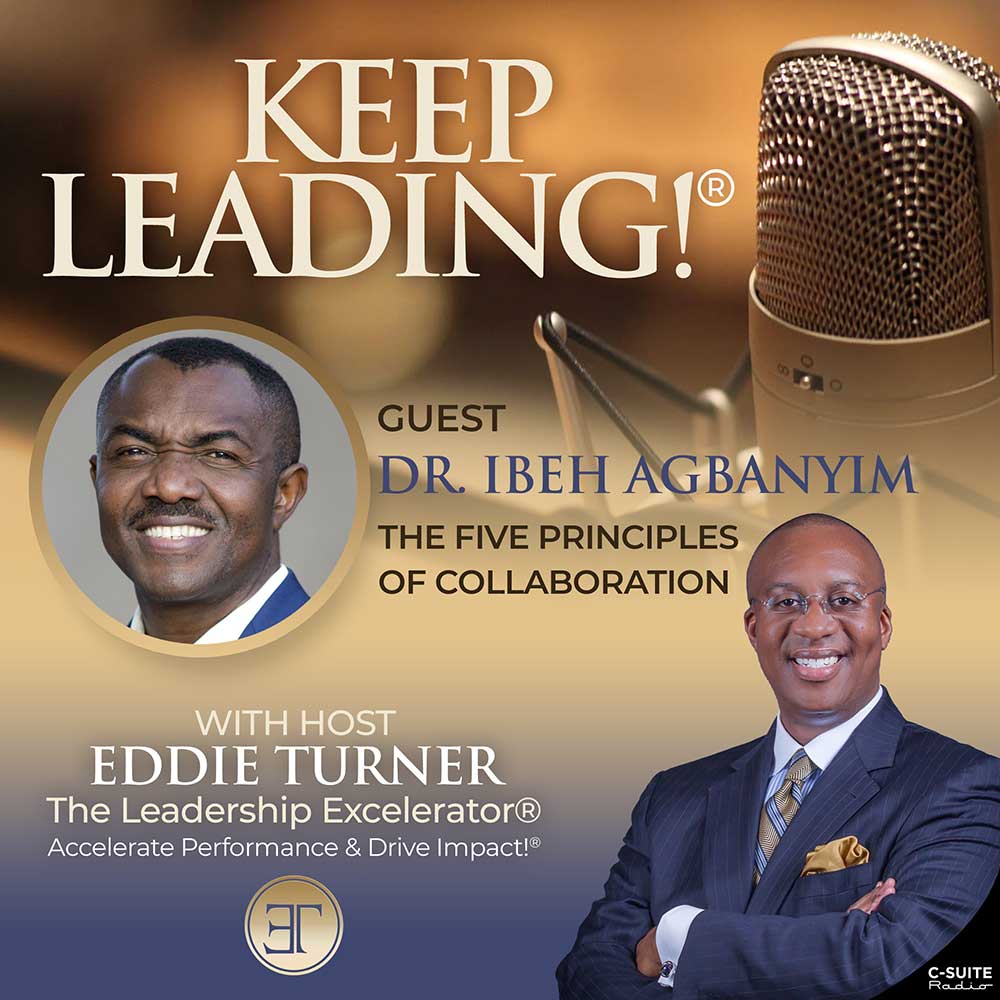
Dr. Ibeh Agbanyim
Executive Coach, Bestselling Author, Speaker, Scientist-Practitioner, Certified Mental Health & Wellness in the Workplace Expert
The Five Principles of Collaboration
Episode Summary
On this episode of Keep Leading!® Live as we explore the essential principles of collaboration outlined by Dr. Ibeh Agbanyim. Discover how trust, respect, willingness, empowerment, and effective communication can transform your personal and professional life.
Learn practical strategies to:
- Foster healthy employee-management relationships in the workplace,
- Overcome barriers to collaboration in social settings,
- Cultivate a strong intrapersonal relationship by understanding your life’s purpose.
Mastering these principles will equip you to achieve success through effective collaboration. Tune in for actionable insights and a practical guide to cooperative success!
Keep Leading!® Live
60 Second Videos
About Dr. Ibeh Agbanyim
Dr. Ibeh Agbanyim is a highly regarded executive coach, scientist-practitioner, and bestselling author. He is celebrated for his expertise in enhancing workplace relationships. He has contributed to prestigious publications such as Psychology Today and Forbes. His books, including the popular “The Five Principles of Collaboration,” have guided numerous executives globally.
Dr. Agbanyim earned his PhD in industrial and organizational psychology from Grand Canyon University and holds executive certificates from MIT and Harvard. A respected member of several international psychology and coaching organizations, he has shared his insights with audiences across the United States, Canada, Europe, the UAE, and Africa.
Website
https://www.fvgrowth.com/
LinkedIn
https://www.linkedin.com/in/j-ibeh-agbanyim-ms-phd-ml-8513322b/
Facebook
https://www.facebook.com/p/J-Ibeh-Agbanyim-100063570607012/
Dr. Ibeh’s Book
https://amzn.to/3QcKnEQ

Leadership Quote
“If your actions inspire others to dream more, learn more, do more and become more, you are a leader.” – John Quincy Adams
Subscribe, share, and review on Apple Podcasts!
https://bit.ly/4kPBcZo
Subscribe, share, and review on Spotify
https://spoti.fi/4iOFzlB
Full Episode Transcripts and Detailed Guest Information
www.KeepLeadingPodcast.com
Keep Leading LIVE (Live Recordings of the Keep Leading!® Podcast)
www.KeepLeadingLive.com
Connect with Eddie Turner
Website: https://www.eddieturnerllc.com
LinkedIn: https://www.linkedin.com/in/eddieturner
Twitter: https://twitter.com/eddieturnerjr
Facebook: https://www.facebook.com/eddieturnerllc
Instagram: https://www.instagram.com/eddieturnerjr/
YouTube: http://www.youtube.com/EddieTurnerJr
LinkedIn Business: https://www.linkedin.com/company/eddie-turner-llc
TikTok: https://www.tiktok.com/@eddieturnerllc
Bluesky: https://bsky.app/profile/eddieturner.bsky.social
Agent: https://gray-miller-agency.webflow.io/roster/eddie-turner
100 Coaches Agency: https://www.100coaches.com/coaches/profiles/eddie-turner/
About the Keep Leading!® Podcast
The Keep Leading!® podcast is for people passionate about leadership. It is dedicated to leadership development and insights. Join your host, Eddie Turner, The Leadership Excelerator®, as he speaks with accomplished leaders and people of influence across the globe about their journeys to leadership excellence. Listen as they share leadership strategies, techniques, and insights.
Share the Inspiration
Inspired by what you hear? Share the episode with your network and help spread the message of empowerment and leadership. Use the hashtag #KeepLeadingPodcast and join the community of listeners who are dedicated to continuous growth and leadership excellence.
Transcript
Eddie Turner
Hello everyone. Welcome to Keep Leading Live. Keep Leading Live is dedicated to leadership development and insights. I’m your host, Eddie Turner, the leadership accelerator. I work with leaders to accelerate performance and drive impact through the power of executive coaching, masterful facilitation, and professional speaking.
Today we are broadcasting live on LinkedIn, Facebook, and YouTube. If you’re joining us on one of these platforms, let us know. You can let us know by typing into the comment section to tell us who you are and where you’re located. And if we see that you’ve given us a question, we will absolutely entertain your question. Or if you just simply have a reaction to something you’re hearing, tell us what you think. Even if you disagree, let us know that too. We welcome you to be a part of the conversation.
Hit the share button. If you hit the share button, then your colleagues can join our conversation as well or have access to the replay immediately upon the conclusion of today’s session. And if you’re not following myself and my guest on social media, I’d like to encourage you to do so. Follow us. We’d love to have you as a part of our network and stay connected to you.
In today’s episode of Keep Leading Live, we will explore the essential principles of collaboration. We’re going to do so through the eyes, the lens, and the work of Dr. Ibeh Agbanyim. If we master these principles that he’s going to share with us, we’ll achieve success through effective collaboration and have an actionable guide that we can use and refer to over and over.
Now, why Dr. Ibeh Agbanyim? He and I met at the Harvard Kennedy School. He is a highly regarded executive coach. He’s a science practitioner and a best-selling author. He’s celebrated for his expertise in enhancing workplace relationships. Dr. Agbanyim earned his PhD in Industrial and Organizational Psychology from Grand Canyon University and holds executive certificates from MIT and Harvard. He co-authored Leading with the Heart, building successful teams with trust and compassion. He’s contributed to prestigious publications such as Psychology Today and Forbes.
Now, today we will discuss his very popular the five principles of collaboration, applying trust, respect, willingness, empowerment, and effective communication in human relationships. Dr. Agbanyim, welcome to Keep Leading Live.
Dr. Ibeh Agbanyim
I thank you so much, sir, Eddie. You are—you are the real McCoy.
Eddie Turner
Thank you, my friend. I am so excited to have you. It’s been too long since we’ve really hung out. So, tell us what I may have missed about your background that you want the audience to know about.
Dr. Ibeh Agbanyim
I think you got it all right. When you were introducing me, I was asking myself, that’s how good it was. So thank you so much.
Eddie Turner
Well, you’re quite accomplished and one of the most humble people I know. But I’ll tell you something. I really respect the work that you do and the impact that you’re having around the globe. And this book is a really good book and we would love to know, you know, the five principles of collaboration. What motivated you to write this book?
Dr. Ibeh Agbanyim
Yeah, thank you, Eddie. Before I answer that question, let me just put one or two things in your mind before I answer that question. Collaboration is desperately needed. In fact, collaboration is an essential requirement for human relationships. I’ll put it this way: Humans are—we are already busy. People are busy whether in a relationship, whether you’re hanging out with your friends or whether you’re an executive running an organization.
So imagine, recent research says that an average American makes about 35,000 decisions on a daily basis. 35,000 decisions on a daily basis. And other studies say that people process thousands and thousands of thoughts on a daily basis. And that starts—80% of them are negative thoughts. And 95% of them are thoughts. So we are constantly bombarded internally about what our mind. So you can imagine if you’re—if we are not collaborating or working with people, imagine how suffocated we can be with such information. So that’s why I say collaboration is very, very essential, is very needful, is very required if you want to be well-rounded.
And you know, as far as the neuroscience scientists go, neuroscientists, they said that—Dr. Bruce Perry said that our brain is a social organ. So people are wired to connect. So there is a high need of people collaborating in every facet of life.
What made me write this piece? I would say it comes three piece. One is observation, one is experience, and one is also research. So having traveled extensively, I realized that the act of collaboration is universal. You know, people mention those five principles that I tabulated in my book. In one way or the other, they mention them, you know, what they need to collaborate. So while traveling, I experienced all that from different parts of the world. You know, whether it’s the Southeast Asia or Africa or, you know, Dubai. For that reason, I felt like it would be a good idea to put it in writing. That way people can carry around with them. That’s why I wrote the book.
Eddie Turner
Interesting. All right. Well, you also answered one of the questions I was going to ask you and that is what is collaboration. So thank you for delineating that and what makes it important. And I like the interesting part that you said about the brain being a social—give me that part one more time.
Dr. Ibeh Agbanyim
Our brain is a social organ and it’s right.
Eddie Turner
Social organ. I’ve never heard it referred to that before. A social organ. Very interesting. Thank you very much. Now, when you talk about the reason for writing the book and how you put this down for people to be able to refer to, you’ve given us five principles. What are they?
Dr. Ibeh Agbanyim
Thank you. The five principles that I found universal was—they are trust, respect, willingness, empowerment, and effective communication.
Eddie Turner
Is one of them more important than the other?
Dr. Ibeh Agbanyim
I don’t think so, but they should come because if any one of them is missing in relationship, that area will be deficient. So clear each one of them has a role to play. So all we need to do is pay attention to how we, you know, how those five—if I may say that. I hope that makes sense, Eddie.
Eddie Turner
It does. Well, in your book, you started with trust and that’s one reason I asked the question. I didn’t know if trust was more important than the others. So talk to us about trust. What role does trust play in collaboration and communication?
Dr. Ibeh Agbanyim
Yes, trust is—it’s a very transactional construct. In other words, if you don’t extend, if you don’t prove trustworthy, it’s hard for somebody else to initiate same thing to you. So trust is transactional and it’s also mutual. You know, trust doesn’t exist in a vacuum. Has to be earned. And what do I mean by that? You know, trust is transit, which means it penetrates every area of our life. Whether it’s in a business area, whether it’s in a social area, whether it’s in a relationship.
Now, there is a study or survey that I conduct over the years and it keeps coming back over and over again that in business and relationship, trust ranks number one. So trust ranks number one in business and in relationship. Now, interestingly, it also ranked number two in those areas. But social—in a social setting, respect ranked number one. So when you think about it, it tells us that trust has—you can’t just generate your employees at work. They need from you. Yes, they do need trust, but individually, some of them need—maybe they need to be effectively—to effectively communicate with them. Or some of them, they like you to empower them to do more things. So you can’t just—trust doesn’t exist when it comes to—Sorry. I’m sorry. Sorry.
Eddie Turner
What do you do when trust doesn’t exist?
Dr. Ibeh Agbanyim
It creates a vacuum. So creating an area—an environment of effective communication will be the first place to go to. You need to find out why are you not trusted. And again, since you mentioned that, there are three types of trust that I might like to share. So trust is not just one. There are different levels of trust. And one of them is what is called goodwill trust. Now, goodwill trust essentially means the fact that we are human beings, there is a fundamental innate expectations that we have of each other. So when you see a human being, another human being, it doesn’t matter where you see them. Your first reaction is not to run away. Your first reaction is to be cordial or, you know, that’s the goodwill type of trust. Supposed to—when you see a gorilla, 800-pound gorilla on the street or in an elevator, the natural do is to flee. So trust—the goodwill type of trust simply suggests that we have a fundamental expectation from one another.
Okay. And then you—when you come to contractual, the second one is contractual. Now, contractual type of trust can be verbal or written. So there are some people—when you talk about the contractual trust, you talk about agreeing to do things and then you stick to it. For example, we are having this podcast right now because we agreed without written or verbally. So we convey here and then we are doing. So if one of us didn’t show up, we have violated that contractual trust.
Now, the third one is called competence type of trust and is expressly based on skills. So especially when you—when I talk to my—when I go to my doctor, I don’t necessarily know him on a family level, on a personal level or relationship level. I’m going to him expressly because of his skills as a medical doctor. So I trust him based on that. If I’m flying an airline or if I’m taking a flight to a destination, I’m trusting the pilot based on competence trust. Yes. I don’t know other parts of his life, but all I know is he will take me—hopefully he will take me to my destination in good spirits.
So if you understand that there are different types of trust, it will be very difficult to discard another human being. Because when you say you don’t trust somebody—I hear it all the time when I go for coaching. People will say I don’t trust my manager. And I always go back and ask them, how come you don’t trust them? What level of trust you don’t trust them? And then they’ll ask me, what do you mean? Say, well, we have different types of trust.
Eddie Turner
So you gave us three of—I’m sorry. We have a little bit of a delay. So I’m sorry if I keep cross talking you. We have a little delay so sometimes I think you’re done and then I start talking and you’re still going. So my apologies for that.
So my big question is when there—now you’ve given us three levels. When either of these levels is impinged upon, how do we resolve it?
Dr. Ibeh Agbanyim
Thank you for that question, Eddie. You resolve it by—again, it goes back to effective communication. You have to communicate. It’s about communication, communication, communication. Otherwise you will have what they call response bias. And response bias is basically when you’re giving somebody the answers that you expect them to have. If that makes sense. So the way you—to fix that problem of distrust is to communicate with the person that you are distrusting. You can’t just let it go. You can’t assume. You have to approach it with effective communication.
Eddie Turner
Thank you. Now, you have a whole chapter on effective communication. Now, that means something different to different people. So what is effective communication?
Dr. Ibeh Agbanyim
The essence of communication is to be understood. If you are not being understood, that means you have not communicated effectively. Effective communication is basically making sure that the language, the level of language that you are using in a communication is understood by whoever that you are communicating with. And there are different types of communication. But to be effective, you have to use the language that the person will understand. Otherwise communication has not taken place. So effective communication is you meeting people where they are and speaking in their language. When I mean language, I’m saying even if it’s in English language, you don’t use academic words or technical words to a person who is not in that—in your field of training. So you speak in a level that people can understand you. That’s what effective communication is.
Eddie Turner
Okay. Thank you for defining that. Speak in the other person’s language and make sure not to make assumptions, talk about it is what I’m hearing you say. So thank you for giving us that solution for those who may not know what to do. They now have a couple of actionable steps that they can take.
Well, I want to pause right now to acknowledge the sponsor of the Keep Leading podcast. If a single employee’s indecision can cost an organization $10,000 to a million dollars, imagine the potential financial impact when more individuals are added to this indecision equation. It can spiral out of control very quickly.
What’s the solution? The solution is Decision X, a bespoke on-demand service designed to help your leaders overcome indecision and move forward with their work. Visit Papion MDC and discover how you can help your team get unstuck, shift perspective, and advance today. Visit Papionmdc.ca. Oh my friends in Canada there. All right, very good.
Dr. Ibeh Agbanyim and I are talking today about the five principles of collaboration. And Dr. Ibeh is an executive coach, best-selling author, speaker, scientist, practitioner, a certified mental health and wellness expert and also a prolific author. We’re talking about his book, but I want to shift just a moment.
Dr. Ibeh, you’ve written a lot in Psychology Today and Forbes and I often read your Psychology Today articles. And in reading them, you’ve covered so much ground. Is there one of these articles you’ve written that is like your favorite or you find yourself sharing the most with people?
Dr. Ibeh Agbanyim
Yeah, I probably—I wouldn’t say there’s one because there are quite a few of them. But let me just highlight on one. The one I wrote about smiling, you know, smiling in the workplace. There was something about that—that article that got a lot of attention and it has been, you know, should I say republished by other magazines just by doing that.
And then the second one is the most recent one that I just published, the music. How music is very important in the workplace. And I mentioned something about 53 to 72% of surgeons, they listen to music. This study was worldwide. You know, the worldwide study that surgeons listen to music. 53 to 72% of surgeons listen to music while conducting their surgical procedures. So these are the two that I can just, you know, I can go on and on, but I’ll just leave it at that too. But yeah, smiling and using music.
Eddie Turner
All right. Well, the importance of smiling and the importance of music in our lives. Well, if you are not already following Dr. Ibeh Agbanyim, do so and check out those articles that he’s posted in Psychology Today for some incredible insights.
Now, I have someone joining us from LinkedIn, Ezra Miller. Hello, Ezra. Ezra is a loyal follower of the Keep Leading podcast. She’s—I share her tremendous support. She’s joining us all the way from Turkey. And so Ezra says, vulnerability is key for trust. If as a leader, I am not sharing my emotions, then I’m not opening it space for others to share their emotions. And if I am vulnerable, I am opening a space which is safe and brings trust. This is my experience. Thank you very much. I really enjoy listening.
Thank you, Ezra for sharing your reaction to what we’re discussing and sharing what your approach is. What’s your reaction to what Ezra, who’s a master certified coach, is saying here, Dr. Ibeh?
Dr. Ibeh Agbanyim
Absolutely. I agree with him. I agree with her. Vulnerability, of course, is a key and it takes—it takes humility to be vulnerable. If you’re not—it’s hard for you to be vulnerable. So trust and vulnerability, they go—they go hand in hand.
And I forgot to—though in what I missed. There’s something that they said—hearing is not the same as agree. You can hear things and disagree, but you are not entitled to disagree until you understand. And this was said by Supreme Justice Sonia Sotomayor. I’m sorry, go ahead.
Eddie Turner
All right. All right. Thank you. Thank you very much. Again, I apologize for—there’s a little delay for you and I. So for those who are just joining, so I apologize. I didn’t mean to cut you off there. So thank you for acknowledging what Ezra said there. We appreciate that, Dr. Ibeh. And Ezra Miller, thank you again, Master certified coach all the way from Turkey. We appreciate you and your loyal support of the Keep Leading podcast.
If you are listening and enjoying our conversation, please feel free to share your reaction as well, no matter where you’re joining us from, which platform.
All right. Now, Dr. Ibeh, you talked a lot about communication and trust and this whole goal of how this allows us to collaborate. And that can be difficult at times for people. So if there are barriers, what can we do?
Dr. Ibeh Agbanyim
Again, it goes back to—it depends on what the—but it goes back to communication. You can’t—you can’t tell, I mean, you can’t confront whatever issue you are having without communication. Now, communication, we have non-verbal and verbal communication. So we have to communicate. Communication brings down the barrier, especially when it’s effective communication.
Because I cannot tell you how many times I’ve been to workplaces for training to train their executives. And whenever they tell a story about how their employees are not or their managers or supervisors are not doing well, what I’ll ask them, have you mentioned it to them just like you’re telling me? They’ll say, well, I don’t have time and, you know, they are busy. They will come up with all kinds of excuses. I say you have to call them and let them know where they are standing. Because if you’re not, like Bob said that last time, that’s inhumane. When you don’t—when people don’t know where they are standing, that’s inhumane. So I believe communication is everything.
Now, erroneous assumption or untested assumption can lead us to that rabbit hole. You make all kinds of assumptions in your head and then most of the times you come out wrong. So the best thing to do is to learn how to communicate.
Eddie Turner
Thank you for that. And in your book, you make the point that there’s a role that empowerment plays when we’re trying to overcome these barriers.
Dr. Ibeh Agbanyim
Yeah, of course, empowerment. If you don’t allow, if you don’t give people the green light or if you don’t validate what they are doing, it is difficult. It affects job satisfaction. It affects employee engagement, even affects motivation. So if I can simplify it, there is a need for us to empower our workforce, our team members. Now, when we fail to do that, leak one way or the other. You see people, you will see their, you know, they shift eyes. So there’s a need for you to allow your employees to express themselves at work.
I’ll give you another example. When I did a study about—in one of the companies. So what they did was most of the employees were the ones that feel comfortable and they were retained in the workplace. They told me that they liked their supervisors and they liked how they allowed them to do things, you know, make decisions. And because of that, there was a direct relationship between job satisfaction and empowerment.
So I always—I always encourage my clients to make sure that they communicate, number one, with their employees and also allow them to make decisions that affect them directly. I hope that answers your question, Eddie.
Eddie Turner
I apologize. I pressed the wrong button.
Dr. Ibeh Agbanyim
Can you hear me?
Eddie Turner
It does indeed. Yes, I hit the wrong button there for a second. It does indeed, Dr. Ibeh. I appreciate it. Now, I’m really enjoying our conversation and I could talk to you for hours. But tell me, what’s the most important message you would like to leave our audience with?
Dr. Ibeh Agbanyim
My message is very simple. There is not a—there is no difference between how you operate at work, you operate at home. If we learn how to humanize the workplace, what I mean humanize the workplace is when you treat people with utmost respect, when you treat people with absolute trust, when you empower people to do things, to do what they know how to do, or when you are—when you are—when you allow them to willingly—I mean, when you do all those things, you will eventually—they will willingly do work for you.
And companies are losing money. I’m talking about millions of dollars in work-related stress. And this stress, sometimes we generate them. I mean, what I mean generate, I mean the organizational management generate such stress. So if we learn how to humanize the workplace by respecting people, by giving them the benefit of the doubt and trust their judgment because you already train them, just allow them to do the job. And then let them have the willingness to exercise what they know.
If we know how to do that, I’m not about the technical skills because technical skills you already train them. But the soft skills is where—where companies lose the money. And somewhere about 300 billion dollars a year, what organizations lose in occupational-related stress. You know, workers comp, you know, absenteeism, presenteeism, all those things come together because we find a way not to dehumanize the workplace sometimes. So my campaign is to humanize the workplace that people will give you the absolute high productivity and performance.
Eddie Turner
All right, thank you. And on the Keep Leading podcast, I always ask, is there a quote or a piece of advice you’ve received that you use that helps you to keep leading?
Dr. Ibeh Agbanyim
Yes, there’s one that I always use. I travel around. I use it to close my workshops. It simply says, if you hear a voice within you say you cannot paint, by all means, paint and that voice will be silenced. That’s by Vincent Van Gogh.
All right, thank you. So basically employees—allow, yeah, allow your people to be and they will do the work for you. Don’t be afraid.
Eddie Turner
All righty. And I want to acknowledge that Stephanie Williams is giving us an emoticon. She’s giving us a heart. So we’ll give that right back to you. We appreciate that. She’s joining us from Facebook. So we appreciate that.
And if people want to know more about you, where can they find you, Dr. Ibeh?
Dr. Ibeh Agbanyim
They can—I’m very present in LinkedIn. That LinkedIn is my main go-to. And also my email address is partofengagement.net.
Eddie Turner
All right, very good. And we’ll let remind them that your website is FVGrowth.com and they can also learn more about you there as well.
Well, it has certainly been my honor and privilege to have you as my esteemed guest today, Dr. Ibeh. Thank you for joining me here on the Keep Leading podcast live.
Dr. Ibeh Agbanyim
Thank you, sir. Thank you so much, Eddie. I’m grateful.
Eddie Turner
And thank you for listening. That concludes this episode, everyone, where we learned more about the five principles of collaboration and how mastering these can make us more effective in our personal and professional lives. I’m Eddie Turner, the leadership accelerator, reminding you that leadership is not about our title or our position. Leadership is action. Leadership is an activity. It’s not the case of once a leader, always a leader. It’s not a garment that we put on and take off. We must be a leader at our core and allow it to emanate in all we do. So whatever you’re doing, always keep leading.