
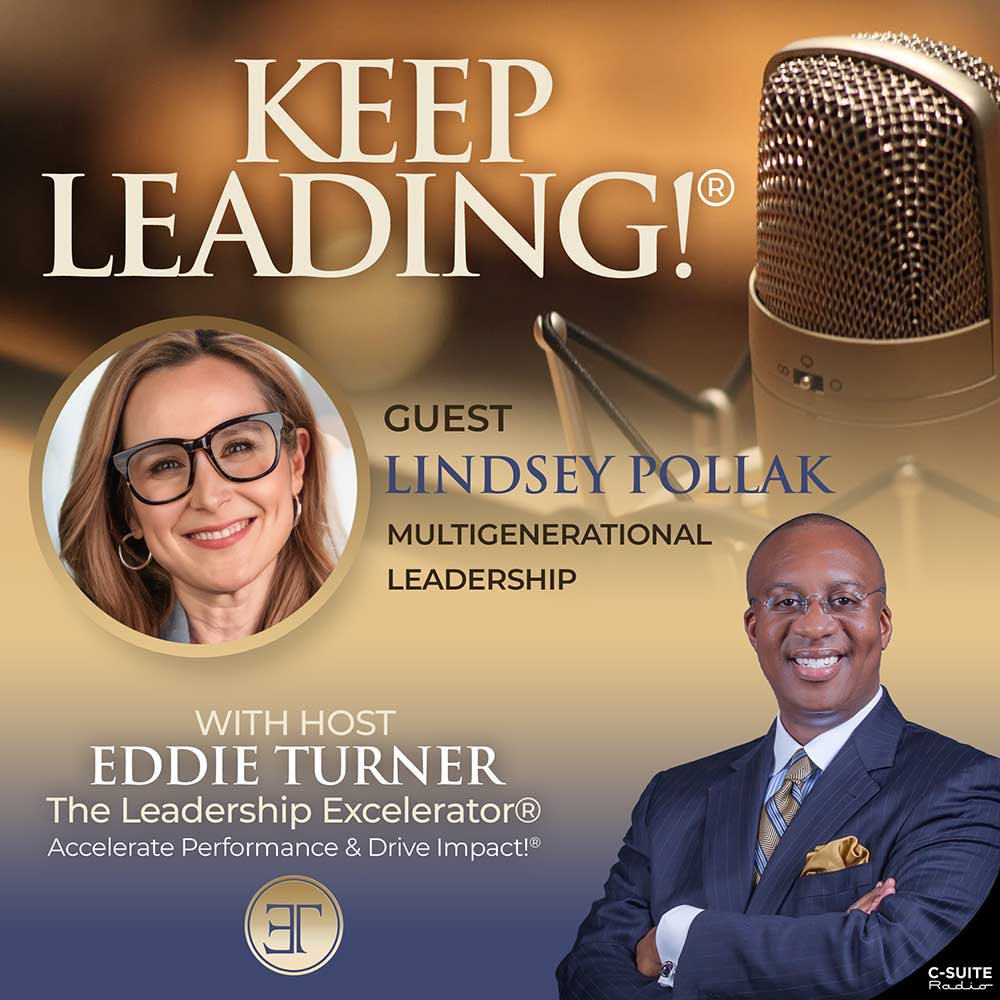
Lindsey Pollak
Multigenerational Work Expert | Visiting Fellow at NYU Stern School of Business | NYTimes Bestselling Author | Keynote Speaker | Executive Coach | Board Vice Chair at FourBlock
Multigenerational Leadership
Episode Summary
Five generations. One workplace. Endless possibilities—or potential chaos?
For the first time in history, five distinct generations are working side by side: Traditionalists, Baby Boomers, Generation X, Millennials, and Generation Z. With a 50+ year age gap between the oldest and youngest employees, workplace tensions aren’t just inevitable—they’re already here.
But what if generational diversity isn’t a problem to solve, but a competitive advantage waiting to be unlocked?
Join host Eddie Turner on the Keep Leading!® Podcast as he welcomes Lindsey Pollak, New York Times bestselling author and often described as a “generational translator.” Named to the 2020 Thinkers50 Radar List, which honors the top global management thinkers whose work is shaping the future of how organizations are managed and led, Lindsey reveals how smart leaders are turning generational differences into organizational strength.
In this essential conversation, you’ll discover: • Why traditional one-size-fits-all leadership approaches are failing in today’s multigenerational workplace • The hidden workplace preferences driving each generation—and how to honor them all • Proven strategies for transforming generational friction into collaborative innovation • How to communicate across generational lines without losing your message
As Lindsey writes in her acclaimed book “The Remix,” “we are more similar than we are different. We all value similar things like family, security, and fulfilling work.” The key is learning to speak everyone’s language.
Ready to remix your leadership approach? Don’t let generational differences divide your team—let them define your success.
Keep Leading!® Live
Keep Leading!® Video Shorts
Bio
Lindsey Pollak is a New York Times bestselling author and international speaker often described as a “generational translator.” She is the author of four career and workplace advice books, including “The Remix: How to Lead and Succeed in the Multigenerational Workplace.” Her speaking audiences and consulting clients have included more than 300 top corporations, law firms, and universities, and her insights have appeared in such media outlets as The TODAY Show, The Wall Street Journal, and CNBC. Lindsey is a graduate of Yale University and is a proud member of Generation X.
Website
http://www.lindseypollak.com
LinkedIn
https://www.linkedin.com/in/lindseypollak/
Favorite Leadership Quote
“Common sense is not so common.” – Voltaire
Subscribe, share, and review on Apple Podcasts!
https://bit.ly/4kPBcZo
Subscribe, share, and review on Spotify
https://spoti.fi/4iOFzlB
Full Episode Transcripts and Detailed Guest Information
www.KeepLeadingPodcast.com
Keep Leading LIVE (Live Recordings of the Keep Leading!® Podcast)
www.KeepLeadingLive.com
Connect with Eddie Turner
Website: https://www.eddieturnerllc.com
LinkedIn: https://www.linkedin.com/in/eddieturner
Twitter: https://twitter.com/eddieturnerjr
Facebook: https://www.facebook.com/eddieturnerllc
Instagram: https://www.instagram.com/eddieturnerjr/
YouTube: http://www.youtube.com/EddieTurnerJr
LinkedIn Business: https://www.linkedin.com/company/eddie-turner-llc
TikTok: https://www.tiktok.com/@eddieturnerllc
Bluesky: https://bsky.app/profile/eddieturner.bsky.social
Agent: https://gray-miller-agency.webflow.io/roster/eddie-turner
100 Coaches Agency: https://www.100coaches.com/coaches/profiles/eddie-turner/
About the Keep Leading!® Podcast
The Keep Leading!® podcast is for people passionate about leadership. It is dedicated to leadership development and insights. Join your host, Eddie Turner, The Leadership Excelerator®, as he speaks with accomplished leaders and people of influence across the globe about their journeys to leadership excellence. Listen as they share leadership strategies, techniques, and insights.
Share the Inspiration
Inspired by what you hear? Share the episode with your network and help spread the message of empowerment and leadership. Use the hashtag #KeepLeadingPodcast and join the community of listeners who are dedicated to continuous growth and leadership excellence.
Transcript
Eddie Turner: Hello everyone. Welcome to Keep Leading Live. Keep Leading Live is dedicated to leadership development and insights. I’m your host, Eddie Turner, the leadership accelerator. I work with leaders to accelerate performance and drive impact through the power of executive coaching, masterful facilitation, and professional keynote speeches.
If you are joining us today across YouTube, Facebook, or LinkedIn, please let us know by dropping a note in the comments. Tell us your reaction to what we’re saying. If you have a question, feel free to ask it, and if I see it, I will absolutely make sure that we get an answer for you from our expert guest.
By the way, if you’re not following my guest today, please follow her on social media. You’re going to want to learn from her not just in the short time we have in this discussion, but as you look at her body of work by following her on social media.
My guest today is a New York Times best-selling author. She is an international keynote speaker who is known as the generations translator. My guest today is the amazing Lindsey Pollak.
Now, let me tell you a little bit about my friend Lindsey. In addition to the short information I shared with you, I invited Lindsey on the show because she can explain generational differences and the impact they have on all of us in the workplace through the misunderstandings that take place. And sometimes it’s not just about the person, it’s simply because we’re talking different languages because we have these different perspectives depending on when we were born. And so therefore there’s a need for all of us to really master generational competency, and she is the expert who can help us to do that.
Lindsey, welcome to Keep Leading Live.
Lindsey Pollak: Eddie, I could not be more excited to be here. I’m such a fan and admirer of you and really excited for this discussion.
Eddie Turner: Well, thank you. I am a fan and admirer of you. And ladies and gentlemen, what I didn’t say, not only is she one of the world’s premier experts on this subject, but she’s just one of the nicest people you will ever meet. And this picture here. Do you remember this, Lindsey?
Lindsey Pollak: I do. I feel very short in that photo, but yes, with you and our dear friend Bill Carrier. Love it. Love it, love it.
Eddie Turner: Indeed. Lindsey and I are also members of Marshall Goldsmith’s esteemed 100 Coaches organization. Bill Carrier is our executive director for the organization, and we were able to be together for the third annual meeting just last summer. So, had to share that memory, Lindsey.
So, tell us, Lindsey, I invited you on also because I was working on a project for a client, and with this client, what I was working on was a leadership development workshop. And in this leadership development workshop, actually it’s a certification program. I wanted to highlight this component of leadership, understanding generational differences. And immediately you came to mind in your book, The Remix. The Remix, how to lead and succeed in the multi-generational workplace. Can you tell us what motivated you to write this book?
Lindsey Pollak: Yeah, I would love to. So, my career origin story is that I personally really struggled to get my first job out of college. I wasn’t sure what I wanted to do. I didn’t really understand the job hunting process. And so in 2007, I wrote a book called Getting from College to Career that’s since been updated a few times, but I really wanted to write the book that I wish I had had when I was starting out.
And so for the first 10 years or so of my business, I was really helping college students to get their first jobs and acclimate into the workplace. And I thought that was the gig. And then this word millennial kind of exploded into the media, and everybody started talking about the millennial generation. And I got some calls from corporations saying, can you help us understand this younger generation of college students that you seem to talk to? And so I did that for another 10 years or so.
And then I’m a Gen Xer. I had a child who’s a Gen Z. People kept getting older and the generations kept working together, and I started to realize that it wasn’t really practical or effective to just focus on one generation coming into the workplace. Really a new competency that leaders have to have is to work with all generations. And because people are working and living longer and later into their lives in a much healthier way into their 70s and 80s and beyond, I think this is a competency that everybody has to build, but it really started with my own journey to get my first job and realize I had no idea what I was doing.
Eddie Turner: And as a result, you literally because of the time this was happening for you, became one of the world’s first multi-generational experts and especially or should I say millennial experts, is it?
Lindsey Pollak: I did. When Chat GPT came out, I typed in, who is the first multi-generational ex or millennial expert? And Chat GPT called my name. So I was very, very early on the topic of millennials and multi-generational. There are a lot of great people who have been doing this work for a long time. But I think sort of calling it a competency and deciding that it’s not about managing one generation of people, it’s about being able to manage multiple generations of people. Good leaders have always done that, but I think naming it as that competency, I hope I’m one of the people out there kind of raising the flag for that.
Eddie Turner: Absolutely. And just good leadership you’re pointing out have always done that, but they’ve never had to do it across five generations. Yeah. And you talk about that in your book. And for those who don’t know what we mean when we say generations and what those generations are, can you just highlight that for us?
Lindsey Pollak: Yeah, so everybody understands the concept of generations globally for all time because we’re all members of families. So when you think about great grandparents, grandparents, parents, children, grandchildren, etc., each one is a generation. So the technical definition is when a member of a generation has their first child. So 18 years or so is usually the length of a generation.
When you bring it into a workplace context, we have these broad groups, and really it started with the baby boomers who were born between 1946 and 1964. They’re the only generation in the United States to be named a generation by the US Census Bureau. And so a lot kind of comes from that extremely large, largest we’ve ever had generation. So they kind of pre-named the group before the boomers, the silent or traditionalist generation. After that we have Gen X, then we have millennials, Generation Z, and now they’re calling the next generation Gen Alpha.
So a lot of this story begins with the massive influx of baby boomers into the workplace. If you’re from a different country, some of those terms resonate, some don’t. But millennials are really called the first global generation because of Facebook and the internet. So when you meet young people from all around the world, they do have familiarity with words like millennial and Gen Z because of social media and how that generation feels really connected online.
Eddie Turner: Very interesting. So we’ve run out of letters, so after Gen Z, we’re back to Gen A or Gen Alpha.
Lindsey Pollak: That’s exactly right.
Eddie Turner: Thank you for sharing that overview just so that we make sure everyone’s on the same page with us in what we’re describing. I have a long-held view about songs that are remade and my attitude as having been a musician in my past life is, if you’re going to touch someone’s song, it better be so good that people forget who the original author of the song was. Don’t do a bad job on it. Do a disservice. And so when I read how you define the remix, it immediately resonated with me. Please tell us about how you define it in the book, which you addressed right away early on, and how you’ve taken that and applied it to these different contexts.
Lindsey Pollak: I’m so glad because I was very nervous using a musical term because I am not a musician myself. So, when I was trying to name the book and kind of my theory of generations, it’s never about one or the other. It’s never about the baby boomer way or the Gen Z way, for example. It has to be about the mixes between the two and really taking the best of all the generations.
So, I sort of hit on remix partly because music is very generational, right? We tend to think about the songs that we grew up with and have a real affinity for them. So, when I decided to use the word remix, I talked to a lot of musicians and producers and DJs, and one DJ told me this great fact. She said, when she plays a wedding, as a DJ, and weddings are usually multi-generational family events, she said, when the dance floor is empty, I play a remix because the older people at the wedding know the classic component of the remix and they don’t say, oh, that song is old, we shouldn’t play it. They still love it. And the younger people at the wedding know the remix version that’s been modernized or changed or improved or adapted in some way, and they love the combination.
So, it’s not about either or, it’s about everybody feeling included and taking the best of both and not getting rid of the old and replacing it with the new, but finding those commonalities and those mixes and compromises.
Eddie Turner: That is absolutely beautiful. And I never noticed that, but you’re right. That is what happens when the DJs at a wedding or ceremony. Very cool trick.
And the other reason that resonates with me is when I studied under Dr. Heifetz at the Harvard Kennedy School and he talked about as a leadership practitioner when we go into an organization, how sometimes as consultants and practitioners, we may be very quick to just scrap the past of an organization and say, here’s the new way you’re going to do it. You’ll be better off this way. And he says, no, honor the old. Look at what’s the best in the about the past. They weren’t always in the situation they’re in today. At a certain point, they got in the rut, but there were some things they were doing right. Can you honor that and bring that forward while introducing these new concepts? So your ideal remix, I just was loving it, loving it, loving it.
Lindsey Pollak: Oh, I’m so glad. You know, another phrase I use which I didn’t coin, it comes from an entrepreneur named Gina Pell. It’s called being a perennial leader, and a perennial leader does exactly what you’re saying. They honor the old, they know their history, and they share it, right? Young people don’t know that necessarily, and they keep up with the times.
So, I think it was a mistake when all those companies when the millennials came in had ping pong tables and you know, all this kind of wacky stuff and got rid of the old. It was like, I think we went a little too far. It’s always about the balance between the two and I think the way you’re describing it is exactly right.
Eddie Turner: Balance. That is absolutely the key. Now, in that book where you show how to lead and succeed in this environment, it’s done well. A lot of people, even when folks and I encourage you to do this, go ahead and look at it on Amazon and you’ll see how many people have commented on this book. And if you’ve ever written a book, you’ll know how hard it is to get one review. Lindsey has hundreds on this book, ladies and gentlemen.
So, just tell us one of the most salient points that you find people commenting on when you’re out there speaking and people are writing you about your book and how it’s impacted them for those who are interested in picking this book up.
Lindsey Pollak: Thank you. You know, I think when you talk about generations, the fear is that you’re going to start stereotyping, right? And making fun of the generations, particularly older people criticizing the younger. And I am really adamantly against that. So I think the comment I get a lot is, wow, thank you for addressing this topic in a way that doesn’t start to stereotype that young people only use technology and older people always want to go face-to-face and don’t want to change their ways because it’s really not true.
And I think when you think about being a multi-generational leader and using the remix, it’s really about being clear on what it is that you want from people, never making assumptions that, for example, somebody wants the same career that you wanted at their age or that somebody in their 70s wants to retire. They might want to work another 10 years harder than they’ve ever worked before.
So, a lot of times companies will call me as a consultant or a coach and say, you know, Lindsey, why aren’t our young people coming to our ERG employee resource group meeting? And I’ll say, have you asked them, right? Have you ever asked them why not? Why aren’t older people applying to our company? Have you asked them? I think once we start just bringing these things up and not making assumptions about other generations, it sounds simple, but that really is the starting point.
Eddie Turner: Excellent. Well, thank you for sharing that. It is certainly a salient point. And we are talking about The Remix. Get your copy, ladies and gentlemen.
However, we have someone who’s tuned in and thank you. If you are like Stefano, who’s tuned in from LinkedIn, he is commenting on what Lindsey is saying. He says, whether the challenges perceived or real, clients consistently raise the issue of navigating multi-generational dynamics. I find the competency-based approach to addressing this both thought-provoking and intriguing and a wonderful topic of discussion. Thank you, Stefano. We appreciate you weighing in and sharing your feedback. Any reaction to Stefano, Lindsey?
Lindsey Pollak: Yeah, thank you so much for this comment. Competency-based approach is really interesting. I’m seeing a lot of companies that are doing skills-based assessments for both applicants to their organizations and people who are already there. So, not making an assumption that a young person is really good at AI, artificial intelligence, or an older person isn’t. They’re saying, let’s test people on it. Let’s see what people’s skill sets are and let them use those to their advantage. So, I think that’s a really good way to level the playing field and not let our stereotypes get in the way.
That said, I like that you said that these challenges are perceived or real. A lot of generational differences are very real, right? Some of them have to do with technology, some of them have to do with expectations, what technology you expect to have on your desk, how diverse you expect your workforce to be. Those things do change over time. So, I think a competency-based approach is a really interesting answer to how to make sure that we don’t bias ourselves against different generations. Thank you for the comment.
Eddie Turner: Thank you for that reaction. And Stefano, again, thank you for listening and joining us live and thank you for sharing your reaction. We appreciate that. We also have Terry. Terry says, amen.
Lindsey Pollak: Thank you, Terry.
Eddie Turner: So Terry, we appreciate you joining us as well. We also appreciate you sharing your reaction. And finally, we have a LinkedIn user who we don’t your name didn’t come through for us. Says, love this. Level the playing field by testing skill sets. So thank you all for listening to our conversation live and sharing your reaction.
So far it’s the LinkedIn audience, but if you’re joined through YouTube or Facebook, we welcome you to do as Stefano and Terry and this listener have done and share how you’re feeling. We appreciate that.
I’m going to pause for a moment to share a word from the sponsor of the Keep Leading podcast. The sponsor of the Keep Leading podcast is Papion MDC. If a single employee’s indecision can cost an organization $10,000 to a million dollars, then imagine the potential financial impact when more individuals are added to this indecision equation. It can spiral out of control quickly. Decision X is a bespoke on-demand service designed to help your leaders overcome indecision and move forward in their work. Visit Papion MDC and discover how you can help your team get unstuck, shift perspective, and advance today. Thank you to the team there at Papion MDC for your support. I appreciate it.
And now as I transition back, we have some other folks who’ve joined us from LinkedIn. Ezra, thank you for listening and we appreciate you giving us a reaction via emoji. We have folks that are tuned in from around the world. I believe she’s coming to us from the Middle East. I just met her online this week. That’s how I know that. And I just can’t remember which country, but thank you, Ezra. We appreciate that. As well as Victor. Victor says, thanks, this is awesome. And she says, thank you. Yes, indeed. We appreciate you. And Adrian Porter, he says, great conversation. Lindsey is without question an amazing multi-generational expert and kudos on the number one bestseller for the third edition of Getting from College to Career.
We certainly appreciate that as well, Adrian, and definitely that one of the things we want to talk about. So thanks for teeing that off. And finally, Ezra is reminding me that she’s from Istanbul. Thank you. She’s so all the way from Istanbul. Thank you.
So yes, on September the 10th, I invited you to talk about one book, but on September the 10th, what happened, Lindsey?
Lindsey Pollak: Oops, I have another one. And I just want to shout out Adrian Porter who does fantastic work on Generation X and is a friend. So Adrian, thank you for joining us.
Eddie Turner: Oh, thank you for correcting my pronunciation as well.
Lindsey Pollak: Oh no, Adrian. No, perfect. You did great.
So yeah, Getting from College Career was the book I wrote back in 2007 and we did a second edition in 2012. And as I started to look at the book and speak to college students, I realized so much has changed, especially since 2012. And so we put together a third edition of the book that came out as you said on September 10th and it is specifically for Gen Z college students and recent grads about what has changed in the job market and also what hasn’t, right? To your point, there’s some things that are still classic strategies like networking and mentoring and being prepared for interviews. And then there’s a lot that has changed when it comes to using AI tools for your job hunt, the difference of how challenging it can be now with so many more jobs listed and global applicants and really advice for this generation specifically.
Eddie Turner: Well, you’ve done so well and attracted so much attention and quite a following that it’s already become an Amazon bestseller and I’m sure in a couple of days we’ll be hearing about it being on the Wall Street Journal and New York Times bestseller list as well also.
Well, you hit on something that’s a big deal. I was with an organization this week and that is literally what 90% of the conversation was about, two letters, AI. And you reveal in the book some of the best tools to use, AI tools to use in your career search and when it comes to interviewing. Obviously, we don’t have time to go through them all, but I’d love to hear what your favorite is.
Lindsey Pollak: Yeah, so I have a favorite tip for leaders and a favorite tip for employees and job seekers. Favorite tip for leaders is I saw a stat that something like 84% of leaders say that AI is critical to the future of their organization, but only 40 something percent have actually given their employees any guidelines on how to use it. So if you haven’t talked to your team about whether they’re allowed to use Chat GPT to compose an email to your clients, talk to them about it. So don’t be afraid of it, have the conversation. If you haven’t tried any of this yet, go to Chat GPT, talk to Siri, whatever it is that feels comfortable for you. I think the fear of it can get in people’s way.
And the best advice for employees or for job hunters is my friend Jeremy Shiffling said the best thing about AI, which is something like Chat GPT or any generative AI tool, is it’s a blank piece of paper problem. So what it does is if you can’t think of how to start a cover letter, if you’re not sure how to start your resume, just put in a prompt that says, I’m applying for a job to be a personal assistant to Eddie Turner, how should I start? And it will give you something to work with and then you add your human element to that.
So number one, don’t be afraid of it. Number two, if you’re a boss, give guidance about when and how to use it. And number three, if you’re really struggling to just get started, Chat GPT or AI can be a really strong tool for you.
Eddie Turner: What an excellent tip. Thank you for sharing that, Lindsey. Now, I will have to add to that just a tad if I might. I had the wonderful privilege of speaking to the great folks at Microsoft this week. And so I must say that on the Microsoft side, we’d ask you to look at Copilot. So fantastic. I love it. What wonderful, wonderful advice.
You also tackle the idea that when you are trying to get over career disappointments, challenges in your career, that you number one, you let people know it’s going to happen. It’s not always going to be rosy, but then when it does happen, how to deal with it. Can you talk about how to successfully deal with it?
Lindsey Pollak: Yeah, it’s so interesting. I spent so much time writing the book focusing on, you know, resume tips. And what people say most resonates with them is what you’re talking about, the mindset piece. And the mindset piece is you’re not going to get every job you apply for. Plan for that. Have a lot of irons in the fire, apply for a lot of stuff.
Number two, the biggest mistake I made in my career was sitting and thinking too much and not just trying stuff, right? So you can take all the assessments in the world, you can plan and write in your journal, but until you start applying for jobs and seeing where you get traction, you’re really not going to know. So don’t sort of artificially get in your own way.
And the third is I think a lot of people really do this alone and sit in their room, you know, stewing and freaking out. You have so many people who love you and care about you. Career centers on college campuses are so active. There are a billion pieces of advice on the internet. I write a lot of them. Eddie, you write a lot of them. Talk to friends, talk to family. You are not the first person to need a job and look for a job. We have all been there and there’s just an enormous amount of wisdom and support, but you do have to reach out and ask people for help. And I think sometimes when you can overcome that fear, you really are able to get a lot of support and a lot of help and most jobs come from people you know anyway, so the bonus is it might even lead to an actual opportunity.
Eddie Turner: So very true. Thank you, Lindsey. And we have another person who’s joined us from LinkedIn who liked the way in our conversation. LinkedIn unfortunately didn’t pass over the ID and the name, but they said, so glad to hear from you again. I was at the Liberty intern summit this summer and it’s great to gain more insight from you. Clearly you have another fan, Lindsey.
Lindsey Pollak: Thank you. That’s so kind. I did get to speak to Liberty Mutual interns this summer and I love speaking to interns. I’m actually jealous of them, Eddie, because starting your career, you have so many opportunities to build just an incredible foundation and introduce yourself and make a good impression and so I’m really glad that this user is following along. Thank you so much.
Eddie Turner: Yes, indeed. Very glad to have this person contribute to our conversation and letting us know that not only did you hear from Lindsey once, but you were so moved by her when you saw her online, you decided to join our conversation live today. So appreciate that.
Lindsey Pollak: Yeah, you know what Eddie? Yeah, and you’re probably a Gen Z, so I love that.
Eddie Turner: Well, phenomenal. That is so, so very good. You, as we said, you have just an amazing body of work out here that is really making an impact and helping people to keep leading. These two books, The Remix and Getting from College to Career, the third edition are available anywhere books are sold.
What’s the biggest takeaway because you have so many morsels in your your latest release. Outside of what you’ve already shared, is there another big takeaway that you’re hearing from people that’s resonated with them about your new book that you’d like to share with us, Lindsey?
Lindsey Pollak: You’ve got to build a network that’s multi-generational. In this world, when you’re young, you need connections who are older, when you’re older, you need connections who are younger. In a multi-generational work environment, you can’t spend all your time with people who are at your peer level. The real magic happens when you know people of all different ages. So really be conscious about building a network that has people from all generations in it. That’s my top tip for every leader at every level.
Eddie Turner: That’s wonderful advice. For a variety of reasons. Not just even from a technological perspective, the change that can happen, but you know, just the wisdom that gets passed on. You know, and so I really appreciate you sharing that morsel from your from your book and what people are telling you.
On the Keep Leading podcast, oh and I should probably say before I ask you for your favorite quote, is the what would be the biggest takeaway you want people to leave this conversation with, Lindsey, as they’re talking about what they heard today?
Lindsey Pollak: Probably the biggest takeaway, a lot of people talk about generational differences as this challenge to overcome. I want you to see it as an opportunity to thrive. That when you know people of different generations, when you can communicate with people of different generations, that is a magic item to have in your toolkit. So rather than being frustrated with different generations or irritated by different generations, try and see it as this amazing opportunity for diverse perspectives and knowledge to pass along. And sometimes it’s harder for those of us on the older end than it is for those on the younger end. So just a note for all of us. But really think about generational diversity as the greatest opportunity we have for success.
Eddie Turner: Indeed. And on the Keep Leading podcast, I always love to ask people what’s the greatest quote that you use or greatest piece of advice that you use that helps you to keep leading?
Lindsey Pollak: Leap and the net will appear. Take those risks and you will be rewarded for taking action.
Eddie Turner: Ooh, I haven’t heard that one. Leap and the net.
Lindsey Pollak: You can Google who said it. I think it’s one of those classics, but leap and the net will appear.
Eddie Turner: I like that. I like that. I may be using that in a coaching session or speech in in the days and weeks ahead.
Lindsey Pollak: Oh, that’s good. I Google who said it? I don’t know. Maybe one of our listeners will know. Let’s see.
Eddie Turner: Well, finally, one of our listeners does want to weigh in. MK Martinson, she says, top tip indeed, Lindsey. It’s such a missed opportunity for everyone in the workforce if they’re not building diversity in their network. We can all learn from each other and we can all teach someone else a valuable lesson. Cheers. Any reaction to MK?
Lindsey Pollak: Oh, I think this is so fantastic. Diversity, you know, generational diversity is an element of diversity and I think sometimes we all kind of live in our silos. So the more we diversify our networks and the perspectives that we’re getting, the more successful we’re going to be. Thank you, MK. I appreciate it.
Eddie Turner: Yes, MK. We appreciate you and we appreciate everyone who has taken time not only to join us, but then also make your voices heard so that you have enriched our conversation even more.
Well, ladies and gentlemen, if you want to continue to find out more about Lindsey and her work, I’d encourage you to follow her online, but also to visit her website, LindseyPollak.com, l i n d s e y p o l l a k.com. You’ll see it scrolling at the bottom of the screen. This is what her stunning website looks like. It’s one of the best websites I’ve seen quite frankly. Any last words, Lindsey?
Lindsey Pollak: Eddie, you are such a friend and such a leader. I admire you. I’m delighted that I was a guest on your podcast and thank you to everybody who tuned in. I look forward to being in touch.
Eddie Turner: Well, thank you, Lindsey. You are just an amazing human being and so glad we were able to finally connect. And thank you all for listening and being with us. That concludes this episode of the Keep Leading podcast. I’m Eddie Turner, the leadership accelerator, reminding you that leadership is not about our position or our title. Leadership is action. It’s an activity. It’s not a garment that we put on and take off. We must be a leader at our core and allow it to emanate from all that we do. So whatever you’re doing, always keep leading.