
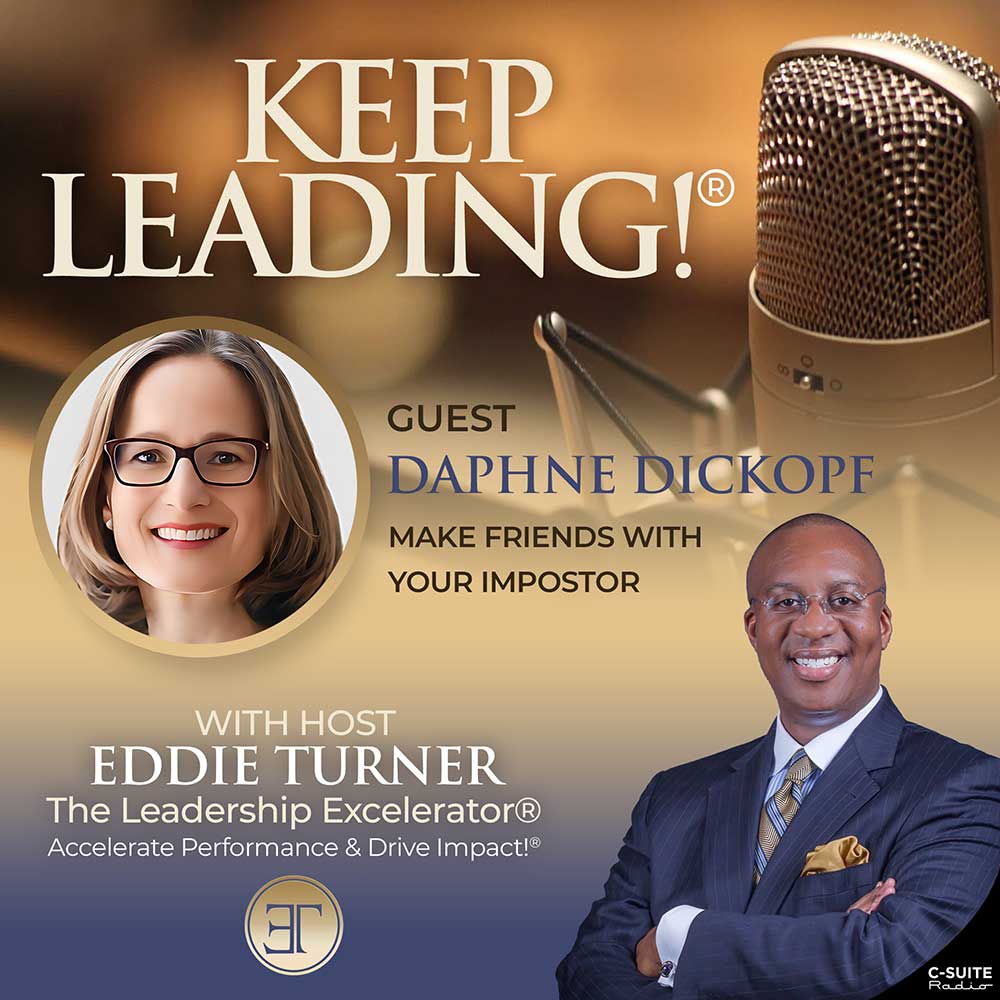
Daphne Dickopf
The Confidence Builder • Author of Make Friends With Your Impostor! • ICF PCC Certified Executive Coach
Make Friends with Your Impostor
Episode Summary
Listen to our live episode of the Keep Leading!® Podcast, hosted by Eddie Turner, as he welcomes Daphne Dickopf for an inspiring conversation explaining how to “Make Friends with Your Impostor.” This isn’t just another conversation—it’s your exclusive invitation to gain insights and strategies.
✅ Break through self-doubt
✅ Reframe your inner critic
✅ Harness impostor feelings as fuel for growth
Discover practical strategies to unleash your hidden potential and transform the inner critic into an inner ally. Don’t miss this empowering session! Tune in and learn how to Keep Leading!® with confidence!
Keep Leading!® Live
Bio
Daphne Dickopf is an ICF-certified executive coach, facilitator, and trainer, as well as the founder of a consulting, coaching, and training company that specializes in individual, team, and organizational development. With over 25 years of experience in leadership development, she has worked with clients worldwide to unlock their leadership potential, improve team performance, and encourage personal growth.
Daphne’s background in international management consulting, along with her own leadership experience, shapes her belief in each individual’s innate ability to find solutions and carve their own path. She holds a bachelor’s degree in International Marketing from Regent’s Business School in London and a dual MBA from ESSEC Business School in Paris and Mannheim Business School in Germany.
Website
https://www.daphnedickopf.com
Other Website
https://www.change-matters.com
LinkedIn
https://www.linkedin.com/in/daphne-dickopf/
Subscribe, share, and review on Apple Podcasts!
https://bit.ly/4kPBcZo
Subscribe, share, and review on Spotify
https://spoti.fi/4iOFzlB
Full Episode Transcripts and Detailed Guest Information
www.KeepLeadingPodcast.com
Keep Leading LIVE (Live Recordings of the Keep Leading!® Podcast)
www.KeepLeadingLive.com
Connect with Eddie Turner
Website: https://www.eddieturnerllc.com
LinkedIn: https://www.linkedin.com/in/eddieturner
About the Keep Leading!® Podcast
The Keep Leading!® podcast is for people passionate about leadership. It is dedicated to leadership development and insights. Join your host, Eddie Turner, The Leadership Excelerator®, as he speaks with accomplished leaders and people of influence across the globe about their journeys to leadership excellence. Listen as they share leadership strategies, techniques, and insights.
Share the Inspiration
Inspired by what you hear? Share the episode with your network and help spread the message of empowerment and leadership. Use the hashtag #KeepLeadingPodcast and join the community of listeners who are dedicated to continuous growth and leadership excellence.
Transcript
Eddie
Hello everyone. Welcome to this edition of the Keep Leading podcast. The Keep Leading podcast is dedicated to leadership development and insights. I’m your host, Eddie Turner, the leadership accelerator. I work with leaders to accelerate performance and drive impact through the power of executive coaching, masterful facilitation, and professional keynote speeches. We’re broadcasting on LinkedIn, Facebook, and YouTube. And we are just incredibly excited to talk about the topic we’re going to talk about today. I am with Daphne Dickopf. Daphne is a phenomenal executive coach and she’s added a new title to her repertoire and that is author. She’s the author of Make Friends with Your Imposter. And so I’ve invited her to be my guest today on the Keep Leading podcast so that we can all learn how to keep leading by making friends with our imposter. Daphne, welcome to the Keep Leading podcast.
Daphne
Thank you, Eddie. Thanks for having me. So excited.
Eddie
Well, I am excited to have you here. It’s been a little while since we’ve been together in person. Tell my listeners a little bit about your background.
Daphne
Yeah, absolutely. So I’ve been in the space of leadership development and organizational transformations for about 25 years or so. I first started out as a management consultant in strategic consulting and then went on to becoming a coach, trainer, and a leadership and executive coach. That’s what I’m doing now. I have my own company. And I coach and consult leaders worldwide, organizations worldwide. I usually am between Europe and the US. I live in the US, but my second home basically still is in Europe. So that’s always exciting to see also the cultural differences between companies and leaders.
Eddie
Well, you certainly have a well-rounded perspective and a first-hand one at that, right?
Daphne
Yeah, yeah, I think so.
Eddie
Excellent. And you bring that to your clients. And along the way, you were motivated to write this book about imposters. Tell us about that.
Daphne
Well, Eddie, first of all, I grew up in Switzerland, but then I left when I was about 14, so in the teenage years, forming years as you may say. And I always felt like I’m not fitting in, right? So wherever I was going, I didn’t fit in. And I then thought like, I’m just the odd one out. And I felt like an imposter. I was trying to fit in, was it the language or the accent or about cultural context I didn’t know. And very late in my career, I got to say, I realized, hey, this is actually a thing that happens to other people as well. It’s not just me. And when I started working together with more leaders also on personal development, I realized it’s happening all the time. It’s coming up in almost all my coachings. And while I was working on it myself for a long time, I realized I got to help people to work with their imposters and, you know, level it up for what it is and where they can be. And I don’t like repeating myself over and over again and I don’t feel like I want to be a teacher of this. So I thought, if I wrote a book, I could just give people a chapter of it and I didn’t have to repeat myself and they didn’t have to listen to me all the time.
Eddie
And now they can read your wisdom. That’s excellent.
Daphne
I don’t know about wisdom, but yes.
Eddie
A lot of people, now when you—well let’s say this. A lot of people have heard this phrase, but for those who may not have heard it before, can you define what we are talking about when we say the imposter syndrome?
Daphne
Yeah. Oh, that’s so important. Thanks, Eddie. Yes, it’s usually has three elements really. People who don’t feel like they’re enough, people who feel like they’re just about to be found out that they’re an imposter, a fraud, that they actually don’t belong where they are. And people who think they have to go get more, do more, be more and it’s never enough. And this is sort of a feeling you have within yourself all the time.
Eddie
Mhm. And where does those feelings come from?
Daphne
There’s some research suggesting it comes from our childhood. How you know, whether we’ve been always said, yeah, you’re not good enough or whether we’ve always said, oh, we expect more from you. Both both areas actually. So as a parent, if you’re listening as a parent, you have to do it wrong anyway. But to be honest with you, all my research and all my coaching sessions, I’m realizing it’s almost everybody. I think there’s only a very few talented, gifted and special individuals who are just so happy with themselves, so well-rounded that they don’t feel that or then they’re narcissist or psychopaths. They also don’t have it. But everybody else pretty much feels like an imposter at part of their lives or sometimes in their lives.
Eddie
So, it’s interesting to hear you say that. You’re saying almost everyone, unless they’re a narcissist, has these feelings of being an imposter.
Daphne
Yeah. And not just narcissist really. I know luckily I have a whole bunch of people around me, friends and family members who don’t feel like that. So I could always test it with them. Is it just me? Do you feel this as well? Is this like global or how does it relate to others? But it is pretty much and it depends, right? So whether you have it on a daily basis, whether it just comes up when you’re doing really difficult things. And so I think that’s where most of us have it. When you’re attempting something new, something slightly scary for the first time, that’s when we feel, do I really have it? I think other people are doing it better. Me writing a book, right? I mean, there’s authors out there who’ve written about this. So who am I to write this book? That’s when it comes up. And then when you calm yourself down again and realize, hey, you have something to offer. You are unique and you can do the hard things. That’s when you’re growing from it and that’s where the beauty lies in it.
Eddie
All right. Well, walk us through what making friends with your imposter looks like.
Daphne
So, basically, making friends with your imposter is about accepting it. Right? The first step is you’re realizing you sometimes have those feelings and you’re okay with it and you know you’re not alone and you don’t have to sit in the corner and wait until it’s over, right? But you can actually proactively do something about it. That’s pretty much what it is. And then there’s several strategies how to do that. But yeah.
Eddie
Please share one strategy how I can make friends with my imposter.
Daphne
Yeah, so basically let’s start at the very beginning. When you’ve accepted it that you’ve got it, then it’s very important to notice in your body and in your reactions when it’s happening, right? So imagine you’re just about to start a podcast, maybe with a new platform you never worked on and you’re like, oh, this might go wrong. I’m not really sure how to do this. Am I really good enough? Should I have asked somebody else who is more experienced than me to do this? Usually what we can—we can feel it somewhere in our body. Or definitely we have these negative thought patterns that come in. And when we realize that that happens often, we can start to recognize it and maybe pause just for a second. Ideally you can go really deep into all right, turning your mind around, but that comes later. First step really is, oh, I’m noticing this. All right. Is it going to derail? Is it going to take over? Is it going to go in a what I call “imposter hijack” or will I be able to steer how this is going to go?
Eddie
Well, what’s the difference between these feelings of being an imposter, a fraud that you’ve described there and a what some might call healthy sense of self-doubt or humility?
Daphne
Yeah. I think it’s—the difference might be very slim or gradual and depending where you are at, not so significant. The underlying factor is when you have a doubt like I can’t do it, but okay, but I can do it and it’s over too quickly and it doesn’t feel like it’s going to destroy you, then it’s maybe not imposter. But when you really feel—I feel it in my body, there’s fear coming up, heart racing, maybe sweaty palms, you know, everything that comes with stress and anxiety in the moment that you’re feeling it, then it’s pretty sure that you have what we’re calling “imposter feeling”. And by the way, that’s why I’m not calling it imposter syndrome as well because it’s not a medical diagnosis. It’s just something as I said, almost everybody’s going through and it’s nothing, not a condition that we cannot get away with or that we cannot deal with.
Eddie
Excellent. So we want to focus on the word choice there you’re saying and that when we talk about a syndrome then that’s medical and more clinical and by talking about imposter feelings, that takes it out of that realm.
Daphne
Yeah, or experience or emotions or voices that you hear. There’s a variety of things that you can call it as well. But let’s not call it a syndrome because it’s not.
Eddie
Okay. Well, you are focused on the idea that many people have these feelings of the imposter. Is there one group that’s affected more than another since you said so many are impacted by it?
Daphne
You know, there’s a lot of research done on psychology students, I guess, medical students because they’re an easy target I want to say to question. So we can see that those populations have it a lot. There is some research seeing if minority groups have it stronger and I recently had a conversation with a colleague of mine who said, you know, in my culture, it’s just not accepted to—you have no choice. It’s maybe some kind of a—well, are you privileged that you can actually even think about self-doubts? You know, we have back in the days she said, we just had to work. We couldn’t think whether we’re good enough about it or not. And so yes. There is also the question about, is it more women? So at the very beginning when the research was done, there were women in the focus, right? So Dr. Pauline Rose Clance who did the first—who coined the term “imposter phenomenon”, she thought it was just women because she had been working with highly successful academic women and she saw a lot of these same traits that she’s now that we’re now calling imposter phenomenon or syndrome. But later on, there’s been a lot of research. You know, it’s actually everyone. I would say when I talk with leaders, no matter what sexual preference, orientation, skin color, hair length, I can hear it every time, right? As I said, there’s these few exceptions who don’t have it, but other than that, you can see it in any shape, form or color.
Eddie
All right. Well, thank you for giving us that research and that perspective of what that looks like because that can be something that people worry about: Am I more predisposed to it because of my gender or my background or profession even? So it’s very, very nice to have that clarity.
Daphne
Even profession.
Eddie
In your book, you give several examples and you provide models from other great authors who’ve really laid this out. Is there a nice framework of your own that you’d like to share with us at this time?
Daphne
Yes, so thank you, Eddie. So I came up after all the research I’ve done on other frameworks and also the work that I’ve done with the leaders that I work with on a daily basis. A really straightforward—I call it the imposter strategy framework and what it is, it’s—I love matrices. So it’s a matrix. It has four quadrants and it distinguishes between whether something is short-term or long-term in terms of the effect and whether something is internal or external, right? So within myself or do I do it with others? And so I call these—I have four names for these four quadrants. So the first quadrant I call “first aid.” It’s got to do with quick things. It’s just for me. I realize the imposter is coming up, some feelings are here. What can I do to mitigate or to turn myself around, right? Something like tracking my compliments that I’ve gotten before and looking at them, doing a mindfulness moment or do something physical like do a few push-ups or when you’re in the middle of a meeting and it’s getting rough, saying “Can we do a bio break?” Things like that.
Eddie
So you’re jumping in the middle meeting, jumping dropping down doing push-ups?
Daphne
Yeah, right?
Eddie
You’re tough. You’re tough. You’re making me feel a little bit sorry for myself right now. I got to change my afternoon activities.
Daphne
Not that I can do many push-ups, but that’s just between you and me.
Eddie
No, the fact you’re doing any, that’s impressive.
Daphne
So that’s that whole quick remedy, that’s first aid. You can do it. It’s quick, it’s subtle. People might not notice it. It can do with breathing techniques, things like that. But then more long-term, you really want to cultivate your resilience, right? You want to build up that resilience that when those imposter feelings come, they don’t really shake you anymore. And those are things like you look at failures, you look at small wins. It’s all about tracking them and making the best of it. Learn from your failures. It’s also about just looking at the challenges and challenge yourself to go for the challenge, right? Can I do that? Is it too too hard for me? just slightly too hard. All right, I will do it. And things like that. Really important to just build up that resilience. Go with gratitude, maybe look at the inner team. So there’s many, many tools that you can use there, but it’s all about making sure you’re strong when it hits you next time that you’re not expecting it. Now then let’s look at the other side of the matrix where we’re looking a bit more on external things that we can do as well. So, I mean, sorry, long-term things and for example—the long-term and sort of external, but you have to internalize it, that’s why I just jumped over my words—is the whole vision aspect. So once you have a vision set up for yourself, you know where you’re going, you have goals, you’re aligning every step, those challenges don’t feel so hard anymore. You have a purpose. You know where you’re going and you can set up each and every imposter moment to get more challenge and to really get one step further on your vision. Be it with, you know, like if you have a vision board, you can then say, “Okay, I’ve done this.” If you’re tracking your goals, however you’re tracking this. And it’s all about what are my expectations and what am I doing? Do I have to be winning it this first time? Can I maybe learn from my experiences? If you look at this as a lifelong learning exercise, you’re always going to learn something and you’re going to grow and you’re eventually going closer and closer to your vision, but you have to have that. If you’re just doing it day by day, you don’t know if you’re going to achieve it. And then last but not least, the external support system. So who are your people? Who has got your back when you’re feeling down? Who are mentors or role models you want to look up or connect with? Maybe external support system could also be a psychiatrist, psychologist, a coach, a mentor, a guide, you name it, a teacher if you’re looking at kids because believe it or not, kids these days deal with a lot of imposter feelings. So those four quadrants: first aid, resilience, vision, and support system—when you have it all in and set up, I think you’re really good to go and imposter feelings are just like a little nudge to work on yourself and nothing more.
Eddie
Thank you. What’s been your relationship with imposter feelings?
Daphne
Yeah. As far as I can remember, I’ve always felt out of place, always felt like I’m not good enough, I’m not smart enough, I’m not articulate enough. And so I’ve been working on it myself and I realized two things. One of it is when you believe in yourself and you know you got the tools to work on yourself, it’s easier and also if you’re in this in a surrounding that appreciates what you’re doing. If you’re in the right setting, then it’s also easier to see, hey, I’m actually doing great work and people do get something from me and I’m not a total loser and I’m not a total fraud. So the setting and the self-belief is really important.
Eddie
Thank you. And if someone is listening to us or watching this broadcast and they’re thinking, “I’m not good enough for this job, this relationship, or for this level of success,” what advice would you like for them to hear from you right now?
Daphne
Yeah. I mean, once you open up about this and confide in someone, you’ll realize you’re not alone. And the more people you ask about these kind of feelings, the more often you’ll hear, “Oh, yeah, totally been there. I’ve done that.” And then it’s more a journey together. So find a few people who you can really trust, confide in them and get them to push you. Get them to be your coaches, your sponsors, your fan crew, right? And then you will see it’s easier when you’re not alone and you’re not alone in this.
Eddie
Yes, apparently especially based on the numbers that you’ve shared. Knowing that you’re not alone is often a nice source of motivation for people to get past those stubborn, persistent feelings.
Daphne
Yeah. Yeah, for sure.
Eddie
Very nice. What’s the most important message you want to make sure that people take away from our conversation today?
Daphne
Yeah. You know, feeling like a fraud is not an excuse. It’s just a nudge for you to work on yourself and go embrace that and see what you can do with it because there’s so much good stuff out here, so we don’t need to be buried down and think we’re the only odd one out. We’re just one of many, many, many people who feel the same way.
Eddie
Great. Thank you. And you know, I always ask on the Keep Leading Podcast, what’s your favorite quote or favorite piece of leadership wisdom that you’ve heard that you use that helps you to keep leading?
Daphne
Yeah. It’s, “Luck comes to those who are prepared.”
Eddie
All right. Excellent. Thank you. And where can people learn more about you?
Daphne
Yeah, my website, www.daphnedickoff.com.
Eddie
Excellent. And for those who are listening to this on C-Suite Radio or wherever you download your podcast, Daphne is spelled D A P H N E D I C K O F F, daphnedickoff.com. Well, we look forward to reading your book. Thank you for the advanced copy you gave me and seeing the success that you have as you continue to impact people around the world so that they can keep leading.
Daphne
Thank you, Eddie. I appreciate it.
Eddie
And thank you for listening. That concludes this episode, everyone. I’m Eddie Turner, the leadership accelerator, reminding you that leadership is not about our title or our position. Leadership is action. Leadership is an activity. It’s not a garment that we simply put on or take off. It must emanate from our core and be seen in everything that we do. So no matter what you’re doing, always keep leading.