
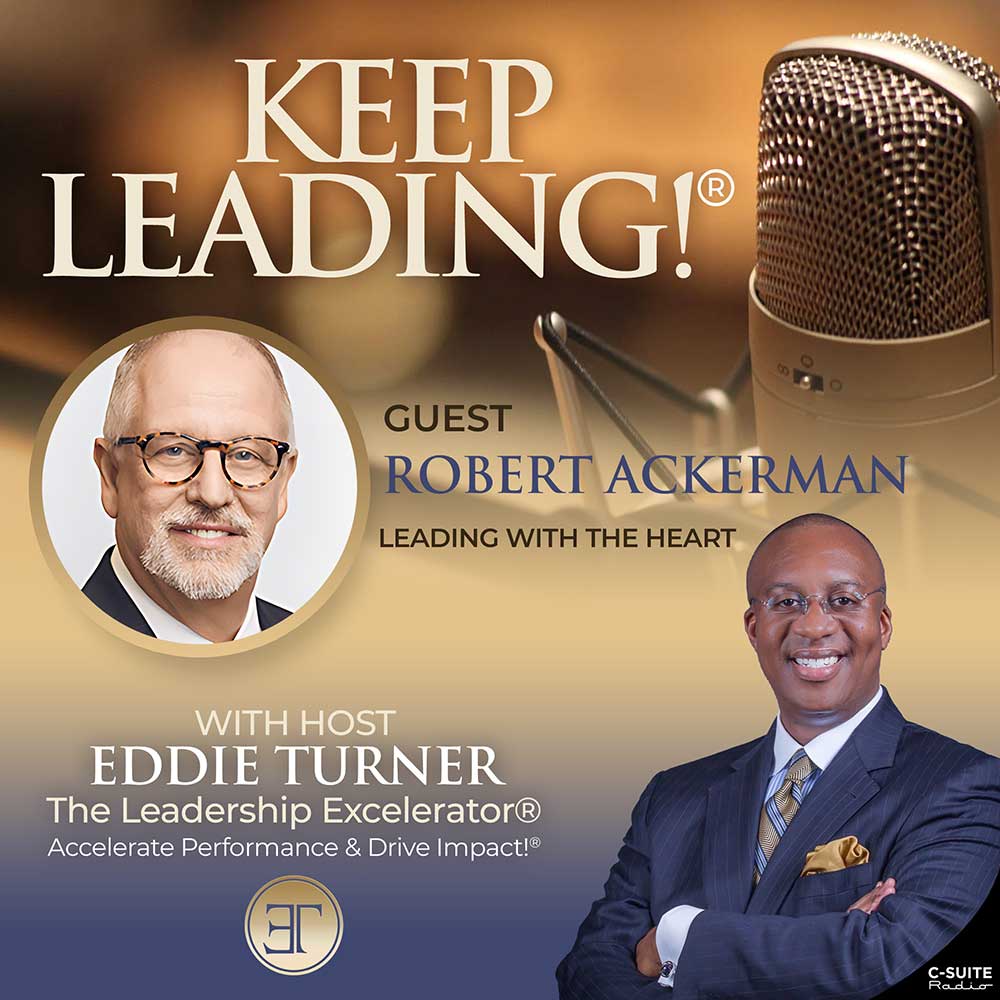
Robert Ackerman
Executive Vice President, Crown Castle (RETIRED)
Leading With the Heart
Episode Summary
In this Keep Leading!® podcast episode titled “Leading with the Heart,” I interview Robert Ackerman, the retired Executive Vice President and COO of Crown Castle, about the importance of leaders demonstrating trust and compassion.
Keep Leading!® Live
60 Second Videos
About Robert Ackerman
With over fifty years of experience spanning government and corporate sectors, Robert Ackerman brings a wealth of knowledge and expertise to any discussion on leadership and organizational growth. Robert’s career began with a notable tenure as Deputy Commissioner at the New York State Division of Housing and Community Renewal. In 1998, he transitioned to the private sector, joining Crown Castle, a then-nascent wireless infrastructure start-up and now a multi-billion-dollar wireless infrastructure company. His contributions were instrumental in Crown Castle’s evolution into the largest shared wireless infrastructure company in the United States. His roles at Crown Castle, including Executive Vice President and Chief Operating Officer, exemplify his ability to manage complex operational groups and drive organizational success.
Beyond his executive roles, Bob has shared his wealth of knowledge as a guest lecturer on leadership and career development for various organizations. Additionally, he co-authored “Leading with the Heart: Building successful teams with trust and compassion,” reflecting his philosophy of leadership rooted in trust and empathy. His dynamic leadership, extensive experience, and global perspective make him a compelling voice in discussions about organizational growth, leadership strategies, and career development. Listeners will gain valuable insights from his journey and the impactful lessons learned over his distinguished career.
Website
https://www.bob3ackerman.com/about-the-book/
LinkedIn
https://www.linkedin.com/in/robert-ackerman-b203178/
Facebook
https://www.facebook.com/robert.ackerman.353
Robert Ackerman’s Book
https://bit.ly/40R1zoe
Leadership Quote
“We rise by lifting others.” Robert Ingersoll
Subscribe, share, and review on Apple Podcasts!
https://bit.ly/4kPBcZo
Subscribe, share, and review on Spotify
https://spoti.fi/4iOFzlB
Full Episode Transcripts and Detailed Guest Information
www.KeepLeadingPodcast.com
Keep Leading LIVE (Live Recordings of the Keep Leading!® Podcast)
www.KeepLeadingLive.com
Connect with Eddie Turner
Website: https://www.eddieturnerllc.com
LinkedIn: https://www.linkedin.com/in/eddieturner
Twitter: https://twitter.com/eddieturnerjr
Facebook: https://www.facebook.com/eddieturnerllc
Instagram: https://www.instagram.com/eddieturnerjr/
YouTube: http://www.youtube.com/EddieTurnerJr
LinkedIn Business: https://www.linkedin.com/company/eddie-turner-llc
TikTok: https://www.tiktok.com/@eddieturnerllc
Bluesky: https://bsky.app/profile/eddieturner.bsky.social
Agent: https://gray-miller-agency.webflow.io/roster/eddie-turner
100 Coaches Agency: https://www.100coaches.com/coaches/profiles/eddie-turner/
About the Keep Leading!® Podcast
The Keep Leading!® podcast is for people passionate about leadership. It is dedicated to leadership development and insights. Join your host, Eddie Turner, The Leadership Excelerator®, as he speaks with accomplished leaders and people of influence across the globe about their journeys to leadership excellence. Listen as they share leadership strategies, techniques, and insights.
Share the Inspiration
Inspired by what you hear? Share the episode with your network and help spread the message of empowerment and leadership. Use the hashtag #KeepLeadingPodcast and join the community of listeners who are dedicated to continuous growth and leadership excellence.
Transcript
Eddie Turner:
Hello everyone. Welcome to Keep Leading Live. Keep Leading Live is dedicated to leadership development and insights. I’m your host, Eddie Turner, the Leadership Accelerator. I work with leaders to accelerate performance and drive impact through the power of executive coaching, masterful facilitation, and professional speeches.
We’re broadcasting today live on LinkedIn, Facebook, and YouTube. If you’re joining us on one of these platforms, let us know. You can do so by emoticons, you can do so by typing into the chat and letting us know your reaction to what you’re hearing. You can ask us a question. We’ll give you an answer. Hit that share button so that your friends can join us or see the replay that’s available instantly when we’re done. I’m going to invite you to follow myself, but also follow my guest on LinkedIn if you’re not doing so already.
Today, we’re going to talk about leading with the heart. To do that, I’m going to interview the executive vice president and chief operating officer of Crown Castle, who’s now retired. He’s going to explain why leaders must show trust and compassion as they lead.
Now, why Robert Ackerman? He has over 50 years of experience spanning government and corporations. He brings a wealth of knowledge and expertise to any discussion on leadership and organizational growth as a result. His career began with a notable 10 years as the deputy commissioner at the New York State Division of Housing and Community Renewal. In 1998, he transitioned to the private sector. And there, he joined Crown Castle, then a national wireless infrastructure startup that’s now a multi-billion dollar wireless infrastructure company. His contributions were instrumental in turning Crown Castle into the largest shared wireless infrastructure company in the United States. And as I mentioned at the top, he rose to become the executive vice president and chief operating officer, exemplifying his ability to manage complex operational groups and drive operational success. And he is the co-author of Leading with the Heart: Building Successful Teams with Trust and Compassion, which we’re going to discuss today.
Bob, welcome to Keep Leading Live.
Robert Ackerman:
All right, well, thank you, Eddie. I’m humbled to be here. That introduction is quite impressive and I hope I live up to everyone’s expectations. I really appreciate the opportunity.
Eddie Turner:
Well, you’re an impressive man and so I’m so excited to have you. Tell us what I may have missed about you and your impressive background.
Robert Ackerman:
Um, not much. I mean, usually when people ask me, I’m happily married for 30 years. I have five kids that keep me humble and honest and I’m always trying to push the boundaries. When you mentioned I retired recently from Crown Castle, I don’t view it as a retirement. I view it as a change of pace, not a retirement. I’m not sitting playing golf someplace. I’m always looking to do new adventures and help out wherever I can. So, it’s a good life. I wake up every morning, I feel blessed and it’s a great life that I’m leading.
Eddie Turner:
Outstanding. Well, many people may not know your company by name, Crown Castle, but they have experienced directly the impact of your company if they’ve gone to a sporting event. Tell us about it.
Robert Ackerman:
Oh yeah. Well, it’s funny. When I was first approached by a headhunter when Crown Castle, at the time it was only Castle Transmission and they were becoming Crown Castle, they approached me and said they’d gotten my name and they thought I’d be somebody that would be a good fit with this new startup company. And as they explained to me what the company did over breakfast at Denny’s, I’m like, I don’t know telecom. I’m not sure what you’re talking about. And they said, well, but you know real estate. And I did know real estate. And it’s really a real estate infrastructure business and it’s a matter of building towers around the nation and having customers that we’re familiar with like Verizon and T-Mobile and AT&T launch their networks off of that infrastructure. And I said, all right, I’ll give that a whirl and I signed on. Like I said, back in 1998, back then I thought it was like the Wild West. People are out there gunning around and shooting. I’m like, oh my goodness, what did I get myself in for?… And through time and experience and, you know, one of my favorite sayings is asking for help is a sign of strength, not weakness. I asked a lot of questions of a lot of people and I found that people were very willing to help teach me both the business side of the tower company and help me mentor as a leader and a coach.
Eddie Turner:
Outstanding. So yes, when people go to big games and stadiums, it’s that infrastructure that allows them to enjoy their wireless technology and taking selfies and streaming and broadcast and things that they like to do.
Robert Ackerman:
And one of my best examples was, we do a lot of the infrastructure at stadiums. And we were in Phoenix for the Super Bowl and we had wired the entire facility at the Super Bowl when it was New England versus Seattle. And we hadn’t really—we tested it, but the true test as you said is at halftime or at kickoff. I invited, we had a suite there because we had just put the infrastructure in. I invited about 15 executives from Seattle from one of my primary customers. I won’t tell you which customer it was. But I invited about 15 of them down. So we go down there and at the kickoff, I have all this equipment that I’m looking at in the back and everything was going great. People are using it and seamlessly and then halftime the same thing, the halftime show and then comes the end of the—if you remember the Super Bowl, I have all these Seattle people in my suite watching the game, looks like they’re about to beat New England and the rest is history. So I said, I couldn’t get out of there quick enough and I’m like, oh my goodness, right? What I thought was going to turn into be a great customer experience turned out to be a huge upset. But yeah.
Eddie Turner:
Yes. The huge blown call where you think the ball’s going to Beast Mode and they throw it instead and a no-name player catches it.
Robert Ackerman:
Yeah, yeah. It got really quiet in the suite very quickly. But they’re still good as customers. They appreciated that I invited them down and I was happy that the whole infrastructure worked well during that whole event because it’s very important as you realize it’s coming up, you know, again this weekend.
Eddie Turner:
Well, so while things didn’t work out quite the way the Seattle fans had hoped, from your perspective, it was a successful game.
Robert Ackerman:
It was a success. It was a success, yes.
Eddie Turner:
Outstanding. Well, thank you for that priceless story. Thanks for sharing that with us. Definitely. So folks have a different appreciation for who Crown Castle is, who happens to be based right here in Houston, Texas, by the way, as they enjoy their game in the Super Bowl this year and other events going forward.
Well, you transitioned from that to becoming an author and you wrote with my good friend from Harvard there, Dr. eBay—uh, and we pronounce his last name properly, Agbanium.
Robert Ackerman:
Yeah, good for you. I always had difficulty. I’ve known him for years and then good job.
Eddie Turner:
Thank you. So, Leading with the Heart: Building Successful Teams with Trust and Compassion. What motivated you two gentlemen to write this book?
Robert Ackerman:
Well, it—I mean, eBay, how we first met was I had moved from—I ran the East Coast for the company and then they asked me to go out and transition to run the West Coast. And the common denominator every day was eBay would come in and eBay was actually working for UPS and he would bring me packages, etc. and we struck up a relationship and it goes to show you, you never know who you’re dealing with. And you should always keep an open heart. And so one day eBay came into me and said, will you do me a favor? I said, of course, what can I do for you? He said, I’m writing my PhD and I want you to review some of the dissertation that I’m writing and tell me what you think along with a book that he was writing at the time too. I’m like, what? Really? And started up this relationship and then eBay and I became friends and he encouraged me to write two other books earlier. It wasn’t about leadership. It was about lessons learned and making important wise decisions. And then when I had heard—then when I announced that I was going to be leaving Crown Castle, I never realized how well thought of I was from our staff. I used to travel around. I had about 35 offices…. I’d travel around to two offices a week. During the winter, I’d go south, during the summer, I’d go north, right? And I got to know everybody because I think one of the key ingredients to being great leaders is getting to know people at—and there was probably a couple thousand people. So when I announced I was leaving, people said, how am I going to get my dose of Bob in the future? What am I going to do? Where’s that going to come from? And eBay and I were talking and eBay goes, it sounds like a piece of the next book that we need to do and he leads me through that writing journey and so really it became something that people said, how am I going to still get that dose? And I still hear from people. It’s so heartwarming to be—I’ve been out of it now for about two years and people still reach out to me all the time and I try and encourage them and give them some guidance. So that was the impetus behind writing this book, Leading with the Heart.
Eddie Turner:
Well, that is fantastic. I love that concept of getting another dose of Bob. And now if they’re attending the program today, they get a chance to get another dose of Bob. I see we have a few folks that have joined us on YouTube. So great. Thank you for sharing that. So tell us, you know, what really—what does it really mean to lead with the heart?
Robert Ackerman:
Well, like I told you, when I first started in the telecom company, it was like the Wild West and I didn’t know if I was going to fit in. I was concerned. But we all know—when I go around and I ask the different groups I talk to or the people within the company, who’s worked for a great leader? Who’s worked—who’s had a great mentor? What are those things that you’re looking for? And everybody knows, right? They treat me with respect. I feel empowered, right? They’re compassionate, right? They know about it. When I hear about people that are in an organization where you need to separate people from their bosses and not become personalized, it’s not in my gene pool. It’s not in my makeup. I need to know people. I need to see what’s ticking with them, what their concerns are. And I learned a long time ago, there are a lot of smart people around that knew telecom much better than I did. I started asking for that help, right? And so I always surrounded myself with people that are smarter than I am. I’d empower them, I’d encourage them. It’s not about me, it’s about them. And I think when you practice that, people get to see that it’s about you. Enabling the dreams of others is one of those other anecdotes I always go by. What can I do to help you within your job to become better? Because if I’ve spent a lot of time or I’ve had my manager spend a lot of time on hiring, it’s incumbent on you about how you motivate and train and encourage, right? We spend a lot of time and effort in that and I can’t not become compassionate with people that I work with every single day.
Eddie Turner:
Thank you. Now, when you are building your team, are there certain qualities that you look for in the individuals that you select?
Robert Ackerman:
Yeah, yeah. I mean, it starts with humility, right? People need to be humble. And then depending on the job, there’s certain jobs. Like we had a lot of engineers within the company. I don’t know anything about engineering, but I know that people need to have the soft skill, the interpersonal skill. When you’re an engineer, right? That’s not always, you know, I used to tease them all the time. Come on you guys, you know, explain it to me like I’m a seventh grader because man, they are fascinating, right? They know all the tower structural integrity, all this important information to keep my business—to keep it, keep towers upright. Let me put it that way, right? And so I always—you needed a good soft skill, a good ability to present to the common folk because a lot of the people that we used to have to deal with were local zoning and permitting people that didn’t like the—not my backyard. I don’t need a tower nearby. They need that telephone service when they have an emergency, but they don’t like that visual. So, I always look for people that were humble, that knew certain subject matter and that could work well with others, right? That could help explain to others what they’re trying to achieve.
Eddie Turner:
Now, you’re talking about compassion. You’re talking about humility. There’s some people that are listening that might say, hey, wait a minute, this is just a little too soft for my liking…. What do you say to that?
Robert Ackerman:
I used to get that pushback when I first went into the telecom business. I used to hear that pushback. And I just—I used to have a short little pyramid. If you hire and train the right people and they’re compassionate and they lead with the heart, they have soft skills where they can communicate well, our customers will feel it. I don’t want to have employees that customers feel like, well, you’re the contractor that I need to deal with. I want them to feel like we’re part of the same team for the same goal. And when our customers view us compassionately, that we care, we care about your company as much as you do. In fact, I used to encourage people, know more about our customer than their employees know. I want you to know how they’re doing. Are they having hard times? Are they struggling in particular areas of the country? And show it in a compassionate way. And when you have great employees, customers feel it, and when you have great customers, then financially you’ll become successful. Publicly traded company, we need to get a return for our customers, but I always thought you get that through the first stage of hiring the right people that work well together.
Eddie Turner:
Very nice. I have a mentor who used to say that the customer experience will never exceed the employee experience. So to your point, the employees have to have a feel a certain way about the organization and therefore must show up a certain way before they can then transfer that to what your employee and what your customers will feel and experience.
Robert Ackerman:
Well, I was always fortunate too. Like the stadiums we did, at the time we weren’t allowed to talk about it, but I can now because I’m not at Crown anymore. We used to do all the infrastructure for Disney, for Disney World, Disneyland, Disney in Hawaii. And I got to meet with a gentleman that some people probably know, Lee Cockrell. Lee Cockrell, he was in charge of Disney World. He wrote a lot of books and we used to go and I’d bring my management team there on an annualized basis and talk about customer service. I mean, Disney, Lee would tell you, we know we’re not—we know we’re not inexpensive. We know and 80% of their customers were repeat customers. So customer service became critical and we used to learn from Lee and his staff as what that meant for customers. And that was always a worthwhile trip every single year. And we used to let our company, our employees bring their spouses and their children and it was part of a team building exercise that always paid huge dividends.
Eddie Turner:
Well, from world class stadiums to working at the happiest place on earth, sounds like you really had one of the best jobs out there, Bob.
Robert Ackerman:
I did. I loved my job. From the first couple of years I was a little nervous and then when we started hitting stride, I loved my job. It was time for me to leave just because I had some other ventures I wanted to go to, but I miss those people and that company every day.
Eddie Turner:
Wonderful. Well, thank you for sharing. I’m going to pause here, Bob, so we can acknowledge the sponsor of the Keep Leading podcast.
If a single employee’s indecision can cost an organization $10,000 to a million dollars, imagine the potential impact when more individuals are added to this indecision equation. It can spiral out of control quickly. What’s the solution? Decision X is a bespoke on-demand service designed to help your leaders overcome indecision and move forward with their work. Visit Papion MDC and discover how you can help your team get unstuck, shift perspective, and advance today. So very grateful to the good folks there at Papion MDC based in Canada, long time supporters of the show.
I’m talking to Robert Ackerman, the retired executive vice president, chief operating officer of Crown Castle. And we’re talking about leading with the heart. Please let us know if you’re here, if you have a question, you want to just share a reaction to what you’re hearing. We’d love to have you be part of our discussion.
So there’s a lot in the news today about changing opinions, viewpoints when it comes to diversity, Bob. So when you’re talking about how you build these teams and how it involves compassion and trust, is there still a role for diversity?
Robert Ackerman:
Well, there is. And within the company when I was at Crown, it became apparent to me that diversity not only helped within the organization itself, it helped from a perspective of customers. A lot of customers have very diverse workforces and we needed a diverse workforce. And it had nothing to do with, as you hear a lot of today, compromising on credentials. There are a ton of people with lots of great credentials. Go find them and hire them and a diverse workforce absolutely can provide a better experience for your company, for your employees and therefore your bottom line. So I know people get hung up today. I hear it all the time. And I used to have—there used to be a gentleman I learned a lot from a long time ago. He was from Trinidad Tobago. He was a labor union. His name was Joe Barato. And Joe used to say to me, Bob, we all know what’s fair and equitable. We all know. We come about it from a different viewpoint, but we all know in our hearts. And he and I used to sit across the table from each other negotiating labor contracts and union contracts. And a lot of his labor force was very diverse and at the time, my company was trying to become more diverse and Joe would tell me, it’s about people, Bob. It’s not about quotas or anything else. There are a ton of people out there that have all sorts of qualifications. You’d be better served if you come together from different viewpoints and different social experiences, and ultimately you’ll end up being a better company and shareholders will be rewarded with a better bottom line.
Eddie Turner:
Yes. Well, thank you for sharing that and coming from an executive leader like yourself, a prestigious company, that certainly is an interesting viewpoint to have and to share with our listeners. So we appreciate that.
When you have a conflict on a team, what role does leading with the heart, trust and compassion play in resolving the conflict?
Robert Ackerman:
Oh yeah. I mean that—it’s critical. It reminds me, I used to use the example, everybody’s seen America’s Got Talent or Britain’s Got Talent, right? Everybody saw it. Everybody knew who Simon Cowell was. I used to use the example when I spoke to people about Simon Cowell, he was at Britain’s Got Talent and they had a young gentleman, a red-headed Ed Sheeran looking guy come out and he went to sing. And you could tell he was extremely nervous. He had fans out in the audience. And he started to sing and he had a good voice and Simon did the thing where people always get very upset with him and they kind of waved off the music and the music stopped, right? And I used to use this as an example for people. What Simon did was he said, you know, the gentleman’s name was Gilth. You know, Gilth, I think you have a good voice. I think you’re very nervous. I think you need to calm down and I don’t like the choice you made with the song. Go get a drink, come back, pick a different song. And what he did, he did it in front of all these people, right? So all of a sudden you have an audience that is now rooting for Gilth, right? Gilth is going to come back out, he’s going to sing again. He picks a better song. And I used to use that as an example when I worked. I said, look, we had an executive, an Indian gentleman, Ram Karan, come into our company. And he talked to us about feedback and everything else. And he came up with a saying that I’ll always remember: if people don’t know where they stand, it’s inhumane, right?
Eddie Turner:
Yes.
Robert Ackerman:
Simon took that and Simon went and said, Gilth, I don’t like what you’re doing now. I think you have talent, right? Go back and start again and he let everybody know what he was doing. It wasn’t out of cruelty, it was out of compassion that he wanted—Gilth went on to get the golden buzzer. Gilth went on to get a music contract, right? And if it wasn’t for giving him critical feedback at that time, at that moment—not at a six-month review, not at the end of the year—people need that compassionate feedback at the time. If someone is being disruptive in the audience, in the office space, I want to talk to them about, is there something more going on in your life that I could help with if you’re comfortable with because when we spent all the time and effort to hire you and motivate you and train you, we didn’t think this was going to be an issue. How can we help resolve? And as a manager, if you don’t do that, then you’re the person that’s becoming the issue for me that you need to be a compassionate leader and use those type of examples to help with that workforce environment.
Eddie Turner:
Okay. Well, thank you. For those who are listening to this discussion and say, you know, I just—I struggle with this. If they’re struggling with leading from the heart, with trust and compassion, what advice would you give them?
Robert Ackerman:
I say give it a whirl. I’m sure when I first started and I saw what was going on in the telecom business, there were companies. I’ll name one. There’s a company called Omni Point. You may not have heard of them anymore because they don’t exist anymore. And those were the gunslingers in town. And when they started and we had to interact with them, they were not compassionate people. They were not—they didn’t view us as teams, tower company with their telecom business. They didn’t view it as teamwork. They were little dictators. They were, you’re not doing good enough. They were hard to deal with. It took up much more time on a percentage basis than other customers would take up. They were struggled to deal with and they struggled as a company, right? If you’re not in touch and in tune like Lee Cockrell was at Disney World with his staff, then I’m predicting that there may be the exceptions. Somebody may do well, some company may be good being a bully and having dictatorial practices and you work for me and right? Ultimately, I think nine times out of 10, that’s not going to become a successful company that’s going to attract talented people. One of the best things that happened with me when I was at Crown, I would have customers knock on my door. I want to come work with you guys. And that was because they saw the way we dealt compassionately with customers and with employees.
Eddie Turner:
All right. Well, thank you for that. What is the main message you want to leave our listeners with for today?
Robert Ackerman:
One of the things I keep at my nightstand. It’s a little saying and I believe in it. Sometimes it makes me a little emotional when I talk about it. And it said, we rise by lifting others, right? If you’re in it for yourself, if you’re not—I get more satisfaction out of doing things for other people, for other entities. Part of what I’m looking to do now is to help other people in a new amusing way that at some point I’ll let people know. But I’ve never ever regretted helping someone else and it always lifted me by doing that. And enabling the dreams that other people have. If you don’t even know what their dreams are, I’ll give you a really quick little example. There’s a woman we hired that we thought was going to be really great and she was struggling. And I went to her and I said, what seems to be the issue? And her passion wasn’t to be in the telecom business. She didn’t want to do that. She wanted to write children’s books. And I said to her, okay, I’ll help you figure out a way that you can write children’s books and I’ll reach out to see if there are other people that could help you with it. She became a better employee. Eventually, she left, but she knew I cared about her and her passion and by helping her to achieve that, she went on to open up her own little day nurseries, preschool nursery and named some children’s books that ended up getting published, right? So when you help other people and—and that—I tell that story, it warms my heart that Rebecca achieves her goals and her dream.
Eddie Turner:
We’re someplace Rebecca sitting there better off because you chose to rise by lifting her up. So thank you for sharing that. And what excellent words to use to help us all keep leading. Where can people learn more about you, Bob?
Robert Ackerman:
Well, I’m about to launch a web page. You can friend me on Facebook. You can learn about me on Instagram and on LinkedIn. But you can friend me on Facebook and I’m going to be converting that Facebook page into a new venture I’m doing. Actually, I’ll give you a little sneak preview. After I left, I was bored. When I left Crown, I was bored. I started, I bought 150 acres out in South Carolina and I started, I thought I was going to just do some ATVing and doing some things out there. I’m turning it into a children’s amusement park.
Eddie Turner:
Oh.
Robert Ackerman:
And I want children to go there for free. I’ve reached out to local churches and local schools to have them out there. I built Jurassic Park. I built the Wild West town. I built a castle. I built zip lines and you can go digging for dinosaur bones. I’m doing all of this and I hope to launch that this spring by bringing children out there to spend a day supervised by their parents and mentors and all because it gives me a great feeling.
Eddie Turner:
Well, wonderful. It’s been such a pleasure to have you. What an honor to have you. We’re going to encourage everybody to follow you on LinkedIn, Facebook, and Instagram as you suggested, to get a copy of Leading with the Heart: Building Successful Teams with Trust and Compassion by you, Robert Ackerman, and Dr. eBay Agbanium. It is truly an honor to have you and wishing you continued success in your retirement and with your golf game there.
Robert Ackerman:
Thank you so much, Eddie. It’s been a pleasure. I really appreciate the opportunity to be with you.
Eddie Turner:
Thank you. And thank you for listening. That concludes this episode of Keep Leading Live. I’m Eddie Turner, the Leadership Accelerator, reminding you that leadership is not about our title or position. Leadership is action. Leadership is an activity. It’s not about once a leader, always a leader. It’s not a garment that we put on and take off. We must be a leader at our core and allow it to emanate in all we do. So whatever you’re doing, always keep leading.