
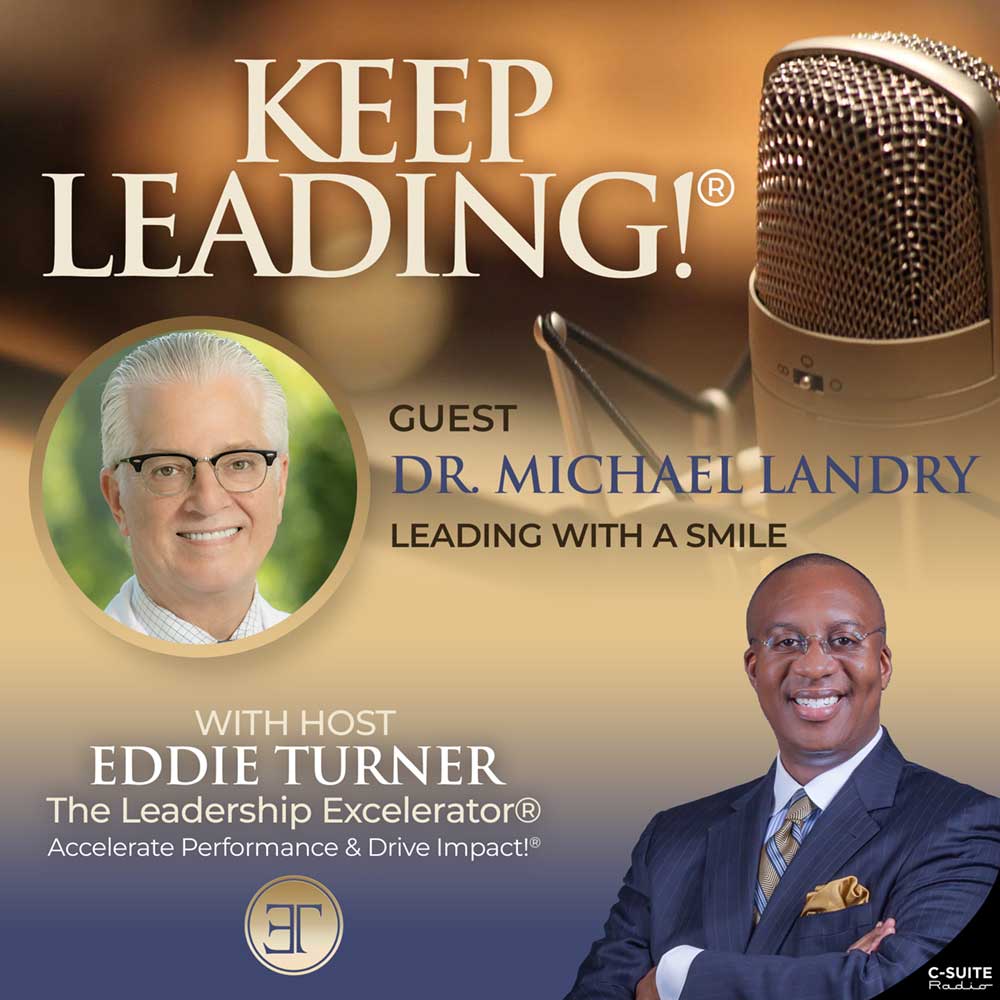
Dr. Michael Landry
Board-Certified Dental Aesthetics Expert | Owner, Consultants in Dental Aesthetics
Leading With a Smile
Episode Summary
What can a board-certified dental aesthetics expert teach us about leadership? Discover the answer in this inspiring episode of Keep Leading!® podcast, as host Eddie Turner interviews Dr. Michael Landry, owner of Consultants in Dental Aesthetics and a nationally recognized leader in his field.
Dr. Landry offers a unique perspective on leadership, having built a successful practice while earning fellowships in seven prestigious dental academies. From managing complex cases to lecturing across the country on innovative dental technology, he knows what it takes to lead with both precision and compassion.
In this conversation, you’ll see how Dr. Landry’s approach to patient care—especially his passion for diagnosing and treating the often-overlooked epidemic of sleep apnea—reflects the qualities of outstanding leadership: noticing what others miss, advocating for those in need, and having the courage to tackle problems that could literally save lives.
Whether you’re leading a team, building a practice, or serving your community, Dr. Landry’s insights on excellence, continuous learning, and maintaining work-life balance will inspire you to lead with both skill and compassion.
Keep Leading!® Live
Video Short
Bio
Dr. Michael Landry is the proud owner of Consultants in Dental Aesthetics and is an invaluable part of our robust team of skilled doctors. He is a board-certified diplomate in aesthetics and sleep dentistry. Dr. Landry has been awarded fellowships in the Academy of General Dentistry, the International Congress of Implantology, the Misch International Implant Institute, the Institute for Advanced Laser Dentistry, the International Academy of Dental-Facial Aesthetics, the International College of Dentists, and the American Society of Dental Aesthetics.
Dr. Landry has lectured nationally on CEREC restorations, the use of CAT Scans in dentistry, treating patients with hemophilia, 3D printing, digital scanning, 3D designing, and practice management. Dr. Landry also has a passion for treating patients with sleep apnea. “Just as many people have sleep apnea as diabetes and asthma, but sleep apnea often goes undiagnosed. Currently, only 10% of those with sleep apnea have been diagnosed. If left untreated, sleep apnea can shorten your life by 7 years. We can use oral devices instead of CPAP to treat this disease.”
Dr. Landry was born in Orange, Texas, and attended Lamar University and the University of Texas Health Science Center in San Antonio. He is married to his wife, Mary Ann, and together they have four grown children. He attends Prince of Peace Catholic Church, where he serves as an Acolyte. In his spare time, Dr. Landry can often be found enjoying some time outdoors while golfing or fishing.
Website
https://www.houstonsmilespa.com
Other Website
https://www.hsapnea.com
Facebook
https://www.facebook.com/ConsultantsinDentalAesthetics
Instagram
https://www.instagram.com/consultantsindentalaesthetics/
Subscribe, share, and review on Apple Podcasts!
https://bit.ly/4kPBcZo
Subscribe, share, and review on Spotify
https://spoti.fi/4iOFzlB
Full Episode Transcripts and Detailed Guest Information
www.KeepLeadingPodcast.com
Keep Leading LIVE (Live Recordings of the Keep Leading!® Podcast)
www.KeepLeadingLive.com
Connect with Eddie Turner
Website: https://www.eddieturnerllc.com
LinkedIn: https://www.linkedin.com/in/eddieturner
About the Keep Leading!® Podcast
The Keep Leading!® podcast is for people passionate about leadership. It is dedicated to leadership development and insights. Join your host, Eddie Turner, The Leadership Excelerator®, as he speaks with accomplished leaders and people of influence across the globe about their journeys to leadership excellence. Listen as they share leadership strategies, techniques, and insights.
Share the Inspiration
Inspired by what you hear? Share the episode with your network and help spread the message of empowerment and leadership. Use the hashtag #KeepLeadingPodcast and join the community of listeners who are dedicated to continuous growth and leadership excellence.
Transcript
Eddie:
Hello everyone.
Welcome to the Keep Leading podcast.
Keep Leading podcast is dedicated to leadership development and insights.
I’m your host, Eddie Turner, the Leadership Accelerator.
I work with leaders to accelerate performance and drive impact through the power of executive coaching, masterful facilitation, and professional speaking.
Today we are streaming live on LinkedIn, Facebook, and YouTube.
Feel free to hit that share button so that your friends can join our conversation or have access to the recording later on when the session concludes.
And if they should miss it here on social media, this session will be available wherever you download podcasts.
If you have questions, feel free to ask your questions live during our session, or certainly I encourage you to follow my guest on social media, uh, on LinkedIn.
You will want to stay connected to this expert.
You will also want to visit his website, which I’m going to mention several times because it’s very important that you go to HoustonSleepSpa.com.
What if I told you that there is a silent epidemic that is affecting as many people as diabetes and asthma, but 90% of the sufferers don’t even know they have it?
Well, because of that, that prevalence and its impact on people and their ability to show up as the leader that they like to show up as, I have brought in an expert who I highly respect, and I respect so much, he helps me.
I’ve brought in Dr. Michael Landry.
Dr. Michael Landry is a board certified diplomat in aesthetics and sleep dentistry, and the founder of Consultants in Dental Aesthetics right here in Houston, Texas.
And he’s going to talk to us today about dentistry and, uh, sleep apnea.
He has been a pioneer and groundbreaking alternatives to CPAP therapy, and he speaks and lectures across the country.
He’s got about 50 letters after his name and several, uh, fellowships and diplomats, and so I can’t wait to share his expertise.
And I will tell you as an aside, I affectionately refer to him as the man that either saved my marriage or saved my life. Because of my, I didn’t know I had sleep apnea. Because of that and my snoring, my wife was either going to end up divorcing me or smothering me to death with the pillow. But I’m happy to say that we’re, I’m still alive. We’re happily still married and still madly in love and both getting a good night’s sleep as a result.
So, That’s great. Dr. Landry, thank you and welcome to the Keep Leading podcast.
Dr. Landry:
Absolutely, it is my pleasure to be here, you know.
You’re absolutely right.
Sleep apnea is the most underdiagnosed epidemic that we have in our country.
And as you alluded to, 90% of the people that have sleep apnea have not been diagnosed.
There’s as many people that have sleep apnea as there are that have diabetes and asthma, a huge number of people.
And most of those have been diagnosed, they know something’s going on.
So many people, like yourself, I just snore.
I get tired in the afternoon.
I wake up with a headache in the morning.
My wife and I sleep in separate bedrooms. We haven’t slept in the same bedroom in years.
And many people aren’t willing to want to try CPAP.
CPAP works, it works great, but many people are unable to wear it.
So many people say, hey, I can’t wear it.
I’m not going to wear CPAP, I’m not going to do that.
Well, there’s many other alternatives.
We have oral appliances, mandibular advancement devices, is a fancy name for those.
Uh, there’s also Inspire, which is a surgically implanted implant that goes into your chest and helps to keep your airway open at night.
So there’s many ways to treat sleep apnea that people just aren’t aware of.
Eddie:
Now, you mentioned something there that I want to underline.
What is the indicator that a person has sleep apnea?
Dr. Landry:
Well, there’s several comorbidities that go along with it.
We have a particular acronym, it’s called STOP BANG.
S for snore.
T for tired.
O for obstruct.
Does someone has tell you that you stop breathing at night?
P for pressure, high blood pressure.
B for BMI.
A for age.
N for neck size, and G for gender.
And if you’re a male with a 16 and a half inch neck, over the age of 50, with a BMI of two, you snore, then those five put you at high risk.
If you answer three of those questions, it puts you at high risk for sleep apnea.
Eddie:
Okay, good to know.
And, uh, even some technology has been introduced where people wear, for example, an Apple Watch.
You have the ability to set your Apple Watch to help you detect that.
So if somebody isn’t, uh, right, telling you that you’re snoring too much, uh, as you said, don’t, because I did dismiss it and just think, oh, I’m just tired… I work a lot of hours, I stay up late.
It actually could be the first indicator that you are suffering from sleep apnea.
But I actually learned it not from somebody I would have thought I would have learned it from, but from you, my dentist.
So as a dentist, what was the indicator that I was suffering from sleep apnea?
Dr. Landry:
Well, you’re male, you’re over the age of 50, your neck is bigger than 16, and you have high blood pressure, right?
Eddie:
Mhm.
Dr. Landry:
So there you go.
There’s there’s four of them right there.
And I get that in your medical history.
The dentist gets that in your medical history. Maybe not neck size, but you can look at someone and you can tell is their neck size bigger or not.
Do they have a, you know, most all of us Americans nowadays have an elevated BMI.
And that’s how I call that elevated BMI. We didn’t say that we’re fat, but we have an elevated BMI. If you have a BMI that’s over 30, then you hit that group.
Eddie:
And you noticed something in in my bite.
Dr. Landry:
That’s right.
Part of it is that people that have sleep apnea also grind their teeth because when they go apnic at night and they stop exchanging air, they don’t stop breathing.
They still expand their chest, contract their diaphragm, do all the things that you would normally do, but no air goes through.
You’re just like snoring and it just stops. Dead quiet.
And that’s when you’re obstructed.
And during that time, then your oxygen level starts to go down, your CO2 level starts to go up, and your brain says, excuse me, Eddie, we’re dying.
So what do your body do when you think it’s dying?
It squirts out some epinephrin, the adrenaline, the fighter flight hormone.
And that epinephrin causes you to clench your teeth together, grind your teeth around, because that brings your bottom jaw up and forward and opens up your airway.
So for someone who grinds their teeth, that’s another indicator that your dentist is going to talk to you about.
Hey, you grind your teeth.
They said, no, I don’t grind my teeth.
Well, yeah, the flat spots on your teeth indicate you grind your teeth.
And there’s another thing that we also notice that’s called a scalloped tongue.
The edges of the tongue, they kind of go round and round because they’re close to the teeth because the tongue is squishing out against the teeth all the time.
Eddie:
Yes, so you pointed out my grinding that you noticed, and you combine obviously I was, uh, overweight, uh, still overweight, but, uh, more so at the time.
And that, uh, was and and you started to, uh, ask me about that, then I, I said, yeah, you know, I do grind my teeth at night and yeah, I do kind of find myself waking up grasping for air.
And so that was the indicator and you sent me on my way and getting on the sleep, uh, apnea, uh, path, uh, has been a tremendous help for me.
So I just want to highlight that for leaders that obviously that if we’re not able to get a good night’s rest, that clearly has an ability on how we show up as a leader.
And so getting the assistance from an expert like Dr. Landry, uh, can go a long way to helping us be the leaders that we want to be.
Dr. Landry:
Yes. Sleep is so critical in our lives.
In fact, if someone has been sleep deprived for 24 hours, they are inebriated or they are disabled enough to be equal to someone who has a 0.8% alcohol blood level, 0.08% alcohol blood level.
How about that? So next time, next time you go to the ER, ask your doctor, hey, how long has it been since you slept?
He says, oh, it’s been about 36 hours, say, give me somebody else.
I don’t want the drunk guy.
And when you talk about leaders, you know, if you’re chairing a meeting and you haven’t slept the night before, then you’re one of the drunk guys up there.
You’re not going to think as good, you’re not going to act as good.
Eddie:
That’s a staggering statistic, Dr. Landry.
So you’re saying, even if I’m a person who is sober, I don’t drink at all, if I am showing up to work and haven’t slept well in 24 hours, 36 hours, I’m as in, I am as inebriated or as ineffective as a person who’s so inebriated that their blood alcohol level is at 0.8.
Dr. Landry:
That’s right. 0.08. 0.08, sorry…
And that’s the same thing that makes you legally drunk.
Yes, sir. And it’s it’s not like you’re staggering and slurring your speech, but it’s your mind processes.
The things that’s so important for leaders to have that mind going all the time, to be creative, to have that futuristic visionary type thinking.
Eddie:
Thank you for sharing that.
That certainly underscores the need to not only get the adequate number of hours of sleep per night, but the quality.
And that is certainly something that we can do if we have the right sleeping, uh, aids, uh, getting to be sleep apnea, uh, treatment.
Dr. Landry:
Right. Exactly.
Eddie:
Now, if I am not, because you’re you’re a dentist, but got into this area of of sleep. Uh-huh. How did that take place?
Dr. Landry:
Well, you know, that’s another thing that we haven’t discussed, talked about that is things that happen from having sleep apnea, comorbidities as we call them.
And that I have a history of Alzheimer’s in my family.
My grandmother died of Alzheimer’s, my father died of Alzheimer’s.
I’ve been tested.
I have the APO4 gene for Alzheimer’s.
I have a 75% chance of getting Alzheimer’s.
That’s why it’s 70 years of age. I’m still working and I plan on working the rest of my life because I want to keep thinking all the time because as soon as I stop thinking, I will stop thinking.
During sleep, our our conversation right now is going to a place in your brain called the hippocampus.
Hippocampus, that’s your short-term memory.
At night, during NREM two stages of sleep, that information is uploaded from the hippocampus to the cortex.
It goes from short-term to long-term.
If you don’t get that quality sleep, then you don’t get that memory consolidation occurring.
And so it leads to short-term memory loss.
So that’s what got me first involved in it and that I, uh, thought, I started looking at how can I keep from getting Alzheimer’s like my father, like my grandmother.
And that was one thing that popped up on my list and was talking about sleep and further investigation just led me into this pathway and it it’s been very rewarding for me because I have people tell me, you gave me back my life.
I didn’t realize what it was like to sleep.
In fact, I heard someone from that just this, uh, past week tell me that.
Eddie:
Beautiful.
And I can relate.
I mean, until you’ve gone through it, you don’t understand how how much you may have undervalued quality sleep.
And then when that is, that’s returned to you, it is a true gift and it is if new life has been breathed into you.
Dr. Landry:
Oh, yeah. Absolutely.
Eddie:
Fantastic.
Now, if I’m not interested in being a Hollywood celebrity, is there a reason I should still be concerned about the quality of my smile?
Dr. Landry:
Oh, absolutely, Eddie.
You know, the first thing anybody sees when they look at you is their smile.
I mean, you’ve got a great smile.
You really do.
Come on, show me those teeth again.
There you go.
And it’s that’s the first, you know, the the key contact points we have with another human being are going to be the eyes and the smile.
That’s going to be the first thing you see.
And if you don’t have a smile that you’re proud of, then you’re not going to smile.
You’re going to give it to the lip thing like that.
Eddie:
Yes.
Dr. Landry:
I had tetracycline stains as a child up until adulthood.
And as a result, my smile and my pictures growing up was always just like that. No teeth.
After I got veneers placed on my teeth and I got my real teeth in my head, I was on on a trip with my brothers.
We were riding motorcycles up to four corners to stand on the spot.
And we had these little bitty cameras.
It was before the days of cell phones.
We had cell phones, they didn’t take pictures.
And we’re looking at these little cameras and you blow up the picture on the back and you can see what the picture that you took, these little digital cameras.
And I started noticing this thing on my face I had never seen before.
It was this horizontal white line.
I’d never seen that before.
It was my smile. It was my teeth.
I was showing teeth.
Showing teeth when I smiled.
And to me that that was a big moment in my life.
And it makes a difference in how you come across.
Eddie:
Absolutely.
Dr. Landry:
It it gives you that confidence level because when someone’s always, you know, talking to you like this or, you know, like that, you just don’t have as the connection with them.
You don’t have as much confidence in them.
I mean, if you’re in sales, gosh, in sales, it’s smile.
If you’re in leadership, what’s it about?
It’s your smile because you’re going to communicate more with the people that work for you through your smile than you are with your frown.
Eddie:
Excellent.
And you highlight this a lot in your book. So the idea that, hey, you only need to worry about your smile if you’re trying to be the next great, uh, actor in Hollywood is, uh, not not true.
It it matters on every everyday level in whatever profession we’re in, how we are perceived as a leader is directly connected with the quality of our smile and our teeth.
Dr. Landry:
Absolutely.
Eddie:
So if someone’s listening to us and they’ve had challenges that perhaps no other dentist could could resolve, and they they’re listening and thinking, boy, I’d like to have a better smile, but I’m told there’s no help for me. What do you say to that?
Dr. Landry:
Come see me and we’ll talk.
I I I’ve had lots of people that have come to me and they said that, yeah, the dentist said I couldn’t have implants.
They said dentist said I couldn’t have veneers.
Yeah, the dentist said I couldn’t have crowns.
The dentist that said that just didn’t have the confidence level in themselves, didn’t have the expertise.
They weren’t able to perform the procedures that were required to give that patient the result that they wanted.
That’s why I’ve I’ve studied so much in my life.
I’ve learned so many things that if if you don’t, I’ll back up a little bit.
In dentistry, you have to be a continual student of dentistry.
There is nothing, not one single thing that I still do the same now that I did when I was in dental school.
It’s all changed.
I’ve been doing this for 44 years, so you can imagine there’s been a lot of things that have changed.
And when something comes out, you have to have that ability to discern which is good and which is bad, which is going to be effective.
And sometimes it’s, uh, simply, can we? Is is that the right thing to do? Just because we can, doesn’t mean we should.
And there’s a lot of things that come through dentistry are in that category.
So you have to evaluate and is it going to give us longevity? Is it going to give us beauty? Is it going to give us function? Is it going to give us all the things that we need or is it just new technology?
Eddie:
Yes, indeed.
And you are a continuous learner and you continue to enhance the quality of offerings you provide for patients because of that.
And when I went to your office, you shared with me some sophisticated technology that you’re using in terms of 3D and, uh, and how you what something that normally would have would have had to been sent off someplace, you do it right there on the spot. Tell us about that.
Dr. Landry:
That’s right.
I’ve been using, uh, CAD CAM 3D technology since 2004 actually to make crowns in a single visit.
Uh, when you come in, we can, uh, prepare the tooth, we can scan it with an intraoral scanner.
We don’t put that yucky stuff in your mouth that makes you throw up and gag.
And then we can put that on the computer and then the computer and I can design a crown together.
We send that to a mill, kind of like a CNC machine in the office and takes a block of porcelain and it mills out everything except what that tooth looks like.
And then that tooth can then be cemented on the crown that day, which it helps in many ways and that it reduces post-operative sensitivity because when we put a temporary on and you go out and spend three weeks waiting for that permanent crown to come back in, and well that temporary is kind of leaking and you’re getting some of that oral bacteria up underneath the crown, which can lead to sensitivity.
As well as when the crown falls off because you ate something chewing sticky, you forgot, then you got to go back and get it glued in again.
We we get past all those.
Now, is that indicated for each and every restoration that I do in the mouth?
Absolutely not.
There’s certain times when I need to use a different material, one that I can’t use on a CAD CAM basis.
Uh, sometimes we actually use gold.
We still use gold sometimes on people’s back teeth because they they have such powerful, powerful bites that they can destroy anything else that we put in there.
So we have to go with that.
Uh, and and milling a block of gold to get a gold crown wouldn’t really be cost effective.
And someone that I’m taking and I’m doing, um, 10 crowns on all their teeth, I’m covering all the teeth.
That’s something I’m usually going to send to a lab.
I’m not going to do that in the office.
Could I? Yes, I could.
Should I? No, maybe I shouldn’t because just because you can, doesn’t mean that you should.
And if I could sit there in the with the patient in the chair for 10 hours to get that accomplished, would I really be serving the patient well?… Or if I can accomplish all that work in maybe four hours, wouldn’t that be better for them?
So it’s not just about me, it’s about the patient.
And that’s what we make is we have a patient-centric office.
It’s all about the patients.
It’s not about me.
It’s not about what hours I want to work.
We’re open Monday through Friday.
It’s we’re here to serve you.
And it’s about what your needs are, what your wants and your desires are.
And that’s why I’m going to tell you what all the possibilities are.
And and you may say that, you know, I’m not interested in making a smile over and I’ll say, well, let’s look at your smile.
Let’s talk about it.
Is there something that you ever stopped doing because you’re afraid to smile with your teeth?
And it it’s opening up those questions, finding out what those, you could call them emotional disabilities, reasons that a patient changes their functions because of their smile.
And they many times don’t think about that.
Eddie:
Indeed.
When we, it’s like a a beautiful woman who’s just gotten that new shiny engagement ring.
She all of a sudden starts to use that left hand a little bit more, right?
Dr. Landry:
Oh yeah, yeah, yeah.
Eddie:
Right-handed people become left-handed after a wedding ring. Absolutely.
So the same is true.
When you have a a nice smile because of having seen a great dentist like yourself, you want to show it off.
And it’s not even that you’re forcing yourself to.
You just love how you look and feel so much you can’t help but smile.
Dr. Landry:
Well, And it’s some sometimes a functional thing too, you know.
Uh, I had a patient once that quit going to her friend’s house to have dinner because she couldn’t chew.
Oh. She couldn’t chew when she went to her friend’s house.
Okay. And it wasn’t until I I asked her these questions, these leading type questions of, you know, what what do you think about this?
What do you think about that? Did that really come out?
And so for those patients, we can put implants in their mouth.
We can put implants to restore teeth again.
We can give you something to chew with so you can go to your friend’s house and have dinner without being embarrassed.
Eddie:
Again, another gift that you are able to return to someone through the quality work that you do.
Truly life enhancing and life changing.
Dr. Landry:
That’s what’s really cool.
That’s cool about dentistry really is is I get to do things like that for people.
People always think of the dentist, you’re the the pain giver, the the mean person.
No, it’s it’s I can I can give you back your life.
Eddie:
Yeah, you, uh, you do give a little bit of pain. Well, you know.
But you do it with a smile and you do it in an environment that is second to none.
So I want to highlight that right now.
What I’ve put on the screen, uh, those who are going to hear the audio podcast can’t see this, but I’ve got HoustonSmileSpa.com on the screen.
Those will see the video and who are with us live.
Uh, we’ve got a few people who’ve joined us from YouTube that I see.
Uh, that is able, they’re able to see this.
This is what your office looks like.
Now, sometimes you see a website and then you show up to the actual facility and it looks nothing like what you saw online.
Let me tell you folks, that is not the case.
This does not look like a dentist office.
This looks like, uh, just a stellar looks like the cover of Architectural Digest, quite frankly.
Dr. Landry:
Thank you. Thank you.
Eddie:
And that’s what it looks like when you go there.
And I can’t show you the pictures that I’ve taken of doing my visits, but when you step in here, it is truly a breath of fresh air and you will see that it truly looks and functions like a spa.
You owe it to yourself to go visit Dr. Landry and his team at Consultants in Dental Aesthetics.
Now, I’m very loyal to people who do services for me.
And I, when my wife found Dr. Landry’s office, she kept telling me, you need to go, you need to go.
I’m like, no, no, I like my guy.
And I did.
He’s an amazing dentist.
But I got over, I got too busy and I missed my window for appointments and I couldn’t get in with him.
And so, uh, it was at the end of the year and I wanted to get that last visit in.
And so I said, okay, I’m going to give Dr. Landry’s office a try.
I went and I I miss my good friend, but I’m never going back.
I love, I fell in love with Dr. Landry’s office, uh, from day one and you you’ll see why.
Now, here’s what we talk about.
Dr. Landry:
That’s our reception lounge.
We don’t call it a waiting room because we we don’t want you to spend time waiting in there…
We want to receive you.
There’s going to be someone who’s going to open the front door for you when you arrive and they’re going to open the front door for you when they leave.
And they’re going to seat you in the reception lounge.
They’re going to ask you, would you like a beverage?
You’re going to help you help you if there’s any paperwork that needs to be filled out electronically that hasn’t been done yet.
And they’re going to make you feel comfortable.
We’re going to welcome you into our home.
Eddie:
Indeed.
And people who know me know that I’m maniacal about quality and customer service.
And it’s intricately tied to leadership.
And so when we talk about Keep Leading, what we’re doing here on this show, this is a part of it and you are leading in a way no one else is doing in dentistry.
So your book is a category of one and you truly are a category of one.
And I just want to highlight something that you say here in your book that I showed that in the pictures, but here’s here’s what you say and I just I have to read this verbatim.
Our practice is highly patient-centric. And I just love that phrase.
Every detail of patient’s experiences has been designed and refined.
The difference in our practice is evident at your first visit.
When you walk through our front doors, you don’t enter a waiting room, as you just said.
It’s a comfortable reception lounge.
Our front office people are not front desk, quote unquote. They are concierges.
We offer silver tray service where you can have champagne or mimosa. You can choose a beer, a glass of red or white wine, or water.
We have a full service coffee bar if you’d like a latte.
Most importantly, we serve you.
And another point that you make here finally that I want to highlight is what is a category of one dental practice?
It’s a dental practice that values the power of distinction versus the cost of blending in.
It’s one that goes above and beyond for its patients, creating an environment that’s difficult if not impossible for others to duplicate.
This distinction doesn’t just apply to our physical building, it’s also found in how we treat our patients and the services we provide.
It doesn’t get any better than that.
And I’m here to tell people this isn’t just something you wrote.
I’ve experienced it and through countless visits, it hasn’t changed.
Sometimes something is great the first time and you go back and like, oh, it’s that has not been the case.
And I highlight this because again, this is important to leadership. The experience, how you make people feel when they’re in your presence and when they leave is the hallmark of a great leader.
You are leading, Dr. Landry.
And I did some work, uh, for years in in what’s called the experience economy.
And this is work by Joe Pine and and and Jim Gilmore and they they highlighted the best in class organizations that were separating themselves not on cost.
These organizations say, hey, if you want a cheap cup of coffee, there’s McDonald’s, there’s a couple other places.
But if you want a premium cup of coffee, right?
You’re going to go to Starbucks.
Well, I’m here to tell you folks, be it that you want a great comfortable stay at a hotel and you chose, hey, there’s some places that if I want to save a couple bucks, I can go to my Holiday Inns or whatever they may be.
But if I want a premier experience, I’m going to go to maybe the Ritz Carlton.
Dr. Landry and his team have taken the Ritz Carlton experience and placed it in dentistry.
Look at where he’s sitting right now.
Does that look like a dentist office?
So, I just wanted to highlight that.
Dr. Landry:
Yeah, that’s our greeter station behind us.
You are you’re greeted to the front door.
There is no one answering the phone.
You are the most important person that’s in front of that.
We have all that stuff in the back.
We don’t we don’t need people answering the phone out in public.
It’s it’s important that your experience is the most important thing that’s going on in our lives at that time.
And that’s what we want you to have.
It’s, you know, like you mentioned the Ritz Carlton, the holiday, you use that analogy all the time.
Both will give you a bed and a roof over your head, but one will give you an experience and the other one won’t give you that same experience.
And both are okay.
You choose where you want to go to.
If you choose to come to Consultants Dental Aesthetics, we’re going to treat you as the most valued customer we have each and every time that you’re here and the whole time that you’re here.
Eddie:
Outstanding.
Dr. Landry, we’ve had a we’ve covered a lot, covered a lot of ground in this discussion.
There’s still a lot of things I haven’t asked you that I want to ask you….
Uh, but there’s just one last item I want to get to.
You’re a man of, uh, not just a businessman and a phenomenal businessman.
You’re also a man who loves his family and it’s evident in what you do and and and and you’re a man of faith.
And you believe in giving back to the community.
Can you tell us about your free dentistry for a day program and the impact that’s had in our Houston community?
Dr. Landry:
Absolutely.
It’s just we for many years we were aligned with a, uh, 501c3 that was called, uh, Dentistry from the Heart.
It was first developed in Florida.
And during the COVID days that kind of faded out, went away.
And we had done, oh gosh, seven or eight free days of dentistry.
We open up our office.
We get, oh gosh, we’ve had, uh, seven or eight dentists and four or five hygienists and we have seen 197 people in one day.
Wow. And we have given away $160,000 dentistry in one day.
Well, after the COVID time, we had to resurrect that.
So we came up with our own called Gift of Dentistry.
The acronym being God.
And we have a cornerstone in front of our building that says, to those that much is given, much is expected.
And I want to give back as much as I can.
So we have an annual day every year that we’ve opened up our office.
We have 13 treatment rooms and we have all of them full the whole time.
And we have oral surgeons, we have, uh, hygienists, we have general dentists.
We’re doing fillings, extractions, and cleanings.
All you have to do to qualify is be 18 years old and have some sort of government ID so we can prove who you are and we’re going to take care of you that day.
It’s to me one of the most funnest days that there is because it’s it’s not a me come in and diagnose something and tell you, okay, it’s going to be this much.
It’s just what do I need to do for you today?
Okay, let’s do it.
Let’s just do it.
Eddie:
What a gift.
You truly are a phenomenal man in so many ways and that’s why I wanted to highlight you today, Dr. Landry.
Thank you. Please tell us the most important concept that we discussed you want people to take away from our conversation today.
Dr. Landry:
Well, before I get to that, I got to give credit to one other person in my world and that’s my wife.
Okay. My wife used to be the director of inflight training for Continental Airlines and what she did was she brought business first class into our dental practice.
She’s been the visionary for this.
She helped me design this building.
She the interiors are all her.
She’s the one that does the training for the patient care.
She has this phrase called we’re either green and growing or we’re ripe and rotten.
And so she is the person that is behind all of this and she she’s just fabulous.
I’ve got to give her credit for that because she truly deserves it.
But probably the most important thing is that there’s people that have made dentistry a commodity.
They think that you can get the same thing at this place, at this place, and this place, and this place.
And it’s simply not true.
Maybe there’s three of those places where you can get something that’s similar, but what you get when you come to Consultants Dental Aesthetics is a totally different experience.
It’s not about what you do for people, it’s about how you make people feel.
What do they remember when they’re gone?
It’s how you made them feel.
And we’re going to make you feel like you’re the most important person there and that you are treated fairly, that you’re treated well, and that you’re treated with the utmost respect.
Eddie:
And I can, uh, fully affirm all of those statements. Thank you.
Is there a quote or a life lesson that you use that helps you to keep leading?
Dr. Landry:
God gave me a gift.
He gave me influence over so many people in this world and my job for him is to use that influence to help every person that I encounter each and every day to help them be the very best version of themselves.
Eddie:
Excellent.
Thank you, Dr. Landry.
And I want to tell people again how to reach you at HoustonSleepSpa.com.
Dr. Landry:
No, it’s HoustonSmile, HoustonSmileSpa.com.
Oh, I’m sorry.
Yes, thank you for correcting me.
HoustonSmileSpa.com.
And then we have another website that’s called HSApnea.com.
That’s the sleep side of the office.
Eddie:
And HSApnea.com.
Dr. Landry:
That’s right. Thank you.
And we’ll be sure to put that in the show notes so that people can click on that from