
Dina Smith
Executive Coach I Author I Keynote Speaker I HBR, Fast Company, & Forbes Contributor
Leading In the New World of Work
Episode Summary
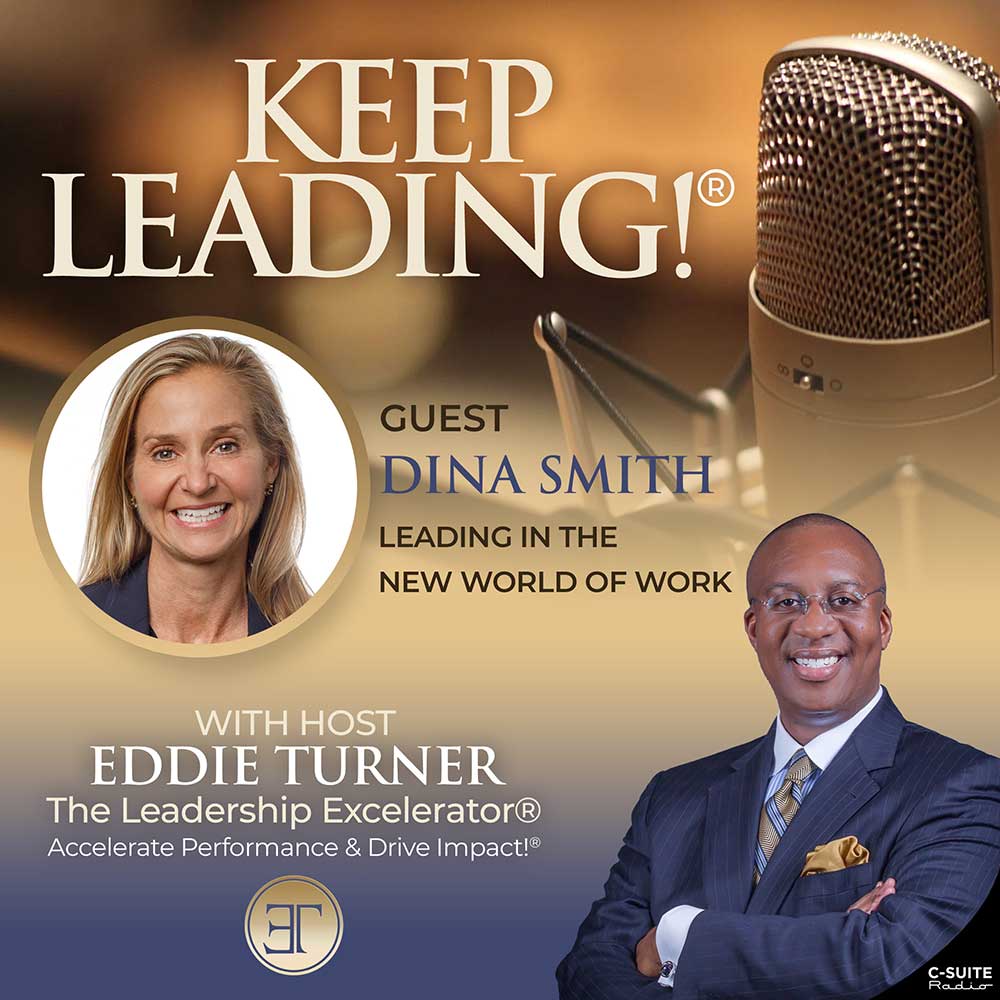
Join Eddie Turner on the Keep Leading Podcast for an insightful conversation with Dina Smith as they explore the evolving landscape of leadership. Discover why the expectations and emotional demands on leaders have reached unprecedented heights, and learn about the concept of emotional labor and its impact.
In this episode, Dina presents an intriguing analogy to illustrate leadership dynamics. Through Dina’s unique framework, you will gain valuable insights into effectively managing triggers.
Stay inspired, stay motivated, and Keep Leading!®
Keep Leading!® Live
Keep Leading!® Video Shorts
About Dina Smith
Dina Smith is a seasoned leader and executive coach with a 25-year proven track record of helping individuals and teams excel. Utilizing her executive experience and expertise in organizational psychology, Dina coaches senior leaders and teams at world-renowned brands such as Adobe, Netflix, PwC, Gap, Gilead, Dropbox, Stripe, and numerous high-growth companies.
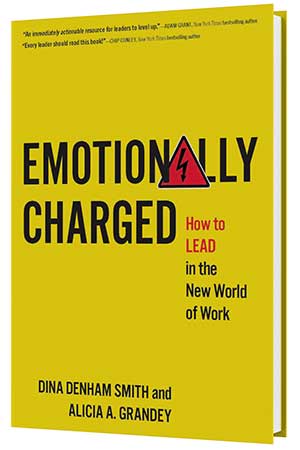
Dina has authored over 60 articles on leadership and career success for publications like the Harvard Business Review and is frequently featured in international media outlets such as the Wall Street Journal, Business Insider, Newsweek, and the BBC. She is also the author of “Emotionally Charged: How to Lead in the New World of Work” (Oxford University Press, 2025).
Website
https://www.dinadsmith.com
LinkedIn
https://www.linkedin.com/in/dina-denham-smith/
Dina’s Book
Leadership Quote
“You can’t stop the waves, but you can learn to surf.” – Jon Kabat-Zinn
Best advice: Sleep on it
Subscribe, share, and review on Apple Podcasts!
https://bit.ly/4kPBcZo
Subscribe, share, and review on Spotify
https://spoti.fi/4iOFzlB
Full Episode Transcripts and Detailed Guest Information
www.KeepLeadingPodcast.com
Keep Leading LIVE (Live Recordings of the Keep Leading!® Podcast)
www.KeepLeadingLive.com
Connect with Eddie Turner
Website: https://www.eddieturnerllc.com
LinkedIn: https://www.linkedin.com/in/eddieturner
Twitter: https://twitter.com/eddieturnerjr
Facebook: https://www.facebook.com/eddieturnerllc
Instagram: https://www.instagram.com/eddieturnerjr/
YouTube: http://www.youtube.com/EddieTurnerJr
LinkedIn Business: https://www.linkedin.com/company/eddie-turner-llc
TikTok: https://www.tiktok.com/@eddieturnerllc
Bluesky: https://bsky.app/profile/eddieturner.bsky.social
Agent: https://gray-miller-agency.webflow.io/roster/eddie-turner
100 Coaches Agency: https://www.100coaches.com/coaches/profiles/eddie-turner/
About the Keep Leading!® Podcast
The Keep Leading!® podcast is for people passionate about leadership. It is dedicated to leadership development and insights. Join your host, Eddie Turner, The Leadership Excelerator®, as he speaks with accomplished leaders and people of influence across the globe about their journeys to leadership excellence. Listen as they share leadership strategies, techniques, and insights.
Share the Inspiration
Inspired by what you hear? Share the episode with your network and help spread the message of empowerment and leadership. Use the hashtag #KeepLeadingPodcast and join the community of listeners who are dedicated to continuous growth and leadership excellence.
Transcript
Eddie Turner
Hello.
Welcome to Keep Leading Live.
Keep Leading Live and the Keep Leading podcast are dedicated to leadership development and insights.
I’m your host, Eddie Turner, the leadership accelerator.
I work with leaders to accelerate performance and drive impact through the power of executive coaching, masterful facilitation, and professional keynote speeches.
My goal is to help you stay inspired, stay motivated, so you can keep leading.
Today, we are broadcasting on LinkedIn, Facebook, and YouTube.
If you are joining us on one of these channels, please let us know you’re here by commenting in the comment section.
You can ask a question.
And if you’re not already following my guest today, I’m going to encourage you to follow my guest.
You’re going to want to stay connected with my guest today, and you’re going to find out why in just a moment.
Uh, DDI just released a report, their leadership report, the leadership landscape, and it’s the longest one of its type, uh, that’s been running for the last 11 years.
And in it, they revealed what is impacting leaders today unlike ever before.
And what it shows is that there are a lot of vulnerabilities and there’s some apprehension among leaders about what they need to do to lead more effectively in the world of work.
Uh, never before have you seen perhaps where it’s no longer, hey, we’re going to eliminate the low performers.
Now we’re actually eliminating top performers who are doing well.
Why?
AI.
There’s just certain things you don’t need managed anymore if it could be automated.
So there’s a lot of uncertainty.
How can we as leaders deal with it?
How can you and I learn how to lead in the new world of work?
To answer that question and to explain it, I have the expert for us today.
My expert guest today is Dina Denham Smith, and she has written a new book entitled Emotionally Charged, how to lead in the new world of work, where she’s going to provide us the answers.
Dina, welcome to Keep Leading Live.
Dina Denham Smith
Hey, Eddie.
It’s good to be here.
Eddie Turner
It is so good to be with you.
I’m excited to have you.
Uh, it’s been a while since we saw each other.
The last time we saw each other, uh, we were with great friends in London.
Dina Denham Smith
We were.
We were.
Eddie Turner
For those who might hear the podcast later versus seeing it live, uh, us with our great friends in London at the Thinkers 50 celebration.
Dina Denham Smith
Oh, so fun you pulled that photo up.
Yeah, there we are, huh?
Eddie Turner
Yes, yes.
It’s a great memory that makes me smile.
So I wanted to share that.
It’s so good to have you back and to be together for this conversation.
Uh, I I told people that you’re the author of a new book that’s on Oxford University Press.
I did not tell people, however, that you are, um, an author, prolific author, uh, with HBR, Fast Company, and Forbes.
And in fact, I just shared your new article that got released yesterday.
Uh, fantastic article that you released.
So tell us a little bit more about you that I may have left out that our audience needs to know.
Dina Denham Smith
Well, gosh, uh, like you, an executive coach, uh, based in a different geography.
I’m up here in the Bay Area of California.
Um, and then, of course, we’re so much more than our professional roles, right?
So I’m a mom, I’m a wife, I try to be a great friend.
I’m a foodie, an equestrian, um, an optimist, and uh, love socializing.
Eddie Turner
All right.
[laughter]
Well, we know that you excel at all of the above, and today you’re going to help us understand, uh, just why we need to adjust, uh, uh, what we can do to adjust to be able to lead in the new world of work.
And so I’m going to actually share that with, uh, with our our our folks who are watching so they’ll be able to see this book so that they know what they’re going to need to look for on the Amazon bookshelves, uh, out there.
Tell us, what made you write Emotionally Charged?
Dina Denham Smith
Yeah, well, so, you know, as an executive coach, I really have the the honor, um, and the privilege of being on the front lines with, you know, senior leaders every day, um, of every week…. And what I noticed, especially over the course of the pandemic, was the extent to which the workplace has changed.
So I was a leader, um, in sort of before I became an executive coach, and the striking difference in terms of the emotional demands on leaders was just super apparent.
So I stepped back from that and I thought about like, well, what exactly is happening here?
And there were sort of four major shifts that have amounted in these exceptional emotional demands on leaders.
So first, um, you know, we do so much more work through virtual technologies.
There’s the rise of AI, as you’ve already mentioned.
There’s so much fear and sort of rapid obsolescence in the workplace.
We have heightened employee expectations for supportive leaders and mentally healthy workplaces.
And then we have an increasingly diverse and polarized workforce.
Well, managing sort of within and across these new trends has dramatically increased the emotional demands on leaders, right?
It’s harder to build trust, um, and motivate people from a distance, for example.
It is there’s more conflict in a more diverse and polarized workforce.
You there is a clear expectation that you support your employees with personal struggles, but you’re still there to drive results.
So the real problem is that leaders to this point have not been equipped with sort of the skills and the resources to be successful against these emotional demands.
And so what my co-author, Alicia Grandy, and I did was write a book to solve for this gap.
And so Emotionally Charged is, um, really chalk full of science-backed, proven, practical strategies for navigating these new emotional complexities that leaders are dealing with day in and day out.
Eddie Turner
And that phrase gives some leaders, um, an uncomfortable feeling when they just we just say the word emotions.
Dina Denham Smith
Mhm.
Dina Denham Smith
Yeah, it’s true.
It’s absolutely true and and it’s a real shame.
Um, there are so many myths and misconceptions, um, that are so sticky, um, you know, despite just decades of evidence about like the value of emotions in navigating our careers and improving relations and improving our performance, in leading more effectively and being more inspiring.
Like the evidence is so complete, um, but there’s just a bunch of myths and misconceptions that have stuck around in the workplace that have led to people sort of ignoring, suppressing, um, and devaluing emotions.
And meanwhile, anytime you have a human in the room, you are going to have emotions, right?
And thinking’s great for logic, but emotions are what lead to action.
Um, and so to ignore them at work is really to your peril.
Eddie Turner
Thank you.
Yes, many leaders feel like, especially from a certain time period, that, you know, I don’t have time for emotions.
I need people that show up a certain way and they think what’s strong and what’s tough, right?
But as you said, anytime you have people, they have emotions, whether you’re forcing them to suppress them or you’re allowing them to be nurtured and to use those emotions effectively at their place of employment.
Dina Denham Smith
Right.
Both your own, both your own emotions, right?
And other’s emotions.
Like leaders are the emotional architects of their organizations.
Um, and so they have a super important role just not only in regulating their own emotions and unpacking and understanding those, but also working with the emotions of other people at work.
Um, so it is it’s a very substantial aspect of their role, but it’s nowhere on the job description.
Eddie Turner
Yes, and so we define that as emotional intelligence when we have the understanding of our own emotions and others and then how to, uh, navigate them and successfully use them in that manner.
Dina Denham Smith
Mhm.
Eddie Turner
Now, you make a point in your book that you refer to as the emotional labor.
How does that surface in what we’re talking about here and balancing emotional intelligence and the effective use of leading our teams?
Dina Denham Smith
Yeah.
So emotional intelligence is sort of like this general capacity.
Um, and emotional labor is actually the work that we do to display the right emotions at any given moment at work.
So all workplaces have these unwritten rules about what emotions are okay, in what amounts and displayed by whom.
Emotional labor is sort of the work we’re doing behind the scenes to conform to those unwritten rules.
And so for leaders, what this can look like is, you know, rallying their team even though they’re exhausted or they’re unsure they even believe in the goal, right?
It looks like code switching across all the different stakeholder groups…. You know, how you show up with the board is going to be very different than how you show up with your team versus your peers.
So it’s it’s managing that.
We have these paradoxical emotional expectations for leaders these days that are that are truly superhuman.
Be confident, but be humble, right?
Be sensitive and caring, but drive results.
Be composed in the face of challenges, but just enough human, right?
Like we are asking for emotional gymnastics.
And then leaders face some really weighty decisions where they’re affecting other people’s lives, layoffs, letting people go, um, because of performance.
You know, doing this requires emotional labor.
So leaders actually do this obscene amount of emotional labor in their roles, especially in the new world of work.
Um, but it is hasn’t been acknowledged really heretofore.
Um, and so it goes un sort of untrained.
And the real problem with that with that is, um, then the first line of defense quite naturally is to hide, ignore, suppress, or fake emotions.
Um, that makes perfect sense, right?
And sometimes it’s actually the right answer in a given moment, right?
But, um, but it largely goes untrained and so leaders don’t necessarily have the skills that they need to manage all of the emotions that they’re expected to manage well.
Um, so where can they get these skills?
Dina Denham Smith
Well, my book, Eddie, that’s what this book is filled with.
It is filled with the skills that one needs to understand and regulate their own emotions, um, as well as understand and regulate the emotions of others in the workplace.
And there there are all of these different tools and these different tools are fit for use.
So there’s certain things, I actually just did a short little HBR on it as well.
Like what can you do if you know you’re going into an emotionally charged situation?
There’s specific tools for that versus.
Eddie Turner
Give us one.
If you’re going into an emotionally charged situation, what’s one strategy we can employ?
Dina Denham Smith
I highly recommend that you employ one of the greatest tools that athletes use, which is visualization.
So what I want you to do, if you are going into a meeting where you know the temperature is going to run high, is in your mind, mentally rehearse that situation.
Think about how you’re going to open the meeting.
Think about the meetings of potential like the the moments of potential tension.
Think about how you’re going to handle those.
Think about the how you want to show up in those moments and like really like close your eyes and see in your mind’s eye that meeting playing out in the way that would be most successful, right?
Eddie Turner
Excellent.
So visualization is one strategy we can use.
Dina Denham Smith
Mhm.
Absolutely.
Eddie Turner
Is there, uh, is there another strategy that you might want to use if visualization doesn’t quite work for you?
Dina Denham Smith
Um, yeah, absolutely.
Um, if you’re not into visualization, I which I I honestly recommend you try it.
It’s been proven to work for professionals, not just athletes too.
But, um, you know, another thing to really think about in advance is how can I modify this situation that I’m going in to bring down the emotional temperature for both me as well as other participants.
So let’s say you’ve got a very difficult decision or really bad news you need to be communicating to your team.
Um, think about like strategically ahead of time, the who, the what, the when, the where, like how can you set this meeting up in a way where like you’re kind of like setting the tone from the beginning, um, to, you know, like so instead of defaulting to the conference room next door, maybe you actually want to book a really sort of private space, you know, down the hall or on another floor.
Maybe you want to invite your HR partner or your your manager to join the meeting, right?
Like think about.
Eddie Turner
Well, that’s a good strategy.
That’s another good option for us to consider.
Dina Denham Smith
Yeah, no, there’s so that’s um that’s the whole.
Eddie Turner
So you gave us two good ones there.
Dina Denham Smith
Okay, good.
Eddie Turner
Good.
Thank you.
So, you know, I was trained under Dr. Heifetz at the Harvard Kennedy School and one of the things that he talks about, one of his famous sentences is about learning to disappoint people at a rate that they can stand.
And to do that, he uses the illustration of, uh, a containment of a pot where you allow it to boil to a certain point, boil, boil, boil, and then right before it’s about to explode before it gets out of control, you take the lid off and you allow it to decompress.
So when I saw your opening chapter in your book from a simmer to a boil, how working leadership have changed, you had me right there because I immediately thought back to Dr…. Heifetz.
So tell us about that, going from a simmer to a boil.
Dina Denham Smith
Yeah, so the the workplace trends that I mentioned a few minutes ago about sort of the rise of, um, virtual technologies to communicate, the rise of AI, these increased employee expectations for supportive leaders and mentally healthy workplaces and an increasingly polarized workforce.
Those those trends were sort of like simmering in the background and the pandemic just turned up the gas on all of them.
So I think back even to my coaching practice.
Before the pandemic, I had a few clients that I would occasionally see on Zoom or Teams or whatever.
But a lot of people didn’t even, they weren’t even all that fluent in, you know, video teleconferencing.
And now everybody, right?
It’s it’s crazy to me.
Like sometimes you have people in the same building who are actually on video together.
Right?
So right?
So, so the pandemic was this inflection point.
So, um, sort of instead of the trends simmering along and allowing everybody to kind of like slowly over time get used to these trends, it just like boom, went to a boil.
Um, and it became so much for leaders so quickly.
You know what’s super fascinating though?
We did a, um, we did a survey of over, um, a couple hundred leaders for our book and we were looking at a variety of things including emotional burden and perceived stress and burnout in the leader population.
And it’s actually higher now than it was at the height of the pandemic.
Eddie Turner
Really?
Dina Denham Smith
And I yes.
And I think what that, um, strongly suggests is the cumulative effect of leading in this environment without being equipped, um, with sort of some of the skills for for handling the emotional complexities and then recovering, um, from a a role that is demanding in a new way.
Eddie Turner
How about that?
Well, thank you for sharing that startling statistic with us that does give us a lot of insight and, uh, amplifies the reason that the insights in your book are so important for us to keep in mind and follow.
Well, what I’d like to do now is pause for a moment and acknowledge the sponsor of the Keep Leading podcast.
If a single employee’s indecision can cost an organization $10,000 to a million dollars, imagine the potential financial impact when more individuals are added to this indecision equation.
It can spiral out of control quickly.
What’s the solution?
Decision X is a bespoke.
Let me try that again and use the right, uh, there we go, the right slide.
Decision X is a bespoke on-demand service designed to help your leaders overcome indecision and move forward with their work.
Visit Papillon MDC and discover how you can help your team get unstuck, shift perspective, and advance today.
Want to make sure that that’s on the screen for those who are watching this live.
For those who’ll hear the podcast later, it’s p a p i l l o n mdc.ca.
My wonderful friends there in Canada.
And want to remind you that the Keep Leading podcast is a part of C Suite Radio.
Together, we’re turning up the volume on business.
Visit c-suiteradio.com to access the Keep Leading podcast or wherever you get your podcast.
All right.
So, uh, want to switch back to our conversation here.
I am talking to the amazing Dina Denham Smith.
She is an executive coach, author, keynote speaker, and she writes for HBR, Fast Company, and Forbes.
And we’re discussing her book Emotionally Charged, how to lead in the new world of work.
One of the items that you help leaders with in your book, Dina, that I want like for you to explain to us, is this concept of being triggered.
How can we lead in the new world of work when we are triggered as a leader?
Dina Denham Smith
Yeah.
Well, let’s just, um, say we all get triggered, right?
Um, we get triggered at work.
There are people, there are events, there are our environments that are personally triggering, right?
And oftentimes the typical reaction is either to sort of shut down and lock up how you’re actually feeling and paint on a smile, or or you react a bit quickly and possibly say or do something you regret.
Um, and ultimately both these reactions are not that helpful.
So then the question becomes in the face of a trigger, like how do you maintain your composure, um, without suppressing or ignoring your emotions?
Um, and so one of the, um, one of the frameworks that we offer in the book deals with specifically this.
And the framework is, uh, called Brave.
Um, and it stands for, um, proven, um, quick ways to deactivate yourself in the face of a trigger…. Um, and these are ways to, uh, regulate your emotions and maintain your composure sort of helpfully in ways that are, um, uh, that are beneficial for your performance.
So I’ll walk you through it really quick.
Um, so B is for breathe.
Sounds basic, sounds simple, right?
But in the face of a trigger, what typically happens is our breath gets really short, that spikes our spikes our heart rate.
And so what you want to do is just take a few deep breaths, lengthening your exhale, right?
This helps move you more into your parasympathetic nervous system from your fight or flight system.
R is for refocus.
Ground in the in the sensations in your body or what’s happening in the room.
The idea is to get your mind off of the trigger and onto something else.
Again, this is proven to help ground you.
A is for acceptance.
Too often, what we do when we feel something that we feel like we shouldn’t feel, like I’m so mad, I’m mad again, right?
We are just we are just escalating our emotions.
So acceptance is a scientifically proven strategy.
Um, and it’s so simple.
It’s just accepting how you feel as normal and natural given the circumstances.
So accept your emotions.
Uh, V is for verbalize, not necessarily out loud, but find a couple labels for how you’re feeling, um, because this helps shift you out of your limbic system into your prefrontal cortex.
So breathing, refocusing, accepting your emotions, and finding a couple labels through verbalizing your feelings are four ways that you can sort of quickly, quickly down regulate.
Um, and they’re they’re simple and that’s the point.
You can literally run through these in 30 seconds or less.
So let’s just say we’ve got a situation where you’ve been blindsided by somebody, um, in a meeting or your manager takes credit for your work or there’s some triggering situation and you just feel that like clench of your body or the rush of.
Eddie Turner
When you’re getting all tense.
Dina Denham Smith
Yeah, like we all feel it in different places, right?
But like we all know like when when all of a sudden we’ve gone from like zero to 60, right?
When you feel that, you know, ideally like run through these things, but if not, like one is better than none.
So take a couple deep breaths.
I like to just like feel the, um, my, uh, what are they?
Like my fingerprint.
Like have you ever tried that?
Like you can actually feel your fingerprint or look out the window, whatever it is, but get your mind off of it really quick.
And then say, um, of course it makes sense that I’d be feeling like frustrated and exposed right now.
Like boom, in 30 seconds or less, you will have really shifted your internal physiology in a way that enables you to be sort of calm and carry on.
E is for engage, right?
Which is, um, the idea that like move forward once you’ve had a chance to deactivate.
So.
Eddie Turner
All right.
Well, thank you for sharing that with us.
That’s helpful for us to keep in mind and it’s easy to remember.
And, uh, we have folks joining us from YouTube, LinkedIn, and Facebook.
On LinkedIn, Gary Bomzer wanted to, uh, amplify a point you made earlier that sometimes we might be in the same building but still on virtual.
And there are reasons for that, of course, but he, uh, is agreeing with you that it does a disservice to professionals to avoid human interaction.
So Gary, thank you for weighing in and being part of our discussion.
All right.
Now, I would like for you to tell us for folks who are listening to our conversation, Dina, and they’re taking in all this information and the good insights you share with us, what’s the main point you want them to walk away remembering?
Dina Denham Smith
Yeah, I think what I want, um, leaders to understand is, you know, emotions are not squishy.
They are fundamentally information and data that you can use to advance your career, to improve your relationships, to increase your performance, and and benefit your health.
So, um, by all means, like start tuning into them more and working with this.
It is it is only to your benefit to start attending to this other source of incredible intelligence, um, that that you can use for your benefit and the benefit of your team.
That would be one thing.
The second would be emotion skills are learnable.
Everything in our book is proven, it’s practical.
So no matter where you are on the spectrum of feeling like, um, this is really scary stuff.
Like I have never been trained in in emotions and how to deal with them to maybe you’ve got a lot of confidence in this area, we can all learn more.
Um, and so just know, have a growth mindset about this.
No matter where you are, you can advance yourself.
Um, and and the last.
Eddie Turner
And that is very important.
Dina Denham Smith
Yeah.
Yeah, and the last thing real quick that I’d want leaders to understand is there’s something called the recovery paradox.
And that is the fact that the people who need the break the most are the least likely to take it.
So when you find yourself pushing through because like the mountain of work just never subsides, when you’re pushing through lunch, when you’re working in the evenings, when you’re putting in a bunch of hours on the weekend, you’re probably stuck in a stress spiral and this over time only degrades your performance and leads to burnout.
So, um, we didn’t get to talk about it, but I am such a huge proponent of leaders really taking care of themselves, um, because it benefits not just them, but everybody else in the workplace.
Eddie Turner
Outstanding.
Thank you, Dina.
And want to acknowledge Gary, uh, appreciate the comment earlier.
So thank you, Gary.
We appreciate you listening, watching, and being part of our live discussion.
Well, Dina, I always ask on the Keep Leading podcast, what is the quote that you use to help you keep leading?
Dina Denham Smith
Um, I I specifically love this quote from John Kabat-Zinn and it’s you can’t stop the waves, but you can learn how to surf.
I think it’s just such an empowered way to think about, um, how we can all rise to the challenges, which will just keep coming.
Eddie Turner
You can’t stop the waves, but you can always learn how to surf.
I like that.
Dina, thank you so much for being a guest today.
We want to remind everybody to go out and get a copy of, uh, your book Emotionally Charged, how to lead in the new world of work.
Uh, we’ll encourage people to go out and also to visit your website, Dina D Smith.com for those who are not seeing this on the screen, who’ll hear it on the podcast later.
Uh, stay connected with her, get with her on social media and learn more about her incredible body of work.
Thank you again for being a great guest, Dina.
Dina Denham Smith
Oh, thank you so much for having me.
Eddie Turner
And thank you for listening.
That concludes this episode, everyone.
I’m Eddie Turner, the leadership accelerator, reminding you that leadership is not about our title or our position.
Leadership is action.
Leadership is an activity.
It’s not the case of once a leader, always a leader.
We must be a leader at our core and allow it to emanate in all that we do.
So whatever you’re doing, always keep leading.