
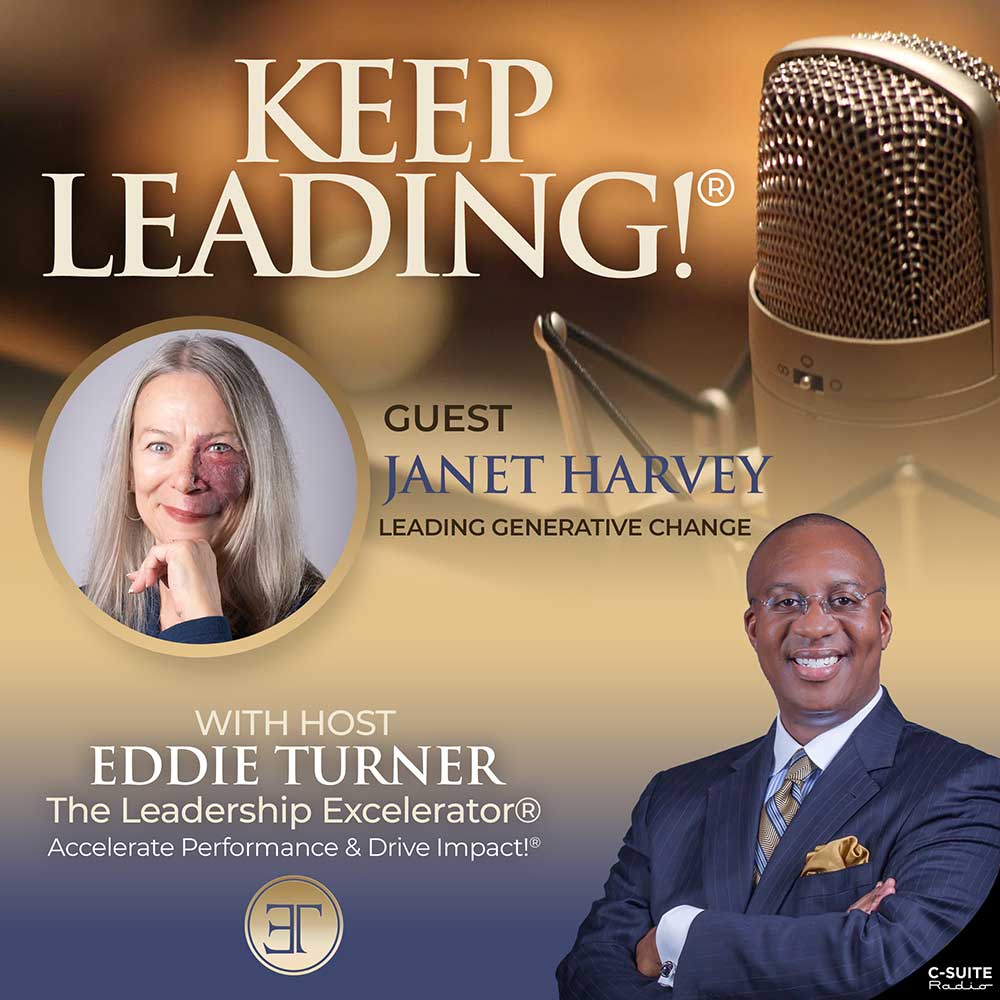
Janet Harvey
Keynote Speaker | Award-Winning Author | ICF MCC & Master Generative Coach | Director of Coaching Education
Leading Generative Change
Episode Summary
In today’s rapidly evolving world, the ability to lead change isn’t just helpful—it’s essential. But what distinguishes leaders who simply react to change from those who actively create it?
In this episode of the Keep Leading!® Podcast, I explored this question with Janet M. Harvey, who introduced a powerful concept: generative change. Rather than simply managing disruption, Harvey shows how effective leaders can harness tension as a driving force for transformation and growth.
In this episode, Harvey breaks down her innovative Generative Wholeness™ framework and offers practical strategies for developing this essential leadership skill. Drawing insights from her book “From Tension to Transformation: A Leader’s Guide to Generative Change,” she reveals how to transition from defensive leadership to a more proactive, creative approach that transforms challenges into catalysts for success.
Whether you’re facing organizational upheaval or simply want to enhance your leadership skills, this conversation offers actionable tools for becoming the kind of leader who doesn’t just navigate change—but creates it.
Keep Leading!® Live
Keep Leading!® Video Short
Bio
Janet M. Harvey is the best-selling author of two award-winning leadership and coaching books: “From Tension to Transformation: A Leader’s Guide to Generative Change” and “Invite Change: Lessons from 2020, The Year of No Return.” She is the CEO of inviteCHANGE, a human development organization that specializes in generative learning and coaching, shaping a world where people love their work life.
As a visionary in the global professional coaching industry, Janet Harvey is an International Coaching Federation Master Certified Coach and Accredited Educator who has engaged leaders, teams, and global enterprises to foster change that sustains well-being and performance excellence. As Janet shares, “Coaching in its many forms has at its root the effect of awakening consciousness and doing so in a highly accelerated fashion that improves productivity and financial outcomes while also generating a healthier workplace climate.”
Janet Harvey utilizes her executive and entrepreneurial experience to nurture leaders in Generative Wholeness™, their signature generative coaching and learning process designed to be future fit.
Website
https://janetmharvey.com/
Other Website
https://www.invitechange.com/
LinkedIn
https://www.linkedin.com/in/janetharvey/
Janet Harvey’s Book
https://bit.ly/4eiGFUu
Subscribe, share, and review on Apple Podcasts!
https://bit.ly/4kPBcZo
Subscribe, share, and review on Spotify
https://spoti.fi/4iOFzlB
Full Episode Transcripts and Detailed Guest Information
www.KeepLeadingPodcast.com
Keep Leading LIVE (Live Recordings of the Keep Leading!® Podcast)
www.KeepLeadingLive.com
Connect with Eddie Turner
Website: https://www.eddieturnerllc.com
LinkedIn: https://www.linkedin.com/in/eddieturner
Twitter: https://twitter.com/eddieturnerjr
Facebook: https://www.facebook.com/eddieturnerllc
Instagram: https://www.instagram.com/eddieturnerjr/
YouTube: http://www.youtube.com/EddieTurnerJr
LinkedIn Business: https://www.linkedin.com/company/eddie-turner-llc
TikTok: https://www.tiktok.com/@eddieturnerllc
Bluesky: https://bsky.app/profile/eddieturner.bsky.social
Agent: https://gray-miller-agency.webflow.io/roster/eddie-turner
100 Coaches Agency: https://www.100coaches.com/coaches/profiles/eddie-turner/
About the Keep Leading!® Podcast
The Keep Leading!® podcast is for people passionate about leadership. It is dedicated to leadership development and insights. Join your host, Eddie Turner, The Leadership Excelerator®, as he speaks with accomplished leaders and people of influence across the globe about their journeys to leadership excellence. Listen as they share leadership strategies, techniques, and insights.
Share the Inspiration
Inspired by what you hear? Share the episode with your network and help spread the message of empowerment and leadership. Use the hashtag #KeepLeadingPodcast and join the community of listeners who are dedicated to continuous growth and leadership excellence.
Transcript
[Eddie Turner]
I’ll try this one more time.
It’s saying that it’s not live.
Okay, let me hit in and see if I can try it again.
It looks like it’s live on Facebook and YouTube, but not live on LinkedIn.
[Janet Harvey]
Hmm.
[Eddie Turner]
So I’m… I’m… I’m afraid to hit the end button for anybody who may be watching on those two areas, which it looks like I have three people.
I have three people who… that have tuned in.
One person’s on Facebook, one person’s on YouTube.
So I’m afraid to hit end.
Uh, so what we’re going to do is just do that and I’ll have to publish it to LinkedIn in another way.
This is the first time this has happened.
So to those who’ve joined on Facebook and YouTube, thank you for being here.
Uh, my LinkedIn audience, they’re… uh, we’ll have to publish this in another manner.
So the live recording will be available on, uh, YouTube, uh, immediately after this and immediately on Facebook.
So we’re going to just jump right in.
My apologies to those who can’t, uh, get it live on LinkedIn, but we’ll get it as a pre-recording.
I am Eddie Turner.
I want to welcome you to another edition of Keep Leading Live.
This is the live version of the Keep Leading podcast, which is dedicated to leadership development and insights.
I’m Eddie Turner, your host, and I work with leaders to accelerate performance and drive impact through the power of executive coaching, masterful facilitation, and professional speeches.
I, uh, want to invite everybody who’s is able to, uh, attend this session and be here with us to go ahead and click in the chat box and tell us that you’re here.
If you have questions, ask questions.
And I want you to follow my guest today.
I want to tell you about my guest who I’m really excited to have with me.
And I am confident that you will enjoy what you learn from her and I want you to follow her on social media.
Be a part of our discussion.
Hit that share button if you can and that way others can join us, uh, later on who may have missed the live recording.
Today we are going to talk about the fact that, uh, change.
A lot of people want to make changes for whatever reason in their personal and professional lives.
And change is so important, uh, that it’s considered a core competency for 21st century leadership.
Now, if you’re going to be an effective 21st century leader who has this core competency, how do you develop it?
Well, uh, my guest today is going to be Janet M. Harvey.
She believes that not only should you master leading change, but the how is generative.
She believes that the change should be generative and she shares ways to do this in her new book entitled From Tension to Transformation.
From Tension to Transformation.
So, if you don’t have a copy of this, you’re going to want to get your hands on a copy of this.
Let me tell you a little bit about Janet.
Janet is the best-selling author of not only this book, but also one that’s entitled Invite Change, lessons from 2020, the year of no return.
Janet is a global visionary in the coaching industry.
She has the highest level credential from the International International Coaching Federation.
She’s a master certified coach.
A credential that less than 5% of all coaches in the world have.
She’s been featured on TEDx, ABC, the Wall Street Journal, Financial Times and many, many more.
So for this reason and others, I’m excited to welcome Janet Harvey.
Janet, welcome to the Keep Leading podcast.
[Janet Harvey]
Thank you so much, Eddie and an opportunity to have a conversation about our shared passion for leading.
[Eddie Turner]
Thank you.
Tell me what I missed about you and your phenomenal background.
[Janet Harvey]
I don’t think you missed anything other than my own renegade that listens to bios and thinks to myself, does anybody really care about any of that?
And at the end of the day, it’s who we are and how we show up in the world that makes the difference.
So, I’d add to that that I never planned this career that I’ve had for now almost 30 years….
It was the opportunities that I allowed myself to see and the courage and fearlessness to step towards them that gave me a wonderful 14-year career in financial services and then I became an entrepreneur in ’96.
I’ve never looked back.
My work has always been about supporting effective leaders and their teams and their organizations as a whole to thrive, no matter what’s changing and the level of complexity and uncertainty that every leader faces on a daily basis, just getting more intense as the world evolves.
[Eddie Turner]
Well, thank you for sharing that.
Here’s why I think this matters.
Uh, to start with, your work is just not any work.
Your work is award-winning work.
So part of the reason why I shared that is, for example, tell us about this.
[Janet Harvey]
This is super exciting.
The Stevie Awards are, uh, really quite a wonderful nod to excellence.
And, um, I’m very humbled.
Like, oh my gosh, the words from the judges when they selected our work around, um, generative change.
Uh, and actually it’s called the vehicle for generative change because my clients kept saying, why does what you do work?
And CEOs would call me and say, my leaders are saying to me you make their head hurt.
What does that mean?
And the first time I chuckled, the second time my antenna went up a little bit and I said, that’s interesting.
I’d be very curious how they would answer that question.
Would you ask them for me?
And the third time I finally decided we needed to do a bit of research.
So, what I would say is that the programs that we’ve been offering since 2010 are really a byproduct of what we’ve witnessed leaders, uh, struggle with, be perseverant with, trust their gut about, use their intuition more fearlessly.
And we put it together and said, aha, there is a common denominator here.
And it is the act of being generative.
Now, for a long time people said to me, I don’t understand that word.
And I said, okay, here it is in the dictionary.
I didn’t make it up.
It means producing results.
However, if we break it down a little more specifically, what are the underlying behaviors and capabilities that make someone able to produce results no matter how much change and complexity they’re facing.
Now, that seemed like a pretty good value proposition since we’re all struggling with, how do we increase productivity in the face of what feels like overwhelm and burnout.
Well, there are four capacities.
One of them is certainly to produce.
But I find that what we do here in coaching work, individuals and one to many, is we’re helping them to remember how to learn.
So much of our professional lives we got pat on the head for producing results, produce more results, produce more results faster, produce them faster with less resource available to you.
A very important mentor in my life early in my professional career said to me, the CFO, you cannot cost cut your way to growth.
Let that sink in for a second.
You cannot cost cut your way to growth.
Now, you and I, we know investing in human development is super important.
But for a very long time it was seen as, um, discretionary.
Oh, that’s soft skill stuff.
You probably saw Eddie the, the news report from LinkedIn now owned by Microsoft.
They’ve reclassified soft skills to power skills.
[Eddie Turner]
Don’t you think that’s cool?
Yes, it’s something that is important and cool indeed.
Well listen, folks who couldn’t get to us on LinkedIn are making their way over to, uh, YouTube and to Facebook and so we’ve got quite a crowd now from the couple that we started with.
So I’m excited that folks knew about the alternative channels and another reason why even when I posted on LinkedIn, I used those alternatives.
So today has proven to be a great day to have had these alternative links.
[Janet Harvey]
It’s agility….
It’s all good.
[Eddie Turner]
Indeed.
Bob Singler says that he’s glad to be here with you, Janet and he’s coming to us all the way from Spokane, Washington.
[Janet Harvey]
Yeah, good to see you here, Bob.
Thank you.
[Eddie Turner]
And empowering leaders, they have weighed in and want us to know that they’re here with us as well.
So those folks have joined us on the YouTube channel and we appreciate having you all and thank you for letting us know that you’re here.
Anyone else who’s joined us, uh, we are having a little bit of technical difficulties on the LinkedIn side, but glad that you are able to get to us on YouTube and Facebook.
Drop your questions for Janet into the chat.
Let us know what you have a question about or if you hear something that you agree with, you can let us know that as well.
Janet, would you tell us about the great work that she’s done in her organization and how she’s been recognized with an award.
And Janet, uh, you something else I wanted to highlight is the, the, the framework.
Now you started explaining that generative framework and so, uh, you shared two of them with me.
Is this the one that you were making a reference to a moment ago or this one?
[Janet Harvey]
Uh, let’s start on this one first because I think the word generative, I mean everybody now uses it regularly because it’s in front of AI.
I’m not sure they really have thought much deeply, much more deeply about what generative means.
And this really was the first light bulb moment for me as I was talking, we had 250 executives, all six continents that we were asking this question of.
So the learning piece, I think is the one that we, we say we want in organizations, but we really don’t have the stomach for it because it requires pausing long enough to reflect.
We all think we know what reflection is.
That was another big aha.
Not so much.
There’s some really key micro skills to that.
And of course, once we allow ourselves to deconstruct what’s actually happening and look at it with, uh, a wider lens perhaps, we start to see, oh, there are other opportunities here.
I want you to hear imagination.
And this is how we begin the process of originating new thinking.
We have to have our, our whole system realize, oh, there’s something besides my favorite habit and preference.
There’s something besides the biases that I hold.
And maybe my assumptions could be out of date.
So, once we make that challenge, we start original thinking.
Well, that’s not good enough.
You have to also be willing to stay with it a little longer, deepen the curiosity to say, what could I create that’s tangible, practical, pragmatic.
And now I’m going to come back to learning again.
Let’s go pilot it, let’s go experiment.
Now, those sound very familiar to leaders in large organizations.
It’s kind of like, well, but of course we do all those things.
That’s, that’s what business is all about.
Well, if that’s so and we really understand it deeply enough, why do we end up coming into organizations to help them solve problems?
It’s interesting, irony.
Because the human factor here, and it goes to what you opened with, Eddie.
We know we must learn to change, but change means we have to let go of something that’s really comfortable and familiar.
Uh oh, tension.
And we don’t know actually how to recognize it.
This is the 21st century skill.
I would say discernment is probably the most important thing we need to develop in advance of learning how to change because we’re needing to soften our grip on what we do out of habit and preference in favor of seeing the signals.
Something is different here.
I might not be able to name it immediately.
In fact, you probably… So what keeps us, what keeps us from wanting to change?
Yeah.
Well, we get highly rewarded for the things that we’ve done historically….
So we develop an identity that says, if I behave this way, I will continue to be successful.
You know, whether it’s who moved my cheese from the 70s or, um, you could be looking at any of the things that are coming out on the effect of technology, knowledge is epically out of date every 12 hours now.
Even just five years ago, we thought it was something closer to two years.
So then if I’ve spent my professional life becoming an expert in something, what do I do now?
Well, it’s learning about how to pause, how to take in information that doesn’t fit with your physical, your physiology.
You probably know about the RAS.
So, you know, this, this part of our brain system learns to filter.
It filters out what we said was unnecessary when we were successful.
[Eddie Turner]
So when the… So stress pausing and, and, and what makes that, what makes the pausing so important?
[Janet Harvey]
Yeah.
So the, so the, the thing I kept hearing from leaders was, I don’t have enough time, right?
I call it the four-letter word that all leaders use as an excuse for why they don’t do what they say they want.
Well, the truth is, pause gives more time than it takes.
Why?
Because we, in the pause, we see what we don’t see from habit and preference.
Pause helps us break the habit, break the preference and give at least a little consideration that somebody else’s point of view that’s useful and relevant.
And if we collect many points of view, we now start to see a much more robust picture of ways we could solve some dilemma or challenge in front of us.
But the reason we don’t is because it challenges our sense of identity.
[Eddie Turner]
Indeed.
[Janet Harvey]
Right?
So now, if we can let our essence and our authenticity come to the forefront and let our persona or our personality go into the background, we’re no longer needing to compare ourselves or in some ways worry about anybody else’s opinion.
We can now embrace and invite other opinions because it is the collection of ideas that gets us to much better innovation, far more effective creativity faster and we learn to be learners with each other.
These three elements are what make generative so important.
[Eddie Turner]
So we need to change, personally or professionally.
[Janet Harvey]
Yeah.
[Eddie Turner]
It needs to be generative.
But we have to pause long enough to know we need to do it and then pause to actually make the changes that we need to make.
Beautiful.
Thank you for explaining that, Janet.
[Janet Harvey]
Yeah.
[Eddie Turner]
And it appears that we have, uh, the, the, the LinkedIn audience is filtering in.
I, I see that it’s, it’s, it’s resolved over here.
That was, uh, a challenge.
So welcome to those who are now joining us midway, uh, on LinkedIn.
Uh, we’re glad to have you and, uh, to the folks who’ve already been with us on Facebook and YouTube.
Thank you for being here and we want you to put in the chat, uh, any questions you have or comments for Janet Harvey.
We’re talking about leading generative change.
I also want to take 30 seconds now to acknowledge my sponsor.
If a single employee’s indecision can cost an organization $10,000 to a million dollars, well, imagine the potential financial impact when more individuals are added to this indecision equation.
It can spiral out of control very quickly.
What’s the solution?
Decision X.
Decision X is a bespoke on-demand service designed to help your leaders overcome indecision and move forward with their work.
Visit Papillon MDC and discover how you can help your team get unstuck, shift perspectives and advance.
So you’ll see the website right there on the site.
Thank you Papillon MDC based in Canada for being a sponsor of the Keep Leading podcast.
Well, Janet, we have, uh, Bob has waiting again from YouTube, uh, and, and he’s in Spokane.
We mentioned that earlier for those who aren’t, uh, on the, on the session yet.
Bob has a question for you….
We’ve been using the term regenerative a lot in our work at New Stories.
How would you distinguish generative and regenerative?
[Janet Harvey]
Oh, Bob, I so love you.
And I think the distinction is more in the level of process than it is in are the terms different.
What I’m appreciating very much about the regenerative work that’s coming forward and, um, Eddie, you probably know this, but this is in every domain of society.
Regenerative agriculture, regenerative economics, regenerative education, regenerative leadership, regenerative business.
You’ll see this coming in the press more and more and more.
And I think what, what we’re recognizing is that the, the core capabilities I just talked about, being able to originate new thinking, to translate that to something tangible that you create, to, to learn about our learning process as we’re producing.
That’s a predicate or maybe, you know, the entry ticket to the amusement park.
Regenerative says that you’re building systems that can do that and be able to reinforce itself.
In other words, when we think about, um, oh, let’s think about recycle, repurpose, reuse.
That’s a regenerative cycle because it says we have a finite set of resources.
When it’s one use is done, then what do we do?
Do we really throw it in the landfill?
What if we didn’t do that?
Of course, this is work that’s been underway for more than 40 years.
I, I, I think Earth Day started in 1970, 71 somewhere in there.
And regenerative to me is really bringing the promise of our ability to think systemically.
And in some ways it’s the way to solve the layers of complexity we’re dealing with.
But at the end of the day, we still need those core competencies and I, and I think the other piece is, um, has to do with expectation and performance.
You know, good decision making gets done by seeing all the angles.
That means we have to accept that we don’t have all the answers.
There are many right answers.
Regenerative is a way to begin to get comfortable with selecting people to talk to, to listen to, to collaborate with and identify the multiple answers.
We’re generative by allowing those threads to continuously weave.
Um, I think it’s hard to do in two dimensions by the way.
I’d love, you know, we can go back to spiral dynamics.
It’s another really good body of work that speaks to regenerative.
So, I think it’s the next evolution that lets us implement systemically, Bob.
That’s bottom line.
[Eddie Turner]
Excellent.
Thank you for your question, Bob.
And thank you for that answer, Janet.
We appreciate that.
Going back to where we, uh, were, uh, before we took the little, uh, uh, break, uh, with Bob’s question and talking about our sponsor, is there a role for self-control in this aspect of generative change?
[Janet Harvey]
Control is an interesting word, don’t you think?
One of the tensions of presence that the leaders talked about with us and when we were doing the research was the, the tension between control and agility.
And what we found was that, um, control was often seen as a negative, uh, as a fear response.
I need to control the risk.
Of course, controlling risk, managing risk, assessing risk and determining what decision to make.
These are all very important things that happen in business.
And we’ve, we’ve hailed agility as the answer for from a six sigma lean quality control point of view.
So you need both.
How do you decide what’s the balance between the two?
Well, it’s going to be pretty situational.
I’d suggest it’s more about power.
And not personal power, but that a system empowers the people who are capable to deploy themselves in a way that is useful.
It’s contributing, it’s creating the results we want.
That means leaders have a responsibility to create the environment where people feel comfortable to bring their thinking, their fresh thinking and to challenge each other, to learn a little more deeply.
So, I, I think at the end of the day, what we’re really talking about is, can we notice?…
Can we notice what’s occurring right in front of us?
And rather than thinking I have to overlay my history, which is rearview mirrors is a tiny mirror.
I want to look out the front windshield.
That’s a wide angle view all the way out to the horizon.
There’s so many more right answers available when we take that perspective.
This is really at the roots of coaching, right?
[Eddie Turner]
It really is.
Now, in your book you do talk a lot about tension and, and its role in, in change and, uh, becoming more creative on the way to change.
Can you just give us one of those aspects?
[Janet Harvey]
You know, I, I think, uh, you probably like me when we were first entering into the workplace, we had many days when we walked in the front door and thought, am I going to have a clue what to do today?
That’s a form of tension.
We might have called it anxiety or fear, I don’t know.
But either way, we have an internal story going on that, um, maybe we won’t make it.
And at some point we finally realize, oh, we know where to find everything and we know who the right people are to go to for answers and so on.
And we start to dampen down our attention to the moments of tension and we think we’re supposed to be calm, cool and collected, right?
The swan on the water actually has duck feet going as fast as they can underneath.
Well, the key is, if your feet are going really fast underneath the water, pause for a second.
Is the danger real?
It might not be.
It might be something that’s a memory, not actually what’s occurring in front of us.
If it’s unfamiliar, why do I think I should have the answer?
Who’s it familiar to?
I’m just modeling some of the questions here because the key is if we pay attention that something’s caught my attention, feels tension laden, it’s worthy of me giving it a few moments to say, what’s really going on here?
And if I can’t see it, who can see it?
And what might be the relevant implications to whatever question or problem we’re working on.
When we ignore tension and it goes on for a long period of time, it gets personal and we end up in conflict.
[Eddie Turner]
Now, so when we ignore it, are you saying it doesn’t just go away if we bury our head?
[Janet Harvey]
It doesn’t go away.
[Eddie Turner]
Oh my.
[Janet Harvey]
That’s exactly right.
Uh, most people don’t even recognize that it’s happened until they end up with, um, some kind of a physical ailment.
[Eddie Turner]
Yes.
[Janet Harvey]
Um, you know, it could be as simple as indigestion or constant heartburn and as aggressive as migraines and on the way to things that take a lot of medical attention.
Tension is the nervous system’s response to a threat.
It’s natural, physiology.
It’s our ignoring that gets us in trouble.
So if we can catch it sooner, reflect on it, pause, ask, what’s really occurring here and be patient with the answers that come with that question we ask interiorly, we’re going to activate our curiosity.
Even the act of the question puts us back into the parasympathetic system.
Now I’ve got more access to the capability of this extraordinary thing called being a human being.
Not to go too far down the neuroscience rabbit hole.
I don’t, I’m not trying to do this scientifically, but other to say, the body knows.
The body knows far faster than our cognitive ability to articulate it.
So if we can learn to sense it, we are going to be able to address it much more quickly and eliminate the downstream effect that full-blown conflict creates.
[Eddie Turner]
Wonderful.
Well, Janet, I have just been fascinated talking to you and I’ve enjoyed our conversation.
What’s the core message you want to leave our listeners with?
[Janet Harvey]
I discovered that leaders thrive when they come home to themselves….
And in my mind, every human being is a leader, not just the folks who are leading big public companies or private companies, at least of themselves.
Every day we have the power of choice and, you know, my life is really dedicated to dignity.
I think it’s a human right.
And I’m sure that each of us believes that for ourselves, but we’re not always in environments where that’s true.
Generative wholeness is a pathway to come back home to oneself and to live with the freedom to express personally and professionally from that authenticity.
It’s what I call a state of being sovereign, accepting responsibility that I have an inner authority to choose how I relate to my life.
This is true for every single person no matter their context.
Obviously conditions are different for people and we have a long way to go in terms of equity because of that.
Diversity is a fact.
The work is inclusion.
Starts with us.
Can we include all of ourselves?
Will we choose wholeness?
You know, Michael Ray is my one of my, uh, early mentors as well, professor from Stanford in creativity.
And his quote is, make your life itself a creative work of art.
I get to do that every day and it’s absolutely my bliss, not a job.
And I wish that for the audience too.
[Eddie Turner]
Wonderful.
Well, I was going to ask you what quote do you use to help you keep leading as a leader.
That’s one of the things we ask on the Keep Leading podcast.
So we appreciate that quote from your professor, uh, Michael Ray.
Fantastic.
Well, I’ve put this up a couple of times.
I’m going to put it up again for folks who may have missed it.
If you want to learn more about Janet M. Harvey, visit her at Janetmharvey.com.
Follow her on social media, connect with her on social media and Janet, I can’t thank you enough for having been a great guest today on the Keep Leading podcast.
[Janet Harvey]
Well, thanks for making the platform available.
You’re a wonderful leader and bright light in the world, Eddie.
Thank you for your work.
[Eddie Turner]
You’re so very kind.
Thank you.
And thank you.
That concludes this episode of the Keep Leading podcast, everyone.
I’m Eddie Turner, the leadership accelerator reminding you that leadership is not about our title or our position.
Leadership is action.
Leadership is an activity.
It’s not the case of once a leader, always a leader.
It’s not a garment that we put on and take off.
We must be a leader at our core and allow it to emanate in all we do.
So whatever you’re doing, always keep leading.