
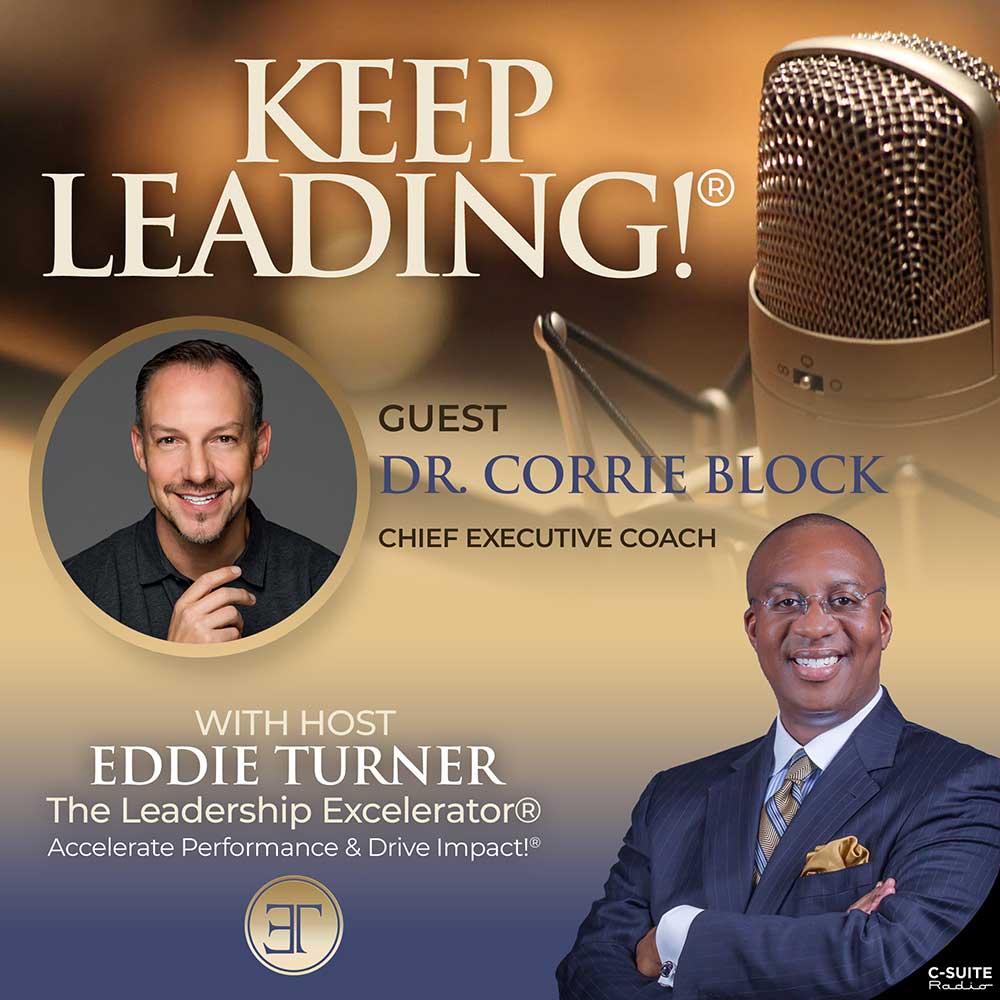
Dr. Corrie Block
Tier-1 Executive Coach │ 2xAmazon #1 Bestselling Author│3xTEDˣSpeaker│Certified Master Neuroplastician & Performance Neuroscience Coach
Chief Executive Coach
Episode Summary
In this episode of the Keep Leading Podcast, host Eddie Turner speaks with Dr. Corrie Block, a leading executive coach, about the unique demands of coaching at the C-suite level. They discuss the need for specialized tools and strategies that go beyond traditional coaching methods, the qualifications required of effective executive coaches, and the importance of love in leadership. Dr. Block emphasizes the need for continuous development and the role of AI in augmenting coaching practices. The conversation concludes with key takeaways on the future of executive coaching and the essential qualities of effective leaders.
Takeaways
- Executive coaching requires a unique set of tools for C-suite leaders.
- Non-advisory coaching may not add value at the executive level.
- CEOs need coaches to improve their performance and that of their organizations.
Keep Leading!® Live
Bio
Dr. Corrie Block helps top-tier executives and entrepreneurs achieve peak performance, meaningful work, and exceptional business outcomes. With over 30 years of experience in executive coaching, strategy, and performance neuroscience, he creates purpose-driven transformations that elevate leadership and enhance organizational results.
Recognized as “UAE’s #1 Executive Coach” by Dr. Marshall Goldsmith, Forbes, SHRM, and CIPD, Dr. Block has guided C-suite leaders, boards, and teams across more than 30 countries. His executive coaching programs have delivered ROI ranging from 53x to 901x, underscoring his measurable impact on both people and performance.
An Amazon Global #1 Bestselling author in Management, Dr. Block ranks #24 globally and #1 in MENA on LeadersHum’s Biggest Voices in Leadership. He has consulted for organizations including Microsoft, PepsiCo, the UN, World Bank, Hilton, and Atlantis Hotels.
A lifelong learner with four postgraduate degrees—including an MBA, a master’s in Global Leadership, a Swiss DBA, and a UK PhD—Dr. Block combines academic rigor with real-world experience, having founded and exited five successful ventures. His insights have been featured in Forbes, CEO Magazine, and Entrepreneur.
Website
https://www.corrieblock.com
LinkedIn
https://www.linkedin.com/in/corrieblock/
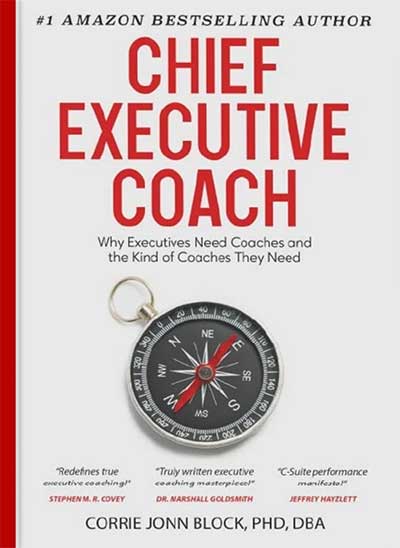
Dr. Corrie Block’s Book
Subscribe, share, and review on Apple Podcasts!
https://podcasts.apple.com/us/podcast/keep-leading/id1461490512
Subscribe, share, and review on Spotify
https://open.spotify.com/show/0I7uAW3x4AWsLe6cnAzHp7?si=14549a44dec3495f
Full Episode Transcripts and Detailed Guest Information
www.KeepLeadingPodcast.com
Keep Leading LIVE (Live Recordings of the Keep Leading!® Podcast)
www.KeepLeadingLive.com
Connect with Eddie Turner
Website: https://www.eddieturnerllc.com
LinkedIn: https://www.linkedin.com/in/eddieturner
About the Keep Leading!® Podcast
The Keep Leading!® podcast is designed for individuals passionate about leadership. It focuses on leadership development and insights. Join your host, Eddie Turner, as he engages with accomplished leaders and influential figures from around the world about their journeys to leadership excellence. Listen as they share their leadership strategies, techniques, and insights.
Share the Inspiration
Are you inspired by what you hear? Share the episode with your network to help spread the message of empowerment and leadership. Use the hashtags #KeepLeading and #KeepLeadingPodcast to join the community of listeners dedicated to continuous growth and excellence in leadership.
Transcript
Eddie Turner:
Hello everyone. Welcome to the Keep Leading Podcast. The Keep Leading Podcast is dedicated to leadership development and insights. I’m your host, Eddie Turner. I work with emerging and experienced leaders to accelerate performance and drive impact through the power of executive coaching, masterful facilitation,
and professional keynote speeches. Today I’m broadcasting live on LinkedIn, Facebook, and YouTube. Feel free to share the link with your colleagues so they can hear this discussion later, or if they have time, even join it now with you to be part of our discussion.
As an executive coach, I think I know a lot about this topic. And then I was introduced to a man who’s literally written the book on executive coaching, but taking it to another level. What does it take to be the executive coach to chief leaders in organizations, those CXOs, as some might call them? My guest today argues that it’s
It’s a little bit more than what might be best serving the rest of an organization. And to be effective at that level, you have to open up a different set of tools. So I wanted to know more about that. So I wanted to read his book and talk to him about his book, Chief Executive Officer. My guest today is called
the number one executive coach in United Arab Emirates by none less than the world’s number one executive coach, Dr. Marshall Goldsmith. My guest today is Dr. Vlach. Corey, welcome to the Keep Leading Podcast.
Corrie Block:
Thank you so much, Eddie. It is such a privilege to be here. I’m so excited. I’m so excited, finally. And you were like, I’m an executive coach and I’m a speaker and I’m a trainer. And I’m like, I’m that too, but I’m not as good as you. And I’m just aspiring to be like Eddie.
Eddie Turner:
no, no, no. In fact, the other powerful thing about your book that we want folks to be able to grab wherever it’s available is that Chief Executive Coach, I’d expect it to have endorsements by Chief Executive Officers, as you do. Some of top corporations have endorsed your book, but you also went to the luminaries in the coaching field. So when Marshall Goldsmith, the world’s number one executive coach and thought leader,
endorses your book. When Dr. Marsha Reynolds, the number one female executive coach, endorses your book, and so many other people who I saw there, I can’t remember all the names now, that’s saying something because they don’t put their endorsement on something lightly. and I can’t forget, Jay, Jay. Jeff Haslett, I don’t know where his name is, Jeffrey Haslett, the CEO of the C-suite Network has also endorsed this book.
Corrie Block:
Yeah.
Corrie Block:
Yeah.
Corrie Block:
Yeah, like, I’m so honored because these people were my gurus and now they’re my friends.
like Marshall and Steven and Mark Covey, whenever they come through Dubai, have lunch, we talk and it’s, yeah, look, I’m not name dropping now. I’m just fanboying. Okay. So I’m actually like, I’ve been a huge fan for years and then suddenly they want to have lunch with me and I’m like, my God. Right. And this is actually happening. But honestly, I think the biggest reaction that I got from really highly established coaches in the industry was thank God somebody said it out loud. Cause we all, we all talk about it. We all talk about it. The fact that
Eddie Turner:
Yeah, saw him out there too, yeah.
Corrie Block:
Non advisory or Socratic coaching is a really great set of tools, but actually doesn’t add value at the C-suite level. And when we’re dealing with a CEO of 80,000 employees, they really need an Olympic set of tools. know, like my coaching roster represents about half a million employees at the moment, which is great. I’m honored by that. But that means that the CEOs that I’m working with, each of them would be representing an average of about 50,000 families. And the decisions they make every day are either going to serve those families or take money away from those families. so for that, you
like you need an Olympic set of tools because they’re Olympic level athletes.
Eddie Turner:
That’s a very powerful way of looking at it. Now, you jumped right in. I was going to ask you a couple other things first, but you jumped right into it. So let’s go there. You said that a lot of people are so happy you said it, that you said it out loud. Said what?
Corrie Block:
Yeah, come on. I’m an open book, mate. I’m an open book. Whatever you want to know.
Corrie Block:
Yeah, yeah. I just said that like, that executive coaching is a niche.
and it can’t be seen as standard coaching. Like this is, it’s a debate that I had with Magdalena Mook actually, because, Magdalena is the president and CEO of ICF, the International Coaching Federation. I’m a huge fan. I’m a big fan of Magdalena. She’s a great leader. She’s an absolutely fantastic leader. And I’m a big fan of ICF. It’s an amazing organization. But when you, when you market non-advisory or Socratic coaching as executive coaching,
then what it does is it spoils the industry because then executives are getting in front of coaches that are just asking rhetorical questions, thinking, look, you know, if I ask the right questions, you have enough information and insight that you’ll just solve your own problems. But that’s not what you need at the Olympic level. Okay. At the Olympic level, they didn’t get there by being unsure of themselves or not looking through all of their options. They’re very good at decision-making in order to get there. What they need are tactics and strategies and information and viewpoints that they haven’t seen before. They need somewhere.
somebody in between a business strategist and a psychologist and if you have those that blend of skills then you can add value but otherwise like a good deal of CEOs that I talked to they say I’ve tried executive coaching and it’s not for me and then I asked them about their experience and they tell me about an ICF certified coach that asked them questions and they’re like yeah this isn’t it’s not adding value and to be sure Eddie the most expensive piece of my coaching isn’t my fee it’s their time okay they’re their time not just not just in missed labor
cost, but in missed opportunity costs because they’re not making other decisions while they’re listening to me and being with me. So if I’m not able to add value to their level of play within an hour, I don’t deserve to be in that room. And that is the job of an executive coach, is to improve the executive performance of an executive in their job. That’s executive coaching. And you can’t just do that if all you have is one set of tools.
Eddie Turner:
Now that’s powerful. And I have to ask you, you said that you made this statement to Magdalena Mook, the CEO of the International Coaching Federation, and what was her response?
Corrie Block:
Yep. Yeah. she’s lovely. She said, well, listen, we have we have 55,000 registered coaches around the world and I think that earns us the right to define what coaching is.
And said, I said, look, I understand what you’re saying. And I would definitely go to McDonald’s for a definition of what burger is, but I would definitely exclude McDonald’s if I was looking for a definition of Kraft burger, because Kraft makes the burger a niche. And by definition, that level of burger, you have to discount the viewpoint of the volume producer in order to define the high level niche.
Eddie Turner:
Mmm.
Eddie Turner:
Ouch.
Corrie Block:
right? You know, like there’s fashion and then there’s luxury fashion and there’s coaching and then there’s executive coaching and by nature of the fact that you’re the most volume producer of certifications in the world, you’ve disqualified yourself from defining what executive coaching is because that’s the highest level of coaching. And it’s the same in athletics, right? There’s a difference between
football coach and an Olympic football coach just because you can coach football doesn’t mean you can coach an Olympic football team and that they’re not going to derive value from what you offer you have to have a specific level of Acumen and and studies and skill and strategy and Yeah, it’s it’s a whole different level of play. So I think we agreed to disagree on that point But yeah, I’m defining what Kraft burger means for my industry and this is this is my definition
That’s it right there.
Eddie Turner:
Well, that’s, and I must say for the record, full disclosure, obviously I’m an ICF certified coach. I bought into the organization, the rigor, the philosophy and all of that. you know, this is intriguing. In fact, when I was reading your book, you made a statement here. You said, if you’re an ICF certified coach, you may be having an emotional allergy to this already.
Corrie Block:
Yeah, yeah.
Corrie Block:
Yeah.
I did say… Yeah, I know, I know.
Eddie Turner:
I laughed. I laughed because I said, yes, everything you’re saying, goes totally against what we’ve been taught, right? But because I’ve also been trained in different schools for coaching, I get what you’re saying. I can hold both thoughts simultaneously, right? And that’s why I also found it interesting that Marsha endorsed your book, because she’s a big, yeah.
Corrie Block:
Yeah. Yeah.
Yes. Yeah. Yeah.
Corrie Block:
This is what’s.
Yeah, look, this is what’s really important. It’s really important to recognize. I’m not saying ICF coaching is bad. I’m saying it’s insufficient. That’s it. It’s a kind of coaching.
But if that’s all you have, then that’s what you think is going to solve the world, right? If the whole, if all you have is a hammer, then the whole world is a nail. So if ICF, if not, if non advisory Socratic coaching is the only set of tools you have, you’ll think that everything. And honestly, it’s a brilliant business move, right? Like if you can convince people that if you can sell people a credential that says anyone can coach anyone else in anything, well, then the whole world is your market, right? And then, and then the rest of the world is their market. It’s brilliant. It’s really brilliant. And from a business standpoint, and it’s great for the coaches.
Eddie Turner:
Yes.
Corrie Block:
but not so much for the Olympic level executives, right? Like if you look at the athletic world, the top, all of the first chair violins at every Philharmonic in the world have a violin coach. It’s the violin coach’s job to coach the violin player to play better violin, but they’re not asking the violin player what they think they should do to get better, okay? And it’s the same at the Olympic level, right? Michael Phelps, the most awarded…
Eddie Turner:
Yes.
Corrie Block:
Olympian in all of history his his coach was Bob Bowman through all five Olympic games right 39 world records and 28 medals Bob Bowman I guarantee you never asked Michael. Hey, what do you think you should do to get better? No, that’s that’s not Olympic coaching. Okay, that’s yes It’s a Socratic method it is a kind of coaching and it’s a set of tools, but that’s not what Michael Phelps needs That’s not what the first-chair violin player needs and that is certainly not what any CEO that I’ve ever worked with needs
Eddie Turner:
Okay, so what do they need, right? Because you mentioned earlier that they need something between a psychologist and a business strategist. You have four different degrees where you’ve got four different graduate degrees, MBA, couple of other masters, a PhD, and all kind of things, right? So for executives looking for that next tier coach, do they need somebody with all those degrees like yourself?
Corrie Block:
Yeah, awesome. Yes. Yeah. Yeah.
Corrie Block:
Mm-hmm.
Eddie Turner:
And then what do we find these people?
Corrie Block:
Yeah, look The degrees no I would say look for me minimum requirement is a master’s degree either in psychology or business, right? So an mba or or masters in psychology only because at the master’s degree you learn how to learn better at the phd level You’ll learn that you’ll never know anything at all, right? Like you you finally have access to so much information that you learn that you’ll never be reasonably confident about your conclusion about anything because you can’t interact with enough information fast enough, so
it really humbles you in a doctorate degree. But yeah, I think for people who are coaching at the CEO level in organizations with a thousand or more employees in it,
minimum requirement is a master’s degree in either psychology or business 10 years in business or either 10 years in psychology or 10 years in business and then the research is really clear actually it’s super interesting it actually doesn’t matter if you come from business and learn psychology to become an executive coach or if you come from psychology and learn business to become an executive coach both of those paths tend to be really really effective what’s not effective is if you avoid either of them if you come from just business and you’re like you’re only counting on your previous
experience then you’re subject to knowledge half-life right the knowledge half-life in business is about five years in technology it’s about two years so if you take a CEO who’s been you know CEO in a technology firm and they’ve been out of the
Top job for four years all of their experience is worth about 25 percent of what it would have been because of the knowledge Half-life of the industry so what they need then is they need they need high-level coaching experience and they need continuous development and that you get by Not just certifications and degrees obviously but by devouring books learning new tool kits studying psychology podcasts Having great conversations with people like Stephen Covey and Marshall Goldsmith really help, you know Because we’re trying to forward the industry at the same
Corrie Block:
time. But yes, at that level, at the Olympic level, an Olympic athlete needs an Olympic coach and the Olympic coach can’t play the game as well as their athlete can but they can coach their athlete at their athlete’s level of play and that’s a huge difference.
Eddie Turner:
Thank you for that definition. So that definition now gives executives looking for a coach a set of standards to look for, but then also for coaches, a set of standards to aspire to. What else is missing?
Corrie Block:
Yeah.
Corrie Block:
100 % 100 % we we need more people. We need more people. Look, I can’t possibly meet the demand of my market. Okay, we’ve got thousands of High-level CEOs and executives and just in my just in the UAE. I can’t possibly do that, right? I tell my whole coaching roster is 12 I take 12 and then I’m done that is it because I care about my clients and I want to invest in them and I’m looking at their level of play and I’m helping each of them in their their particular game So yeah, like we really just need thousands
of more amazing executive coaches and there’s not enough of us on the field that are capable of coaching a CEO of a large organization at their level of play. We need more. We’re starving.
Eddie Turner:
Okay, very insightful. And is that what motivated you to write this book?
Corrie Block:
Yeah, actually, interesting Eddie, because all of my books are product of my irritation with the world. So I study, okay? Look, I don’t…
Eddie Turner:
Okay. That’s one way to sit down and pick up the pen.
Corrie Block:
I don’t play golf and I don’t watch football. I don’t watch any sports at all. I read, I write journal articles, and because my wife has forbidden me from doing a third doctorate degree, I write a book every year. And so the book that I write every year is a product of something that I’m irritated about. And so like two years ago, it was love at work. I was irritated about the fact that like the highest quality of relationship between two people is intentionally exiled from the place where we spend the most time with other people. That didn’t seem logical to me.
Eddie Turner:
Okay.
Corrie Block:
So I wrote a book about that because I couldn’t find it. You know, I was looking around for I think Simon Sinek would have done a better job. Amy Edmondson would have definitely done a better job than I did, but nobody had written a book on the highest form of leadership, which is also love. And I felt obliged to write it. Yeah, so I’m irritated that I had to write that. And then I’m irritated that I had to write Chief Executive Coach because it just seemed to me that I was having too many conversations with executives whose performance would 100 % improve.
which means that they would make more money personally because they would meet their KPIs targets and get their bonuses faster and the board would love them more.
That’s what actually happens. And their companies would make more money because, well, culture starts at the top. Right? So if a CEO’s performance goes up, the entire organization’s performance goes up. The research behind this is so solid. We know this. So why boards of directors aren’t requiring executive coaching for their Olympic level CEOs is absolutely beyond me. They’re not just robbing the CEO of their best game, right? They’re not just robbing them of their highest development as an individual, but
but the company of its best performance and their shareholders of their maximum profits, they’re taking money out of people’s hands and leaving it on the table because they don’t want to offend the CEO and say, listen, at this level of play, you kind of need to show up to the Olympics with a coach. That’s a minimum requirement now. And it…
Eddie Turner:
Yeah. Well, that is a good point because not everyone is doing that, but some are certainly. And one of the most famous was when Eric Schmidt was running Google, he cited the fact that one of the chair of his board, who was a big believer to power coaching, insisted that he get a coach.
And he said he didn’t need one. And then the big sound by a lot of us as coaches have repurposed is that 30 seconds where he talks about the fact that every CEO needs a coach. But it came from his board member.
Corrie Block:
Absolutely, and he’s not alone. You know his coach was Bill Campbell So Bill Campbell was was Eric Schmidt’s coach. Yeah, so interestingly Bill Campbell wasn’t all that
Eddie Turner:
Yes, Melondale coach, yes. But John, John, John Doar was the chair of the board who insisted that he get the coach. Yes. Yes.
Corrie Block:
Yep, 100 % and he was right and he was right. Do you know why he was right? Because you don’t know who Brian Pinkerton is. Do you know? Of course not. Brian Pinkerton invented web crawler, which did exactly the same service as Google did. He had a four year first mover advantage. four years first mover advantage, Brian Pinkerton, web crawler. But you don’t know about him because in 1998 Google
Eddie Turner:
Yes.
Eddie Turner:
Yes.
Corrie Block:
I’m Bill Campbell.
And Eric Schmidt, Larry Page and Sundar Pichai were all coached by Bill Campbell. He was consistent for all of them. And Bill Campbell was never as business successful as any of them. Okay. His last major global post was he was the head of sales for Kodak when Kodak was tanking in the late nineties, you know, when everything was switching to digital and Kodak was hanging on to film. it was his career. It wasn’t illustrious enough for him to have that kind of influence.
And yet there he was. And that’s the difference between web crawler and Google. And that’s why you know all of these people’s names is because when you have a really high performing team and really Olympic level athletes, yeah, coaching is a benefit for talent. It’s not therapy. It’s not cheerleading. And it’s certainly not Socratic.
Eddie Turner:
Yes. Well, IT was my first career and I did it in the 90s when a lot of that stuff was developing. I know the whole, I know the web crawler story and the Netscape and all that, right? And that whole Genesis and stuff was unfolding. I don’t necessarily remember everybody’s names like the guy that started it, Mark Anderson, you know, all those guys, right? So all of that was, you know, my time, right? And I still get jazzed on that. I switched over to this stuff later.
Corrie Block:
You’re not that old, Eddie. Come on now. You’re not that old. Yeah.
Amazing.
Yeah
Corrie Block:
Yeah.
Eddie Turner:
But IT, especially in Monalisa, was becoming a big deal. that you and I can talk about that for a long time, but also this concept of love at work. I love what you said about that. It sounds like we should do another interview, but I love that concept as well. So yeah, so this is really powerful. Go ahead. Yeah, this is really powerful. And then when…
Corrie Block:
Amazing.
Corrie Block:
Yeah, we… Thanks, man. Thank you. No, I’m saying I’m happy to do another interview. love at work. Next time. Next time.
Eddie Turner:
Yeah, yeah, I like that. I know how I missed that when I was doing your, I always do my little prep before sessions. So this is also something that I want you to talk about because this can be very controversial as well. Does an executive coach need experience as an executive to be an executive coach?
Corrie Block:
You
Corrie Block:
Scientifically, no. research is showing that if you have experience as a psychologist…
you can learn enough business to be useful to your executive in their level of play because a good deal of business at that level really is psychology. It’s leadership, management, negotiations, confidence, decision-making, all of that is frameworked on evolutionary and currency psychology. it’s just, if you have a psychology background, you can bring that in and learn the business. Otherwise, yeah, it helps to have some experience in the game.
It would be like, okay, look, you can coach an Olympic athlete, but you’re going to be better if you have some experience doing sports. Even if you were never a winner yourself, if you’ve done sports mechanically, it helps, right? But just remember Bob Bowman, was, who was Michael Phelps’s coach through five Olympic games, right? He was never a competitive swimmer. He swam, I think for his university team for about 18 months in the mid eighties, but you know, swimming in 1985 and swimming in 2000 when Michael took the first
Olympic medal. It was like it was a completely different sport, right? So it helps to understand a bit of the mechanics, but I guarantee you Bob Bowman’s experience in swimming was not valuable when he was coaching Michael Phelps. What was really valuable was his experience coaching swimmers and breaking down. actually, it was interesting. Michael called him a master tactician, right? Somebody with formulas and methods. He broke down every stroke.
He took everything apart and then he would fix one thing at a time until Michael was moving perfectly through the water. that was Bob’s, his gift was to able to analyze Michael’s level of play, pick it apart and then develop tactics and practices and exercises to help him fix every tiny little level of play. And that’s what a good executive coach does is we look at the level of play of our executive. We say, where could performance improve?
Corrie Block:
How can we improve on trust, collaboration, information sharing, decision making quality, input seeking behavior? There’s a lot of these things that we take into consideration, but you can come from psychology and learn the business game, or you can come from business and learn the psychology game, but both I think are necessary at the executive level.
Eddie Turner:
And there’s a lot happening in the industry right now. It’s in a state of transition. And we might even say it’s under assault, as every industry is, because of AI. Where do you see executive coaches, or the profession of executive coaching at large, should say, ahead and over the next five years?
Corrie Block:
Yeah.
Corrie Block:
Yeah, yeah. Yeah, look, I don’t think AI is gonna replace coaching, but I think coaches that use it will replace those that don’t. So it’s like any technology, email, computers, calculators before that. Adopting technology helps you to stay in your role. It doesn’t get you ahead.
Right, but those who use it will end up outgrowing those who don’t and that’s just the way that it is you can age out of coaching if you don’t learn how to augment yourself with artificial intelligence. So AI is really actually helping in terms of psychometrics and synthesis team building. So again, you take the team psychometrics from let’s say you do an MBTI five types and and gallop strength binder, for example, you can plug all that into GPT five and it’ll come up with a great synthesis for you and it’ll tell you
where the strengths and weaknesses are in each of the pairs for each of the people on the executive committee and it’ll tell you what the stress behavior is probably going to look like and the triggers that they’ll that they’re probably going to exhibit well that saves me tons of time okay and that’s the starting place for the conversation when we’re looking at a team’s level of play at the executive level you know you got 80 000 families in your care you kind of want the executive committee to be performing at their natural best and if i can get them there a week faster by using an ai then that’s great
but it’s an augmentation, right? It’s not a replacement.
Eddie Turner:
No.
Well, that’s an interesting concept, right? That it’s an augmentation rather than a replacement. Because there are some places that are only giving their employees AI coaching. And then there are other people that are saying, well, hey, I’m not going to hire a real coach because I can just run it through the different AIs that are out there and get the answers I need.
Corrie Block:
Look, at a mid-management level, I think they’re right. I do. I think AI can replace most of what mid-management need from an executive coach.
At the highest level of play you’re dealing with Olympians, right? So by definition I’ll give you a parallel here in the UAE. We have three airlines Okay, we have three airlines, which means there are three CEOs of airlines in this country Anytime you have only three people playing at the highest global level in your country. You have an olympic sport Okay, there are two exactly two telecommunications CEOs in my country That’s it when you have two people playing at the at the national at the global level
for your country. It’s an Olympic level of sport. So you need somebody who’s going to be able to help you to break a world record, whatever that might look like in telecommunications or aviation, FMCG, oil and gas, it’s all the same. These CEOs are trying to lead their companies to do things that have never been done before. And that’s the very definition of a world record. So when you do that, you’re going to have to have a level of creativity that a derivative AI isn’t going to be able to have because they’re dealing with information that’s already
been had and their level of creativity still isn’t up to the standard of hey listen let’s figure out how to make you run faster than any human has ever been measured running before. It’s a different level of thought. So yeah at the mid-management level I can see it I can see it like helping you process business decisions and negotiations and interpersonal conflict but at the executive level you’re you’re gonna need an Olympic coach.
Eddie Turner:
Okay, thank you for sharing that. What’s the most important message you want our listeners to take away from our conversation today?
Corrie Block:
I love you and that’s not weird and it’s not unprofessional. I love you and there’s nothing to do with romance or sexuality because I love my mother and I love my kids and it’s okay for me to love you because all that means is I’m going to use my resources to try to improve the quality of your life as much as I can for as long as you’ll let me and that is the most natural thing I can think of.
Eddie Turner:
Okay, is there a quote that you use that helps you to keep leading?
Corrie Block:
There’s so many. There’s so many. Yeah. And it’s actually from John Maxwell. Leadership is a follower led sport. Managers are chosen by other managers, but leaders are chosen by followers. No leader is created by another leader. And we don’t follow leaders because they’re great. We follow leaders because doing so improves the quality of our lives somehow. are deriving value from emulating them, from learning from them, from…
know, modeling after them, whatever it is that they’re doing, improves our lives. Because if it didn’t, we wouldn’t follow them. So John Maxwell also said famously, is like, you want to know whether or not you’re a leader, just look behind you. Because if nobody’s following you, you’re just going for a walk.
Eddie Turner:
Well said. Thank you very much. Dr. Corey Block, please tell my listeners where they can learn more about you, follow you, and stay connected to you.
Corrie Block:
Absolutely, yeah, I’m sure that there will be a link in the description to the video below. www.coryblock.com is the easiest place to find me and LinkedIn at Cory Block.
Eddie Turner:
Yes, so this is going to be available wherever you get podcasts because after this session, this will still live on LinkedIn, Facebook, and YouTube. But also you will be getting on Spotify because this is part of the C-suite radio network. We’re turning up the volume on business. And so in all those show notes, you will see the links to Dr. Block so that you can access the content and go there.
Corrie Block:
Nice.
Eddie Turner:
And a reminder that the show is also sponsored by Papillon MDC. My friends out of Canada, when we’re talking about coaching, how can we not mention that they have Decision X, a bespoke on-demand service designed to help your leaders overcome indecision and move forward with their work. So visit Papillon, P-A-P-I-L-L-O-N-M-D-C.
to learn how you can advance your team, get them unstuck, shift perspective today. All right, Dr. Block, thank you so much. It’s been such a pleasure talking with you. I could talk to you for hours. So we definitely gotta get you back on, okay?
Corrie Block:
My pleasure, Eddie. My pleasure, Eddie. It’s so good. And wherever you are, wherever you are, just love somebody near you, okay?
Eddie Turner:
All right, sounds good. That concludes this episode, everyone. Thank you for listening. I’m Eddie Turner, the Leadership Accelerator, reminding you that leadership is not about our title or our position. Leadership is action. Leadership is an activity. It’s not the case of once a leader, always a leader. It’s not a garment that we put on and take off. We must be a leader at our core.
and allow it to emanate in all we do. So whatever you’re doing, always keep leading.