
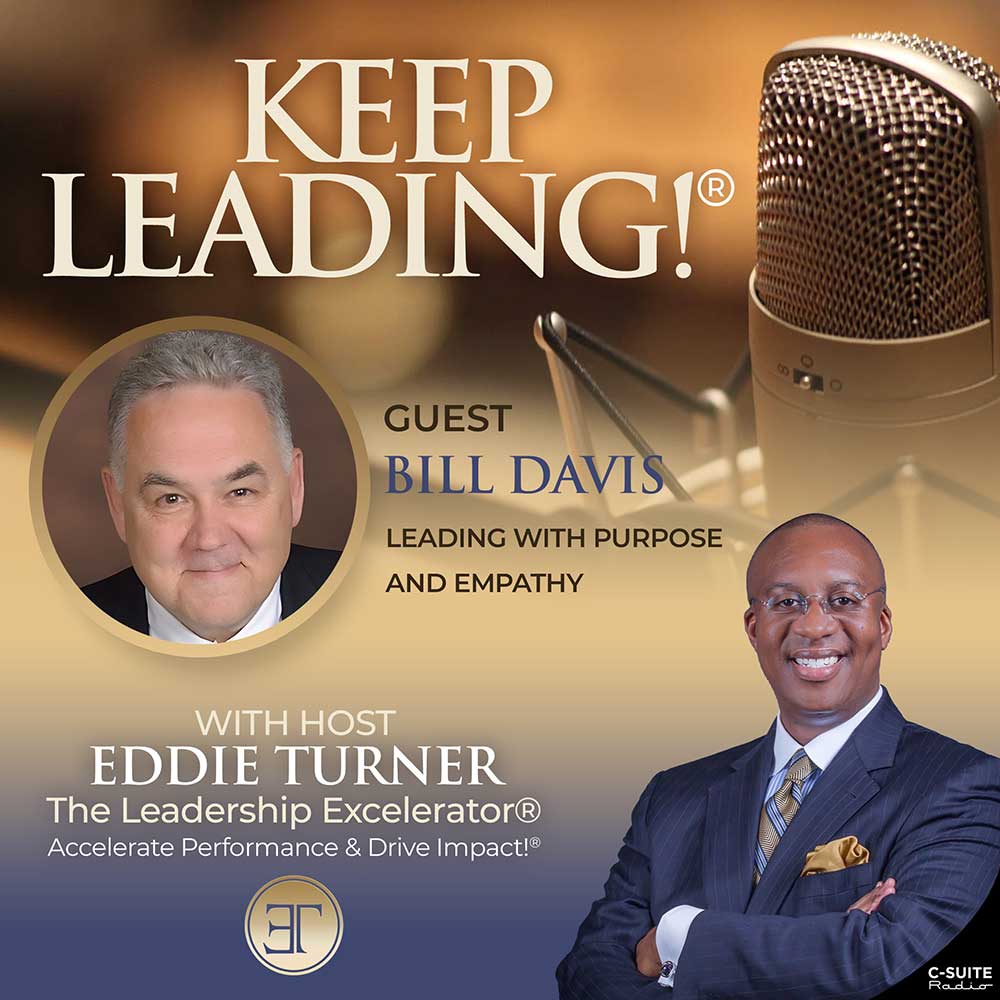
Bill Davis
Program Chair | Assistant Professor at the University of Arizona Global Campus
Leading With Purpose and Empathy
Episode Summary
Join me on the Keep Leading!® podcast for an enlightening episode on “Leading with Purpose and Empathy.” I interviewed Bill Davis, Chair of the University of Arizona Global Campus Chair—Forbes School of Business & Technology Bachelor of Arts in Operations Management and Analysis (BAOMA) Advisory Board. Bill emphasized the critical need for leaders to embody care, empathy, and compassion by taking initiative and embracing servant leadership.
Whether you are a seasoned leader or just starting your leadership journey, this episode will equip you with the knowledge and tools to lead more effectively and compassionately. Tune in to discover how you can make a lasting impact by leading with heart and vision.
Keep Leading!® Live
60 Second Videos
About Bill Davis
Bill Davis, Chair of the University of Arizona Global Campus – Forbes School of Business & Technology Bachelor of Arts in Operations Management and Analysis (BAOMA) Advisory Board, boasts a distinguished career in both the corporate and academic worlds. Over three decades at PepsiCo saw him in numerous leadership roles, transitioning seamlessly into academia, where he has dedicated the last 20 years to teaching over 300 courses online and in-person. His extensive background spans consulting, management, leadership, sales, marketing, strategic planning, human resources, and organizational change.
Bill has earned numerous accolades for teaching, leadership, and scholarship in academia, including the Distinguished CAP Award for Excellence in Teaching and the Institute of Certified Professional Manager’s (ICPM) Managerial Excellence Award. He has authored and co-authored over 160 articles and two books, contributing significantly to higher education and business knowledge. Bill’s dedication to student success and academic excellence is evident through his numerous educational roles and achievements.
Website
https://www.uagc.edu/about/faculty/bill-davis
LinkedIn
https://www.linkedin.com/in/billdavisforbes/
Leadership Quote
“Your Network is your Net Worth”
Subscribe, share, and review on Apple Podcasts!
https://podcasts.apple.com/us/podcast/keep-leading/id1461490512
Subscribe, share, and review on Spotify
https://open.spotify.com/show/0I7uAW3x4AWsLe6cnAzHp7?si=14549a44dec3495f
Full Episode Transcripts and Detailed Guest Information
www.KeepLeadingPodcast.com
Keep Leading LIVE (Live Recordings of the Keep Leading!® Podcast)
www.KeepLeadingLive.com
Connect with Eddie Turner
Website: https://www.eddieturnerllc.com
LinkedIn: https://www.linkedin.com/in/eddieturner
Twitter: https://twitter.com/eddieturnerjr
Facebook: https://www.facebook.com/eddieturnerllc
Instagram: https://www.instagram.com/eddieturnerjr/
YouTube: http://www.youtube.com/EddieTurnerJr
LinkedIn Business: https://www.linkedin.com/company/eddie-turner-llc
TikTok: https://www.tiktok.com/@eddieturnerllc
Bluesky: https://bsky.app/profile/eddieturner.bsky.social
Agent: https://gray-miller-agency.webflow.io/roster/eddie-turner
100 Coaches Agency: https://www.100coaches.com/coaches/profiles/eddie-turner/
About the Keep Leading!® Podcast
The Keep Leading!® podcast is for people passionate about leadership. It is dedicated to leadership development and insights. Join your host, Eddie Turner, The Leadership Excelerator®, as he speaks with accomplished leaders and people of influence across the globe about their journeys to leadership excellence. Listen as they share leadership strategies, techniques, and insights.
Share the Inspiration
Inspired by what you hear? Share the episode with your network and help spread the message of empowerment and leadership. Use the hashtag #KeepLeadingPodcast and join the community of listeners who are dedicated to continuous growth and leadership excellence.
Transcript
Eddie:
Hello everyone. Welcome to another episode of Keep Leading Live. Keep Leading Live and the Keep Leading podcast are dedicated to leadership development and insights. I am your host, Eddie Turner, the Leadership Accelerator. I work with leaders to accelerate performance and drive impact through the power of executive coaching, masterful facilitation, and keynote speeches.
We’re streaming live today on Facebook, YouTube, and of course, LinkedIn. If you are tuned in with us, we want you to be a part of our conversation. Feel free to drop a question in the comment section. Tell us where you’re from. We want to hear from you. And hit that share button and then your colleagues can be able to join us as well or be able to see the recording instantly as it concludes. And if you’re not following me and my guests on social media, I’m going to invite you to do that. We’d love to have you join our community.
Well, of course, on the Keep Leading podcast, I love talking about leadership. And there are a lot of ways to exercise leadership. There is no one formula. There’s not just this perfect way that we can summarize all the great ways to exercise leadership. However, there are many. And my guest today suggests that one of the most effective ways of leading is to lead with purpose and empathy. Joining me today on the Keep Leading podcast, Keep Leading Live, to discuss leading with purpose and empathy is Bill Davis.
Bill Davis is the chair of the University of Arizona’s Global Campus, Forbes School of Business and Technologies, Bachelor of Arts, Operations Management and Analysis. He’s also the chair of our board. He boasts a distinguished career in both corporate and academia. Over three decades at Pepsico saw him in numerous leadership roles and then he transitioned into academia where he spent the last 20 years teaching over 300 courses.
Bill has earned numerous accolades for his teaching, leadership, and scholarship in academia. He’s authored and co-authored over 160 articles and two books. Now, I did not know Bill when I lived in Chicago, but I have to tell you that any of my interactions with Bill, one of the nicest men you’ll ever meet, always reminds me of home. He is the epitome of all things Chicago, especially the Bears and the Cubs. Here with me today is Bill Davis. Bill, welcome to Keep Leading Live.
Bill:
Eddie, thank you so much for that great introduction. It’s such a pleasure and an honor to be here. I look at this as a platform to pay it forward. Your show is first class. I’ve watched your podcast before and I’ve certainly enjoyed working with you on our Board of Advisors and I appreciate you for all the input and insights you’ve given us and, you know, you’re a lifter and I’d be remiss if I did not start with this quote. I like to start my days with a leadership quote now and then. But one of the things you said Eddie a while back and I read your book, and here’s what you said. You said, “Leadership is about making people feel valued and included while inspiring them to be their best selves.” And that came from your book, 140 Simple Messages. And what I’d like to say is you are giving me a platform here to be my best self because I love teaching. I have a passion for leading. I love leadership. I love marketing. I like seeing progress and to be on your show and also to teach at the University of Arizona Global Campus is an honor and a pleasure for me because I’m able to reach people and help people coach. You know, I consider myself a leader coach and I just do the best I can to further others’ success. So thank you very much, Eddie.
Eddie:
Well, thank you for those kind words and thank you for sharing that, Bill. And we have several folks who have joined us across platforms. The platform LinkedIn did not pass the ID, but one person who’s joined us says, “Greetings and good afternoon. Keep the positive energy and vibes going.” So we want to thank that individual for sharing their comments with us. We appreciate that. Another person says, “Hello from Southern Mississippi.” I’m going to assume the MS stands for, “representing the University of Arizona’s Global Campus.” So you have a colleague there or a student. I’m not sure which capacity.
Bill:
Excellent, excellent.
Eddie:
And I said Mississippi because in my mind I hesitated because I’m like, is it Mississippi or Missouri? My two-state abbreviations lack of knowledge there is showcasing itself….
Bill:
And I’m going to say based on our Champs program, that could be Larissa Armstead. She is a great leader in our Champs program, you know, where they do mentoring and coaching for students. So if that is her, welcome Larissa, but I know we’ve got a good audience here, so very nice.
Eddie:
Well, since you brought it up and since folks have chimed in from that aspect, I was going to ask you about this at the end of our interview. Let’s talk about it now. For folks who are not aware, please tell us what does it mean for—and let me see, I’m not sure if this is going to show right. Let’s see, there we go. What does it mean to pursue a Bachelor of Arts in Operations Management and Analysis?
Bill:
Well, I will tell you this prepares you for so many opportunities and what I really enjoy about this particular program, you know, it helps individuals to become general managers, operational managers, analysis, quality managers. You know, we have 15 core courses in here that can prepare you very well. And thanks to some of your inputs too, Eddie, in the Board of Advisors, we’ve even added a leadership and motivation course in there because you have to deal with people, right? But this particular program will give you, you know, skills in decision modeling, accounting, finance, it’ll give you statistics. It’s all there bundled in those 15. And of course, you go through your gen ads, but when you get into these particular courses we have, such a great selection, project management, it’s all there, you know, like I said from accounting and you know, the good thing that Chuck Muse said that was one of the executives in Beyond Meat in one of our recent meetings to a student. The student said, you know, some of the 15 courses I do extremely well in and some I’m kind of average and he inputted in there and he said this and I thought it was pretty profound, so I’d be remiss if I didn’t repeat it. He said, you know, as he was an executive, you know, he said the first thing is show up with the right attitude, you know, come in. He says and you’re not going to be exceptional in every course. He said, but if you know how they fit into a business and you understand the purpose of accounting, finance, if you understand, you know, leadership, marketing, and the ones you’re good at, you’ll shine in and you’ll grow in. So that’s kind of the one thing that we do here is we just prepare for careers. We want our students, we want adult learners to be successful, to be able to thrive. We are there as coaches. You know, I mentioned the Champs program. I think that’s very good. Our Chris Services. We’ve got so many components that bring it all together as one team and we’re all better together in terms of helping students move forward. And Eddie, you’re part of that. And our board is a part of it. I’d be remiss if we didn’t recognize Scott Mullen, Chuck Muse, Dr. Sophia Satterwhite, Dr. Avisha Sadi Jihad, and of course yourself. So what a great dynamic, what great support for the greater good. So thank you.
Eddie:
Well, thank you and you do an outstanding job leading us and this program is truly transforming lives. I love being a part of it because of seeing the real-life results in the lives of students and how their lives are better and what they’re able to do with employment after the program and how their careers truly are changed as a result. So kudos to you for the job you’re doing, kudos to the university for having this a program that really answers a need in the marketplace.
Bill:
Yeah, thank you.
Eddie:
And of course, you do a great job leading our board. We’re some really accomplished people on there. Now, Bill, there’s some other folks who have joined us who want to comment here. Let me see. Oh, this was affirmation of comment earlier. She says, “My pleasure. Bill is an inspiration. I’m happy to call him a friend and cohort.” Very nice. Thank you for sharing that. And yes, this person is affirming that it is Mississippi and this is Chivas Matthews, who I believe I met on one of our board advisory calls. Some great work that he’s doing. He’s another success story from the program. So thank you, Chivas, for your input there…. Leo Patrick. He’s joining us on LinkedIn. Greetings from Scottsdale, Arizona. Go Cards. Thank you, Leo. We appreciate you. Karen Jensen. She says, “Hi, Bill and Eddie.” Karen Jensen here. I can personally attest to the fact that Bill and his leading with purpose and empathy as I work with him at UAGC. Thanks for this great event. You got a lot of fans, Bill.
Bill:
Thank you, Karen.
Eddie:
Thanks, Karen. And I can certainly attest that Eddie, says another LinkedIn user. And finally, one person says here, “Bill’s exemplary leadership knowledge really helps you adapt your current leadership style with a proven corporate leadership success. With his advice, I can maintain what the Navy taught me with what is expected in the corporate sector.” So beautiful. So I’m not sure why I’m not getting the names today. I got Leo’s, but all these others I’ve been come through. Thank you for your contribution. We appreciate your affirmation of Bill, which is one of the reasons I invited him on here. I think the world of Bill, but also let us know how the program has helped you. So we appreciate that, folks, very much.
Bill:
Mhm.
Eddie:
So Bill, let’s talk about that, man. This idea of leading with purpose and empathy. Tell us what makes that important.
Bill:
Well, I, you know, so important to have purposeful goals. You know, for example, I’ll stay current here with education and one of the things that I’ve done is embraced our vision and that is to empower, enrich, support, and graduate students. You know, so the one thing that I try to do is keep my objectivity and understand my purpose, you know, to share, to care, to give back and that drives me. So when I look at the students and I look at my commitment and dedication and my colleagues and friends’ dedication and on the team to further student success, that is very synergistic. I mean there’s great synergy there, there’s momentum and I just love what I do. And when you love what you do, you’re more creative and you model those behaviors, you know, but you have to be committed and dedicated to leading with purpose and to find that purpose. And, you know, Eddie, I’ll just as an easy example, just seeing the intro to your show demonstrates to me that you love what you do. You have a strong sense of purpose for educating and paying it forward and helping people. But purpose is just our understanding our why. Why do we do things and, you know, again, mine is to inspire and guide others. I’ve developed a lot of leaders throughout my career from the bottom up when I’m talking about my careers in the Joyce Beverage 7 Up Independent Distributor to my management executive roles at Pepsi to transitioning all into the higher education in the marketplace. You know, I like seeing people succeed and I like to lead, lift, equip, and support others so they’re successful. And also too, it doesn’t end there though. You kind of nurture them in their transformation. So you’re always engaged, you know, to manage yourself and also help them grow and lift. And purpose anchors a leader. It anchors you and it provides direction and resilience and that passion I have has always allowed me to bounce back during challenges or times maybe when it didn’t quite go right, but it’s all about, you know, alignment, aligning to the organization that you serve, you know, the goals, the critical goals, the things, keeping those top in mind. When I was younger and all I always said, you know, truth in business is the bottom line. So I was always anchored, you know, we got to have business acumen too and I have that. But I also understand too it’s so important on the people’s side to develop that rapport, find that common ground, align to the mission, help people understand how they impact that mission and also letting them know to talk the walk and walk the talk and realize that people are watching more how you walk it than you talk it. The first way you establish credibility is through your words. The next part is through your actions. So you have to remember that you’re on all the time, whether that’s a discussion in the car, whether that’s coaching someone in a store, helping someone, whether it’s a student on a one-on-one, whether it’s in a classroom, you’re on and people are mirroring your reaction sometimes. So when you lead with EQ and you lead with purpose and you put yourself in their shoes and it’s not hard to see where someone might be at because we were there. You know, and we realize that this journey brings challenges. So you can remember, I can remember for example back when I was pursuing my college education and I had the wonderful jobs in Chicago on the south and north sides and I’d get in the car to go to my class that was in Oakbrook or somewhere and, you know, I was always on the go, but I understood all those challenges and the one thing I have to say about UAGC is our culture care that we have ingrained a whole caring outlook to how we do things. You know, we pause. We understand students and we understand the students that are thriving and how to give them the right words at the right time so they continue or give them the coaching they need. So I hope that kind of covers it because what are some—
Eddie:
It does. It does. You know….
Eddie:
It does, Bill. Thank you. And you gave me a lot there. So let me just unpack that a little bit if I might. First, you slid something in there I’ve never heard, Bill. You said I have to lead, lift, and equip. That’s a beautiful way of saying it. And to your point about how we lead by example, yes, my grandmother used to say, “Don’t preach me a sermon, show me one.” So it’s so important to model effective leadership and clearly by all the comments that we’ve received here today, you are doing just that. In fact, we’ve had a couple of other people weigh in here. We’ve got Daniel Castell, who I believe is in Panama. I actually just got his book recently and I promoted that book. Yeah, so Daniel’s new book just came out in English and Spanish. So Daniel, thank you for letting us know you think this is a great episode. Rebecca Good. She says, “Thank you for this interview, Eddie. Bill is sharing such valuable insights on leading with purpose and empathy. His perspective on servant leadership is always truly inspiring.” Thank you, Rebecca. Thank you, Daniel. And then also, we have Rodney. Rodney Donley says, “Greetings from Dixon, Illinois. Go Cubs.” We appreciate that, Rodney. Thank you. Now, Rebecca brings up a good point there. Another aspect of leadership, Bill, that you’ve written about is servant leadership. How does that factor to this concept of leading with purpose and empathy?
Bill:
Sure. One of the things I dedicated myself to early on and it probably has to do with the mentality that I picked up about customer service and care in my early days. You know, I knew that if I didn’t be reliable, credible, you know, store door delivery, working in different business channels as I serviced accounts like supermarkets and convenience stores. I’m talking about the front line as a front line performer that I knew those fundamentals and I knew that those things had to be at a standard. So that’s the one thing that I learned is service means sales, right? And that’s something I kind of took with me into the market. But establishing credibility so people saw you as reliable, honest, dependable, could count on you because that worked really well in relationship marketing. Now, to take that into my administrative roles and to grow in organizations like Pepsi, etc. and move up the ladder and get more responsibility, I realized that serving people was the utmost priority, you know, to be there, to be reliable. You know, in servant leadership, I adapted and embraced a long time ago and to work selflessly with followers, you know, your teammates, your employees, everyone to achieve the shared goals that we’re all looking for and that’s when I talk about alignment to organizational goals, strategies, because that’s so important and it improves the collective rather than individual welfare. Now, I always tried to use equity in there, understand that everybody is a little different so I have to reach people differently too. But I wanted to stand for something. I wanted to stand for my ethical leadership, for example, a system code of conduct based on moral and legal duties and obligations. That’s something that I remember through the years. I’ve got pretty good mental acuity so I’ll be popping in some of that here and there and I don’t mean that from an ego side. It’s just that I’ve been taught by so many great leaders and I’ve learned on and through and off the job that I love those concepts, but I really truly believe in ethical leadership.
Eddie:
And that’s one of the great values you bring to the organization. You’re not just someone who’s an academic, which is nothing wrong with that, but you have this excellent corporate career that you’re able to kind of fold in the practical aspects of leadership and how that looks inside an organization, which is really important in a program like this….
Bill:
Yeah, and I appreciate that Eddie because, you know, I have so much respect for people that have achieved all of these accomplishments, you know, and I credit education for my success too because it gave me my master’s degree and business administration degree gave me the tools to anchor on and understand those theories. But the thing that I always understood too is to how to break that down so it’s practical so that people could apply this, you know, on and through the job so it would lift and so forth. But the whole idea of serving people, those servant leadership, that’s one aspect of me that I’ve embraced. I believe in being a servant leader, but I also believe in being an ethical leader. I believe in being authentic and genuine and to model consistency. You know, and that goes back to that phrase that I talked about and I’m going to give John Maxwell credit for that because I went to his training and he always would say, you know, model consistency, lead and lift others, equip them for success and have always have a positive attitude and nurture them in their transformation. So that kind of thing became part of my DNA and, you know, and I just try to serve. I mean, I am lined up to UAGC. I love our leadership. We have, and I learn from everybody. You know, one of the things that I’ve learned in my career and I’ve had a long one is that I learned from people I haven’t met. I watched their videos, podcasts, read their books. I’ve learned from people maybe that I might not have been 100% aligned for, but I had to work for them and I did work for them and serve them well, but maybe they taught me things that maybe I would do or not do. And then also too, the people that took an interest in me like you did here to allow me to be on your wonderful podcast and to thrive, to pay it forward. So all of that I value and I truly value the experiential learning that I’ve obtained as well as the formal learning, but I just try to make it practical and break it down. So.
Eddie:
Thank you for highlighting that, Bill. That’s so important. So that aspect of servant leadership and how it factors in. We have Daniel amplifying here saying, “Thanks a lot, Eddie and Bill. Talk the walk and walk the talk. Great insight.” We appreciate you commenting there, Daniel. Also from LinkedIn, we don’t have a name on this one, unfortunately, but it says, “Great points all around. Comments from collective audience included. I never would have imagined my career would have been would have landed me here. Support structures in business aren’t new in our society. However, adapting to changes within can be a challenge through nuances every day.” We thank you for your contribution. And finally here, we have a comment again from LinkedIn. We don’t have a name. “You learn fairly quickly that empathy in leadership is not mandatory. It’s a choice. What is great about Bill and Eddie’s approach to leadership is the courage they promote to address the uncomfortable aspects of leadership and use empathy, not just compassion.” That’s Chivas. So thank you for typing your name in there for Chivas. We appreciate that. Good. So I want to separate those two and what makes that important. But before I do that, I want to take a moment to step away and highlight the sponsor of the Keep Leading podcast.
If a single employee’s indecision can cost an organization $10,000 to million dollars, imagine the potential financial impact when more individuals are added to this indecision equation. It can spiral out of control quickly. What’s the solution? Decision X is a bespoke on-demand service designed to help your leaders overcome indecision and move forward with their work. Visit Papion MDC and discover how you can help your team get unstuck, shift perspective, and advance today. So that’s from my friends at Papion MDC based in Canada. This will help your organization. So I’m very grateful to them for their continued support.
All right, Bill. Well, let’s get back to what we were talking about here and this other comment from Chivas. The point that he separates here is there’s a difference between empathy and compassion. What do you feel about that?
Bill:
Well, first of all, I want to say that Sheamus is actually one of our students in the BAOMA. So thank you so much Sheamus for being here. What I would like to say is that, you know, when you use empathy, you put yourself in someone else’s shoes, right? You understand their situation. And of course, you’re all working together as one as a team, you know, but you understand where that person’s at. When you have good EQ, for example, you have social awareness, self-awareness, you understand relationship management, you even self-manage yourself. So you make those adjustments when you’re working with people. And when it comes to compassion, you know, to have some degree of feeling, you know, to their situation because we’re all human, we’re all authentic, we’re all genuine and sometimes life can get in the way, life happens. Sometimes Murphy’s law, what we don’t expect, what’s possible to go wrong sometimes does. Okay, so what we want to do is be aware of, you know, how like I said earlier, people are mirroring our response. They’re understanding that one-on-one coaching session, that five minutes, that pick me up, that whole positive thing. So when I look at the compassion, you know, balance all that and understand that I see you, you know, I understand this situation. Let me give you some suggestions, that kind of thing. And that’s kind of how I move forward with all of that. You know, you’re engaged, you keep people in your line of sight, you understand them and you respond to them. So….
Eddie:
And Sheamus, I hope that that answers your question.
Eddie:
Well, thank you. I appreciate that. I just he made that statement and I just thought it was important to underscore that and highlight that. So we appreciate you on that, Chivas. Well, Bill, you’ve written a book and in your book that you co-authored here, you cover a lot of ground. Tell us about the importance of staying engaged and why it’s essential.
Bill:
Well, you definitely want to stay engaged, right? You want to be in the game. You want to—and when I say game, just a metaphor, I guess, whatever you want. The dynamic, right? The processes, characteristics. You want to lead with EQ so that you understand your purpose, you understand the organizational goals, you understand your people. You know, I like to use situational leadership. I’m pretty flexible and adaptive, but I can see does this one need a little coaching? Does this one need just an uplift and to be left alone? Does this employee team member maybe need a pat on the back? Does this one need some encouragement? You know, it’s not hard when you go out there and you’re engaged to share your wisdom, to share something maybe that’s the right answer. I mean, we’re all in this together and getting back to what I said earlier, lead, lift, equipped others for success, you know, inspire them, but nurture them. So when you’re engaged, you’re also nurturing and you’re also leading. You know, you’re moving people toward the goal, you know. Dr. Gary Packard says here at UAGC, I love this and I’ve watched him speak many times to all of us and he says fly safe, fly smart, fly legal, right? And meaning do the right things ethically and legally. And also, you know, fly safe, fly right, operate right, right? That’s an operations. We’ve got a systems approach, right? We’re looking at things, but it’s also about people. And that’s why Eddie, you and the board and everybody advised us, hey, get a leadership course in there, which we did. So we focused on leadership and motivation, which is in the curriculum with Dr. Patricia Ryan, who oversees our leadership side, which is a great course. And, you know, so when you put all that together in an operations thing, you know, you grow, you grow and you start to thrive and you build here and hopefully you see my confidence, you know. I mean, Dr. Rosabeth Moss Kanter, I’ve read all her books on leading change and that, but she would always say that in her book Confidence where she researched all these companies, she says, “Confidence is the sweet spot between arrogance and despair.” And so when you’re in the middle and you understand, don’t let your ego take over and don’t get over here, but be fair, be consistent, keep operating and, you know, stay engaged. It’s essential. That actually came from Marty McAuliffe who Dr. Marty McAuliffe is my good friend and he authored this book with me and Dr. Charlie Minnick. But the nice thing about the chapters in this book, they’re pretty practical things, right? On how to.
Eddie:
They are practical. I enjoy reading it. Practical to the point….
Eddie:
Well, let me mention one last comment here, Bill. We have from a young lady here or says, “Sorry my name does not appear for the comment that I’ve added. Well said, Bill. Awareness and authenticity are your hallmarks. Leadership on down. Flori S.”
Bill:
Thank you.
Eddie:
So Bill, I appreciate Flori including the comment there and everybody who’s been a part of our conversation to make it a just an active discussion. Really, really nice. We’re grateful. What’s the most important message you’d like to leave our listeners with today, Bill?
Bill:
Well, I’m going to give you one that I’m going to get pretty practical here because I’ve learned from so many people. Dr. Laura Palmer Noon, who was our provost prior, put a flyer out one time. I’ll never forget and it said the three most important characteristics for success. And she said attitude, attitude, attitude. You know, commit and dedicate yourself to something you’re passionate about and you’re purposeful about, live it. Okay, talk the walk, walk the talk. Stay engaged with it. Realize it’s your purpose, it’s what you do. You know, we want to be professional. You know, for example, I have a lot of professional ball player friends like Ron Kittle, Scott Spizio, Moose Skowron, the late Moose Skowron, I knew. But the dedication that those they had for their professional sport was always I admired, right? And I look at people that love their jobs and they’re working. You can feel them. You know, Rebecca Good came in here and talked. If you saw her on some of these Facebook podcasts, you would see someone that’s extremely real and genuine that is dedicated. So dedicate yourself, commit, foster team cohesion and diverse workforces, you know, be inclusive, manage change and just keep addressing the inequities, you know, help people balance. You know, that’s your role is to be a good gatekeeper, be a good overseer and be a good leader.
Eddie:
Excellent. Well, Bill, thank you so much. It’s been an honor to have you on the show. It’s an honor to serve with you, work with you on the board. Keep leading. Keep doing the great work you’re doing for the students there in the organization at the University of Arizona’s Global Campus.
Bill:
Well, listen, thank you so much for having me and hopefully added a little value. Everybody will take a little something from this that they want. So thank you everybody for being here and thank you, Eddie, for this wonderful podcast.
Eddie:
Thank you, Bill. And thank you for listening. That concludes this episode of Keep Leading Live. I’m Eddie Turner, the Leadership Accelerator, reminding you that leadership is not about our title or our position. Leadership is an activity. Leadership is action. It’s not the case of once a leader, always a leader. It’s not a garment that we put on and take off. We must be a leader at our core and allow it to emanate in all we do. So whatever you’re doing, always keep leading.